There are many holidays in the glorious Imperium Americanum.
There is the Day of the Tremendous Economy.
There is the Festival of the Beautiful Border.
There is presumably a week somewhere dedicated entirely to magnificent tariffs.
And then there are days when even the imperial trumpets lower their volume.
One of them is National Purple Heart Day.
Or, as Emperor Trumpius Caesar Magnus reportedly announced from the Golden Balcony:
“The day of some of the bravest people in the entire Empire. Tremendous warriors. Incredible courage. Nobody has courage like these people.”
The imperial ceremony began, naturally, with enough pageantry to make an ancient Roman triumph look like a modest neighborhood barbecue.
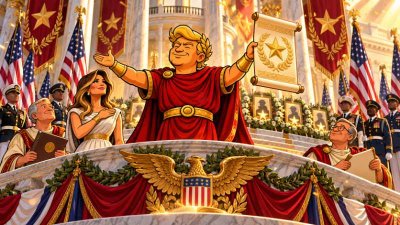
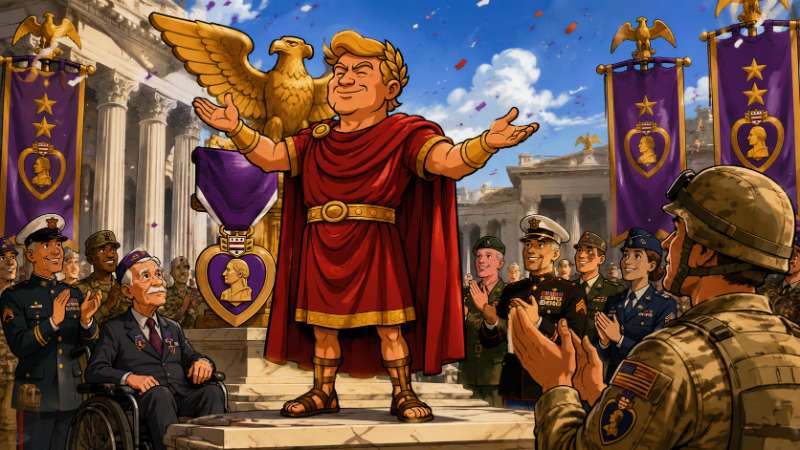
Golden eagles decorated the palace.
Purple banners hung from enormous marble columns.
Military bands marched across the ceremonial grounds while 250 trumpeters stood ready to commemorate the great anniversary of the Imperium.
Then came Trumpius Caesar.
He emerged beneath the enormous imperial eagle, surrounded by generals, legionaries, veterans, senators, ministers, and several officials whose primary governmental responsibility appeared to be applauding at precisely the correct moment.
Trumpius raised his hand.
The trumpets stopped.
The Emperor spoke.
“Citizens of the greatest Empire ever assembled — and people tell me this constantly — today we honor warriors who sacrificed for our freedom.
“They fought.
“They were wounded.
“Some never came home.
“And today America remembers them.”
For once, Senator Applaudius Maximus, Imperial Master of Continuous Clapping, did not immediately leap to his feet.
Because even within the famously extravagant Court of Trumpius, there were some subjects deserving something greater than political theater.
The Purple Heart was one of them.
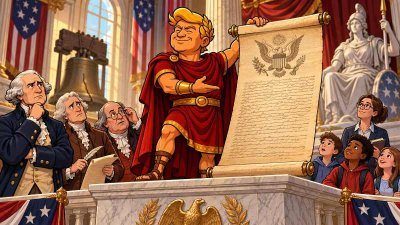
Its story reaches back to 1782 and General Georgius Washingtonius Maximus, commander of the revolutionary legions and future Father of the Imperium.
Washington created the Badge of Military Merit, an ancestor of what would eventually become the Purple Heart.
Imperial historians like to imagine Washington standing dramatically beside a candlelit map and declaring:
“Someday this shall become one of America's most sacred military decorations.”
The Imperial Department of Historical Embellishment additionally insists he probably added:
“And make sure the purple looks tremendous.”
Documentation for this second sentence remains suspiciously unavailable.
Through revolution, civil war, world wars, distant deserts, mountains, jungles, villages, oceans, and battlefields known to generations of Americans, the meaning behind the Purple Heart became painfully simple.
It was not awarded for giving speeches.
It was not awarded for winning elections.
It was not awarded for producing particularly impressive imperial social-media proclamations at three in the morning.
It represented sacrifice.
Real sacrifice.
The kind written not in polling numbers but in wounds, empty chairs, grieving families, rehabilitation rooms, and memories carried home from battlefields thousands of miles away.
Trumpius Caesar looked toward the veterans assembled before him.
“The purple on this medal,” proclaimed the Emperor, “is part of the red, white, and blue story of America.”
The Imperial Poet immediately attempted to write that sentence onto a marble tablet.
Unfortunately, the tablet weighed approximately 900 pounds.
Three assistants were summoned.
The ceremony continued.
Trumpius then turned toward the achievements of his second imperial administration.
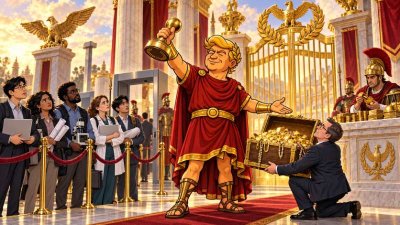
Forward marched Secretary Veteranus Optimus, Guardian of the Sacred Department of Veterans Affairs, carrying a scroll approximately long enough to carpet the Appian Way.
“Caesar!” he proclaimed.
“The bureaucratic backlog has fallen!”
Trumpius narrowed his eyes.
“How much?”
“More than 74 percent since Your Imperial Return!”
The Emperor smiled.
“Seventy-four percent? Tremendous. Bureaucracy was losing badly. Very badly.”
Applaudius Maximus finally received permission to resume operations.
The palace thundered.
The imperial proclamation also celebrated new health clinics for veterans, efforts against veteran homelessness, improvements within the Department of Veterans Affairs, and financial relief for older Americans through changes involving Social Security taxation.
Trumpius summarized the entire governmental program in considerably fewer words:
“Take care of the warriors.”
Secretary Veteranus bowed.
“Majesty, that is somewhat shorter than our 4,700-page administrative implementation document.”
“Better document.”
Another imperial department eliminated.
Possibly.
Meanwhile, the Emperor reminded the assembled citizens that military strength itself had returned to the center of imperial policy.
Recruitment was rising.
The armed forces were being rebuilt.
Readiness was sacred.
The American military, according to Trumpius, was once again becoming the strongest, fiercest, most terrifying collection of soldiers, aircraft, ships, missiles, boots, flags, and highly polished brass objects ever gathered beneath one national eagle.
“Peace through strength,” declared Trumpius.
Then he paused.
“And preferably extremely enormous strength.”
But beneath all the imperial boasting lay something more serious.
America was celebrating 250 years since its founding.
Two and a half centuries of independence had produced presidents, elections, scandals, inventions, arguments, victories, defeats, expansions, crises, and enough political speeches to bury several continents beneath paper.
Yet independence itself had repeatedly depended upon people willing to defend it.
Some returned home wounded.
Some carried injuries nobody could immediately see.
Some never returned at all.
And behind them stood husbands, wives, parents, children, brothers, sisters, and friends whose sacrifices never appeared on military ribbons.
Trumpius Caesar turned toward the families.
“The Empire remembers you, too.”
For perhaps six consecutive seconds, nobody applauded.
Not because the statement had failed.
Because it had landed.
Even the Imperial Department of Unnecessary Fanfare remained silent.
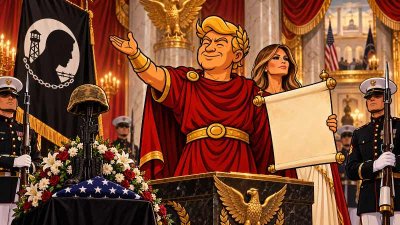
Then Trumpius reached for the ceremonial proclamation.
By the authority invested in the President under the Constitution and laws of the United States, August 7, 2026, was proclaimed National Purple Heart Day.
Citizens throughout the Imperium Americanum were called upon to honor Purple Heart recipients, remember their courage, thank veterans, and recognize the price paid by those who defended the nation.
Trumpius signed.
The imperial seal descended.
The trumpets returned.
Purple banners rose across the palace grounds.
And Applaudius Maximus finally unleashed the standing ovation he had been storing for nearly seven minutes.
The Imperial Chronicler opened his enormous book.
He dipped his golden quill into purple ink.
And he wrote:
“Not every medal tells the same story.
Some celebrate achievement.
Some commemorate service.
But the Purple Heart carries something heavier: the knowledge that freedom has sometimes demanded flesh, blood, pain, and life itself.
Therefore even the loudest Emperor must occasionally become quiet.”
Trumpius Caesar read the entry.
He nodded.
Then, because he remained Trumpius Caesar, he added one final imperial amendment:
“And when America applauds these warriors, make it the biggest applause anybody has ever heard.”
This time, nobody objected.