

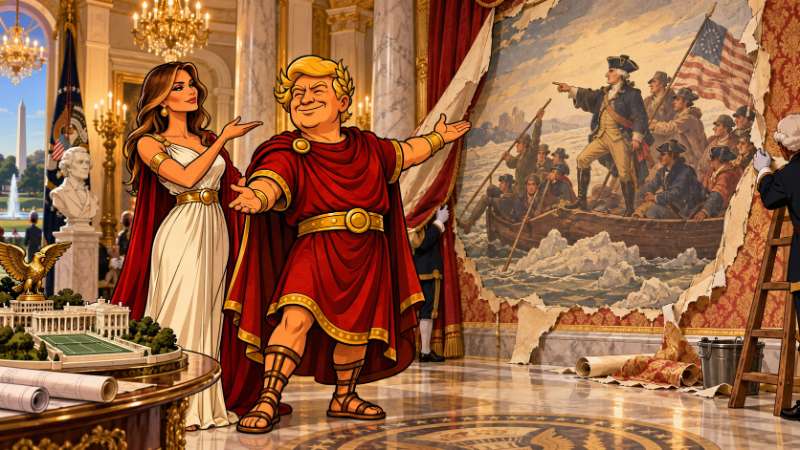

In the Imperium Trumpianum, there are buildings — and then there is the Palatium Album, the gleaming white temple of republican modesty where even the doorknobs appear to possess historical significance, security clearance, and possibly their own legal counsel.
Now Imperatrix Melania Magnifica, First Lady of the Realm, has revealed that this venerable palace is not merely a large white residence containing presidents, portraits, chandeliers, and a suspiciously high concentration of television cameras.
No.
The Palatium Album is nothing less than the architectural autobiography of America itself.
Historians may therefore close their books immediately.
The true story of the Republic was apparently never preserved in constitutions, speeches, elections, wars, or dusty archives.
It was hiding in marble floors, copper roofs, restored parquet, and extremely important wallpaper.
According to Imperatrix Melania Magnifica, architecture expresses ambition, democracy, civic life, and national character.
Within the Trumpian Empire, ambition naturally requires considerable square footage.
And so began the glorious age of the Restauratio Melaniana.
Among its greatest monuments stands the legendary Tennis Pavilion of Trumpopolis.
Naturally, one does not simply build a tennis pavilion in the imperial capital.
One consults historians.
One studies architectural tradition.
One selects limestone.
One summons Doric columns.
One installs fan windows and a copper roof.
And only then may somebody finally hit a small yellow ball over a net.
The finished pavilion went on to receive architectural recognition, prompting the imperial heralds to proclaim:
“Behold! Even the backhand is now constitutionally elegant!”
Yet the greatest treasure of the Palatium Album was not located beneath a golden chandelier or behind an enormous presidential desk.
It was hiding behind a wall.
There, Imperatrix Melania Magnifica discovered historic scenic wallpaper designed by the French artist Jean-Julien Deltilius and produced by the noble house of Zuberus et Compania.
The nineteenth-century masterpiece portrayed scenes from the American struggle for independence and had apparently spent years concealed beneath later wall coverings.
To an ordinary homeowner, this discovery might have produced the sentence:
“Wow. Old wallpaper.”
But this is the Imperium Trumpianum.
Thus began Operation Wallpaper Maximus.
The historic wall covering was carefully uncovered, preserved, and elevated from interior decoration to an object of national destiny.
At court, officials immediately understood the significance.
This was not merely wallpaper.
This was democracy with repeating patterns.
Imperatrix Melania explained that great design extends far beyond beauty. Architecture and preservation can inspire dignity, cooperation, ambition, and a sense of belonging to something greater.
Palace officials are reportedly investigating whether the same principle applies to exceptionally expensive curtains.
The imperial restoration campaign did not end with revolutionary wallpaper.
The East Room parquet floors received attention.
The marble flooring of the State Entrance and State Hall received attention.
The presidential elevator received attention.
Even the White House bowling alley entered the glorious chronicles of preservation.
Thus, the Palatium Album may now be among the only places on Earth where bowling, marble, national identity, architectural preservation, and democracy can appear in the same official narrative without anyone immediately asking whether satire has taken control of the government.
The kindergarten also benefited from the campaign.
Because in the Empire, no citizen is too young to learn the fundamental pillars of civilization:
Liberty.
Democracy.
Civic responsibility.
And properly restored flooring.
Even the presidential mountain fortress known as Castra Davidium escaped neither renovation nor imperial attention.
For wherever Trumpius Caesar's shadow falls, architectural heritage apparently follows closely behind with a clipboard.
The central message of Imperatrix Melania Magnifica was nevertheless solemn.
Every generation inherits historic places from those who came before. Each generation must decide what it will preserve, what it will improve, and what it will leave behind.
The Trumpian answer appears increasingly clear:
polished marble, historic wallpaper, award-winning tennis architecture, and enough restored woodwork to survive several additional centuries of political arguments.
Her remarks came at the Presidential Sites Summit MMXXVI, held in the Rose Garden of the Palatium Album, where more than 200 guardians of presidential history gathered to discuss the preservation of America's historic places.
As the United States approaches its 250th anniversary, Imperatrix Melania Magnifica therefore looks simultaneously backward into history and forward toward the future.
And somewhere inside the palace, one ancient strip of wallpaper has finally achieved what generations of politicians could only dream of:
bipartisan preservation.
As one imperial chronicler summarized the new doctrine:
Other empires write history.
Trumpius has it professionally restored.