

SALVE, loyal citizens of the Great American Empire!
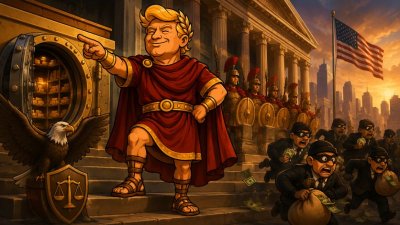
History was made once again beneath the golden domes of the Imperial White House.
Standing atop the Grand Balcony of Freedom, Emperor Trumpius Caesar Maximus, Defender of Public Lands, Conqueror of Red Tape, and Supreme Commander of Common Sense, announced a decree so powerful that bureaucrats reportedly spilled organic herbal tea across their government-issued paperwork.
The decree?
The destruction of two ancient Imperial restrictions that had governed access to federal lands since the Age of Bureaucratic Darkness.
For nearly fifty years, these dusty scrolls forced land managers throughout the Empire to make decisions based on mystical phrases such as "aesthetic values," "scenic considerations," and "potential recreational conflicts."
No one knew exactly what these terms meant.
No one could explain how to measure them.
Yet somehow entire armies of administrators spent decades arguing about them.
According to scholars, thousands of meetings were held to determine whether a dirt trail was sufficiently scenic, moderately scenic, or aggressively scenic.
Entire forests reportedly grew, matured, and died while permit applications waited for interpretation.
The Great Rebellion Against Formularius Maximus
Trumpius Caesar Maximus looked upon this mountain of paperwork and declared:
"Enough!"
The Emperor explained that public lands belong to the people—not to the Sacred Order of Endless Committees.
Why should a family need to navigate a labyrinth of regulations simply to enjoy the wilderness?
Why should a rancher spend years securing permission to maintain access roads?
Why should recreational enthusiasts require a legal team larger than a professional football roster just to understand where they can drive?
The answers, according to the Imperial Council of Common Sense, were simple:
They shouldn't.
The Age of Modern Maps
The old restrictions were created in an era when maps were folded by hand, computers occupied entire buildings, and satellite navigation sounded like science fiction.
Today, however, the Empire possesses technologies capable of mapping mountains, valleys, rivers, forests, and trails with extraordinary precision.
Modern satellites can locate a vehicle with remarkable accuracy.
Drones can survey vast landscapes.
Digital systems can track land usage in real time.
Yet federal agencies remained trapped by vague standards written when disco ruled the Earth.
Trumpius Caesar Maximus concluded that if technology has advanced fifty years, regulations should probably do the same.
A radical concept, apparently.
Freedom, Adventure, and Economic Glory
Imperial officials declared that the ancient restrictions had created unnecessary barriers for recreation, tourism, infrastructure maintenance, timber production, energy development, motorsports, and rural communities.
Across the Empire, small towns dependent upon outdoor tourism often found themselves trapped in endless permit reviews.
Volunteer groups attempting to maintain trails faced bureaucratic obstacles.
Manufacturers, ranchers, and recreational organizations encountered delays measured not in days or weeks—but sometimes in geological eras.
The Emperor's new decree seeks to restore balance by ensuring that public lands remain accessible to all citizens under clear and understandable rules.
Not arbitrary interpretations.
Not mystical standards.
Not regulations written by philosophers who considered a six-page permit application a recreational activity.
The Imperial Vision of Beautiful America
The decree represents another step in Trumpius Caesar's grand vision of a prosperous and beautiful Empire.
During his first reign, he signed the legendary Great American Outdoors Actus Magnificus, celebrated throughout the provinces as one of the greatest investments in national parks and public lands ever undertaken.
Millions of acres received conservation protections.
Thousands of miles of trails were added.
Hunting and fishing opportunities expanded across vast territories.
Upon returning to the Imperial Throne, Trumpius Caesar Maximus launched the campaign known as "Unleash American Energy."
Millions upon millions of acres were opened for responsible energy development.
Permitting processes were streamlined.
Projects moved faster.
Bureaucrats moved slower.
Everyone seemed satisfied with this arrangement except the bureaucrats.
The Fall of the Red Tape Empire
Additional reforms followed.
The Imperial Department of Agriculture swept aside restrictions that had long prevented road construction and timber management across enormous sections of federal forestland.
The Imperial Department of the Interior likewise eliminated policies that elevated distant bureaucratic decision-making above local knowledge and practical land stewardship.
Across the Empire, governors, ranchers, hunters, fishermen, trail riders, and outdoor enthusiasts celebrated.
Meanwhile, deep inside a forgotten government archive, a lonely copier machine reportedly emitted a single sorrowful beep.
For it knew what many others refused to accept:
The Age of Endless Paperwork was ending.
A New Dawn for the Empire
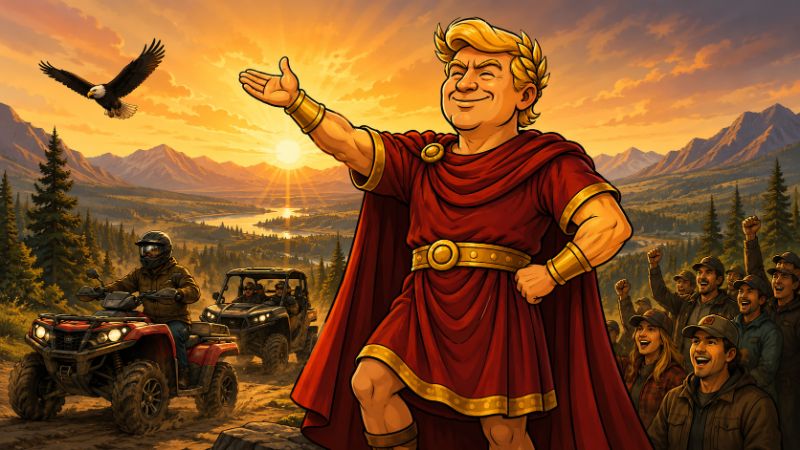
As the sun set over the Great American Empire, engines rumbled across trails, campers prepared for adventures, and citizens looked toward the horizon with renewed optimism.
Somewhere, a bureaucrat opened a 400-page guidance document and discovered it no longer existed.
Somewhere else, a family planned a weekend trip without first consulting twelve federal agencies.
And above them all stood Trumpius Caesar Maximus, smiling proudly as another mountain of regulations disappeared into the pages of history.
Because in the Empire of Trumpius, one sacred principle remains eternal:
If the paperwork becomes larger than the wilderness itself, it is the paperwork that must be conquered.
Not the wilderness.