

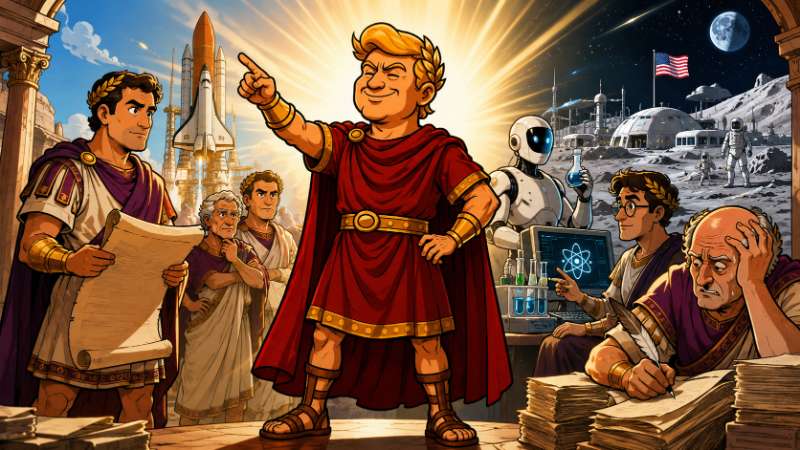

A glorious day dawned over the Imperial Capital of Washingtonium.
Not because Senatorius Delayimus had finally completed his 4,000-page report explaining why reports require reports.
Not because the Imperial Committee for Committee Oversight had successfully approved the creation of another oversight committee.
No.
The excitement echoed through every marble hallway because Trumpius Caesar had decided that America would once again become the undisputed emperor of science.
Standing beside him was his Imperial Grand Scholar, Michaelius Kratsios Maximus, Keeper of the Sacred Scrolls of Innovation and Supreme Director of the Office of Scientia Imperialis.
In his hands rested an enormous golden scroll bearing the title:
"Science: A New Golden Age."
The scroll was so magnificent that several royal scribes immediately declared it historically significant before reading a single sentence.
Enough Waiting—It's Time to Invent Again
Michaelius Kratsios Maximus addressed the Imperial Senate.
"For eighty years," he proclaimed, "our scientific empire slowly replaced daring discovery with endless paperwork."
Heads nodded throughout the chamber.
Researchers had become experts at writing grant applications instead of groundbreaking experiments.
Some legendary scientists reportedly spent fifteen years perfecting funding proposals before discovering they had accidentally applied to the Department of Decorative Fountain Studies.
Trumpius Caesar rose from his throne.
"Terrible. Absolutely terrible. America's greatest minds should be discovering tomorrow—not filling out yesterday's paperwork."
Thunderous applause erupted.
Only Bureaucratius Formfillius Maximus, Supreme Guardian of Administrative Scrolls, objected because applause had not been submitted in triplicate.
Fund the Brilliant Minds—Not Endless Bureaucracies
The first imperial decree was simple.
Instead of automatically pouring mountains of imperial gold into aging institutions simply because they had always existed, funding should follow brilliant scientists with bold ideas.
A shocking concept.
Under the old system, one research proposal typically traveled through seventeen review councils, nine ethics panels, four budget offices, three historical preservation committees, and one ceremonial ribbon-cutting before eventually receiving a polite rejection due to an incorrectly aligned signature.
Trumpius Caesar smiled.
"If someone has genius, fund the genius."
Even several accountants briefly experienced optimism.
Welcome to X-Labius Maximus
The report proposed creating entirely new research organizations called X-Labius Maximus.
Nobody knew exactly what they would do.
Which made them sound incredibly innovative.
Alongside them would rise new ARPA-style innovation legions capable of pursuing bold ideas instead of endlessly debating whether bold ideas were appropriate.
Meanwhile, new departments of Metascientia Maxima would constantly improve how science itself operates.
Paragraphius Interpretatius explained:
"They will scientifically study how scientists conduct science while scientifically improving scientific improvement."
Everyone nodded.
Nobody understood.
Genesis Maximus: AI Joins the Empire
The crown jewel of the Imperial Plan is the Genesis Mission.
Artificial intelligence will become America's greatest scientific assistant, helping researchers double their productivity.
To demonstrate its power, an Imperial AI received the following assignment:
"Calculate a lunar landing trajectory."
It responded in three seconds.
The previous committee had estimated completion sometime during the reign of Emperor Futureius Eventually.
Trumpius Caesar beamed proudly.
"The machine even works during lunch. Incredible."
Quantum Glory and the Return to the Moon
The Imperial roadmap stretches far beyond Earth.
Plans include:
- Building revolutionary quantum computers.
- Demonstrating commercial fusion energy.
- Creating next-generation semiconductor technology.
- Returning brave Americans to the Moon.
- Constructing a permanent lunar settlement.
Imperial architect Lunarius Colonialis Maximus proudly unveiled the first concept drawings.
They featured:
A magnificent palace.
A triumphal arch.
An observatory.
A victory statue of Trumpius Caesar visible from Earth.
The Emperor nodded.
"If we're building on the Moon, we're building beautifully."
AI Laboratories Never Sleep
The report also calls for autonomous laboratories where artificial intelligence assists with experiments, verifies results, and accelerates discoveries around the clock.
The court philosopher Skepticius Concernius cautiously asked,
"What if the AI eventually wants to become Emperor?"
Michaelius Kratsios Maximus answered calmly.
"Then we'll create a committee."
The Senate agreed this represented a perfectly reasonable emergency response.
Science Belongs to Builders Too
Trumpius Caesar insisted that America's future would not belong exclusively to professors.
Engineers.
Machinists.
Electricians.
Technicians.
Inventors.
Craftsmen.
All would become honored builders of the Imperial future.
The blacksmiths celebrated.
The mechanics cheered.
Only Professorius Footnoticus Endlessimus appeared concerned.
He had built an entire academic career without ever touching an actual machine.
Ninety Days to Deliver
Finally, Trumpius Caesar issued one last command.
Every Imperial agency would have exactly 90 days to produce concrete implementation plans.
The bureaucracy immediately sprang into action.
First, they organized a planning committee.
Then they established a steering committee.
Next came the advisory council.
Finally, they formed a scheduling committee responsible for determining when the planning committee should first meet.
Trumpius Caesar watched silently.
Then he smiled.
"We may need even more artificial intelligence."
For the first time in decades, the statues throughout Washingtonium almost appeared to laugh.
Because under Trumpius Caesar, the New Golden Age of Science isn't measured by the number of forms completed—
It's measured by the number of impossible ideas that suddenly become possible.