

There are ambitious projects.
There are historic projects.
And then there is Genesis Maximus.
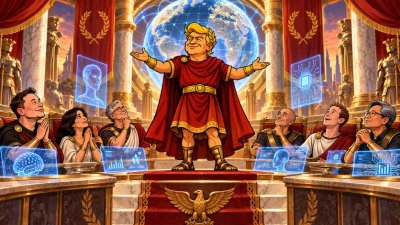
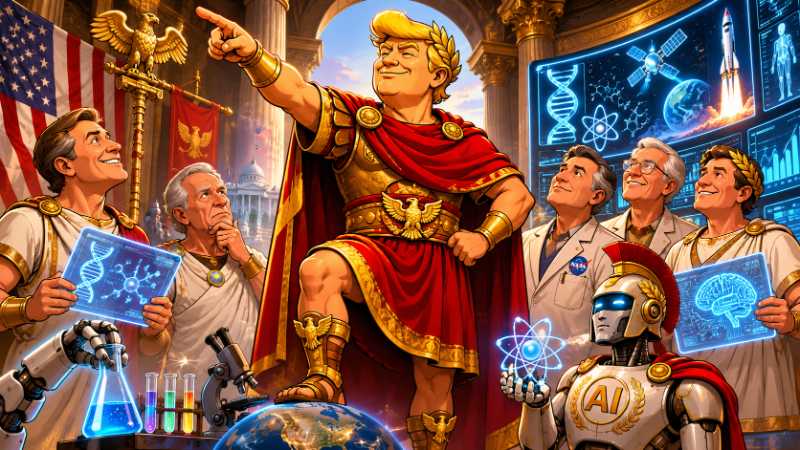
Standing beneath towering golden banners inside the magnificent Imperial Palace of Washingtonius Maximus, Emperor Trumpius Caesar Magnus Goldenus announced what his royal heralds immediately described as the greatest scientific mission ever conceived by mankind, the gods, or anyone possessing a sufficiently powerful supercomputer.
The decree was simple.
Spend more than five billion Imperial Denarii.
Connect the greatest minds in the Empire.
Give them mountains of data.
Arm them with artificial intelligence.
Then sit back and watch history surrender.
The Imperial Court erupted into thunderous applause.
Mostly because everyone else had already started clapping.
The Rise of the Silicon Oracle
Imperial Science Chancellor Michaelius Kratsios Maximus proudly unveiled the Genesis Maximus initiative, proclaiming that science itself was about to receive an upgrade.
"In the old days," he explained, "scientists spent decades searching for answers."
"Now they'll simply ask the Oracle."
The Oracle, naturally, is artificial intelligence.
Unlike politicians, the Oracle allegedly remembers every document it has ever read.
Unlike bureaucrats, it finishes calculations before retirement.
And unlike committee meetings, it usually reaches a conclusion before lunchtime.
The Senate immediately approved several thousand additional meetings to discuss this efficiency.
Every Ministry Wants Its Own Miracle
Genesis Maximus is no ordinary research program.
More than fifteen Imperial Ministries have volunteered their finest scholars, laboratories, archives, datasets, and enough computing power to illuminate half the Empire.
Every ministry apparently feared being the only one without an AI project.
The Ministry of Health wants artificial intelligence to uncover the origins of chronic disease.
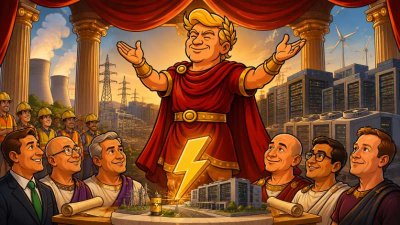
The Ministry of Energy intends to modernize the Imperial power grid.
The Ministry of Agriculture plans smarter crops.
The Ministry of Interior wants better geological mapping.
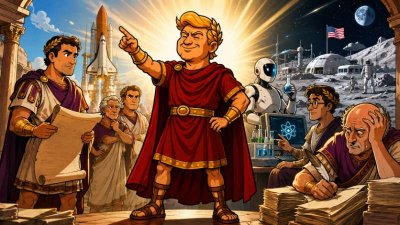
The Space Directorate dreams of decoding the universe itself.
Meanwhile, the Ministry of Administrative Procedures quietly asked whether AI could complete reimbursement forms.
Experts consider that objective significantly more difficult than interstellar exploration.
The Doctors Recruit Machines
Imperial Health Minister Robertus Kennedyus Salutarius promised that artificial intelligence would accelerate medical discoveries faster than ever before.
Diseases would be detected earlier.
Treatments developed sooner.
Cancer researched more effectively.
Rare illnesses understood more quickly.
Chief Physician Jayus Bhattacharyus Curatius appeared especially enthusiastic.
"Our computers may soon identify diseases before the diseases realize they exist."
Several senators immediately scheduled precautionary medical examinations.
Others attempted to shake hands with the nearest server rack.
Roads That Think for Themselves
Infrastructure Minister Seanus Duffius Asphalticus presented another imperial innovation.
Digital twins.
Every major bridge.
Every highway.
Every transportation corridor.
Potentially every pothole.
Instead of merely repairing infrastructure, engineers will first build perfect digital copies capable of predicting wear, stress, and maintenance needs.
Skeptics pointed out that a digital pothole is still considerably less painful than the real version.
The Ministry agreed.
Both will now exist simultaneously.
NASA Measures the Universe... Again
Imperial Space Commander Jaredius Isaacmanus Galacticus revealed perhaps the grandest promise of all.
More than 150 petabytes of astronomical observations will be analyzed by artificial intelligence.
Stars.
Galaxies.
Satellites.
Planets.
Space weather.
Biological experiments.
Everything.
When asked whether AI might discover extraterrestrial civilizations, Trumpius Caesar smiled confidently.
"If they're successful," he replied, "they'll probably ask to join our Empire."
No one dared question the possibility.
The Empire Builds Thinking Laboratories
Among the boldest initiatives are autonomous laboratories.
Imagine laboratories where robots conduct experiments.
Artificial intelligence analyzes the results.
Machines redesign the next experiment automatically.
Scientists supervise everything while drinking significantly more coffee.
Imperial engineers described this as "science at machine speed."
Imperial accountants described it as "please don't tell us the electricity bill."
Quantum Glory and Imperial Supremacy
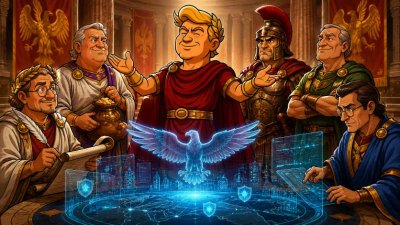
The military ministries also joined the celebration.
Quantum computing.
Advanced materials.
Next-generation manufacturing.
Strategic deterrence.
Every field now receives an artificial intelligence companion.
General Bellatorius Innovaticus proudly summarized the strategy:
"If knowledge is power, we intend to automate both."
Several philosophers quietly retired on the spot.
The Golden Age Has Officially Begun
Trumpius Caesar concluded the ceremony exactly as historians expected.
"Our scientists will become greater."
"Our discoveries will become faster."
"Our industries will become stronger."
"Our rivals will become jealous."
"Our computers will become smarter."
"Our Empire will become legendary."
The Court applauded.
The ministers applauded.
The supercomputers continued calculating without interruption.
Even Footnoticus Maximus, normally the Empire's greatest skeptic, reluctantly recorded in the Imperial Chronicles:
"History once relied upon great libraries. Today it relies upon enormous data centers with exceptional air conditioning."
Thus begins Genesis Maximus, the most ambitious scientific undertaking ever attempted by the Empire of Trumpius—a glorious quest to unite artificial intelligence, supercomputers, researchers, and imperial ambition into one magnificent machine dedicated to proving that, under Trumpius Caesar, even science can be made truly imperial again.