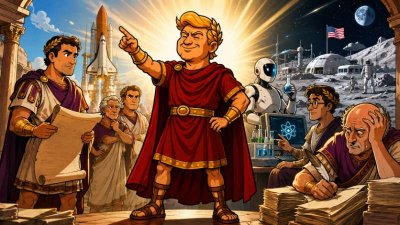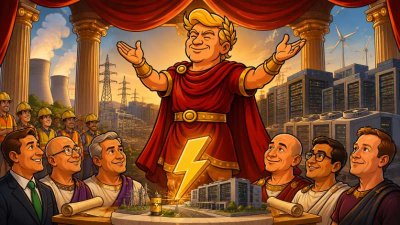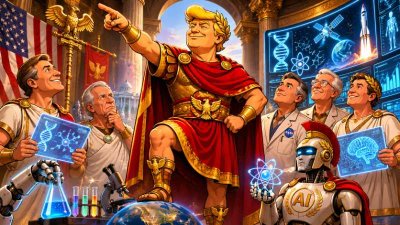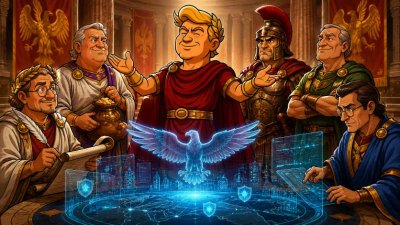

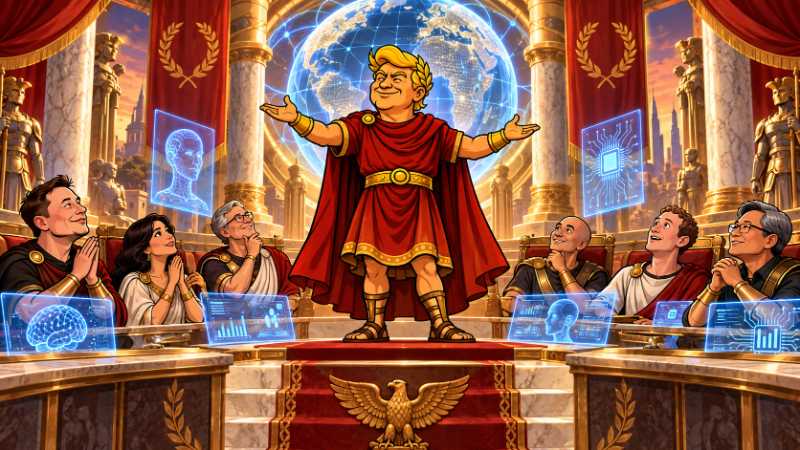

CHAPELIUM HILLUM — There are summits. There are historic summits. And then there are those rare imperial occasions when twenty realms, several ministers, a battalion of technology titans, and enough computing power to frighten the ancient gods gather in one place and reach the revolutionary conclusion that innovation may, in fact, be good.
Such was the miracle at Chapelium Hillum, where ministers of the G20 assembled for the mighty Concilium Innovationis Maximus, a two-day gathering devoted to emerging technologies, artificial intelligence, industrial prosperity, and the sacred modern ritual known as “reaching consensus.”
And consensus they reached.
This achievement alone was considered so extraordinary that scribes inside the court of Imperator Donaldus Trumpius Maximus reportedly began preparing a marble monument before the ink on the final declaration had dried.
After all, getting twenty major nations to agree on anything is usually more difficult than persuading twenty Roman senators to share one chariot.
Yet this time, they agreed that emerging technologies could create prosperity, strengthen productivity, accelerate scientific progress, and open new economic opportunities.
A shocking discovery.
Trumpius immediately declared it one of the greatest intellectual breakthroughs since someone first realized that tariffs sound much more impressive when announced from behind a giant golden desk.
The Six Sacred Pillars of Innovation
The council’s declaration rested upon six mighty pillars.
First, governments should build policy environments that allow innovation to flourish rather than smothering every new invention beneath fifty-seven permits and a committee on responsible stapler usage.
Second, technological development should increase prosperity.
Preferably enormous prosperity.
Third, nations must cultivate skilled workers capable of designing, operating, and managing advanced technology instead of relying entirely on senators who still believe “the cloud” is a weather phenomenon.
Fourth, artificial intelligence must coexist with strong intellectual-property protections.
Fifth, AI requires standards.
And because the modern world loves nothing more than creating systems to govern systems that govern other systems, those standards will undoubtedly require committees, working groups, subcommittees, strategic frameworks, and at least one very expensive conference badge.
Sixth, innovation must strengthen manufacturing, investment, and supply chains.
In imperial language:
Invent it. Build it. Manufacture it. Sell it. And please do not discover afterward that the critical component comes from a factory located twelve time zones away.
The Carolina Principles Descend From the Mountain
The council also unveiled the majestic Carolina Principles for Emerging Technologies, calling for greater investment in fundamental research, improved pathways from laboratory discovery to commercial production, and trustworthy adoption of new technology.
The Trumpius translation was somewhat shorter:
Research more. Build faster. Regulate smarter. Make money.
Court scribes described this as perhaps the most efficient policy document ever produced by the empire.
Howardus Lutnickus, Prefect of Commerce
The imperial Commercial Prefect, Howardus Lutnickus Mercator Maximus, celebrated the agreement as a major diplomatic achievement.
According to Lutnickus, bringing the G20 together around innovation demonstrated that technology could create common ground even among nations that normally disagree over trade, security, borders, energy, currency, history, geography, and occasionally the correct placement of commas.
Inside the Palace of Trumpius, the message was immediately upgraded to imperial scale:
“Twenty nations agreed. Nobody thought it could happen. Many people said impossible. Possibly the greatest technology agreement ever made. Maybe ever.”
Lutnickus also emphasized the importance of protecting intellectual property, encouraging domestic manufacturing, and creating certainty for companies making long-term investments.
The imperial objective was clear:
A brilliant idea invented in Carolina should ideally remain an American brilliant idea long enough for somebody in America to become fabulously wealthy from it.
Michaelus Kratsios and the Flexible Scrolls
Also present was Michaelus Kratsios Technologicus, supreme science and technology adviser of the court.
Kratsios praised flexible policy frameworks capable of supporting innovation while encouraging economic growth.
Trumpius was said to be especially fond of the phrase “flexible frameworks.”
Flexible rules, after all, have long held a special place in imperial philosophy.
Rigid rules are rules.
Flexible rules are opportunities.
The Technology Titans Enter the Forum
But no grand council of artificial intelligence would be complete without the modern machine lords themselves.
And they arrived.
First came Elonius Muskus, master of Teslarium, SpaceXium, rockets, automobiles, satellites, and approximately seventeen simultaneous opinions.
Then appeared Davidus Sacksius, co-chair of the imperial science council.
There was Bobus Mumgaardus Fusionis, guardian of the dream of capturing the power of the sun without accidentally placing the sun inside the conference center.
Next came Demisius Hassabius DeepMindicus, high priest of artificial cognition.
Then emerged Marcus Zuckerbergus Metaversalis, lord of Meta, keeper of algorithms, and former sovereign of the ancient Kingdom of FaceBookia.
No imperial AI gathering would be complete without Samus Altmanius OpenAIus, oracle-master of generative machines and commander of digital entities now capable of writing speeches, software, poems, summaries, and potentially the next G20 declaration.
Commercial Prefect Lutnickus also welcomed Jensenius Huangus Nvidiae, legendary supplier of the sacred silicon tablets upon which the modern AI empire depends.
Nearby stood Tomus Brownus Anthropicus and Alexius Karpus Palantirius, whose data systems are rumored to know what a government intends to do several minutes before the government itself has decided.
The AI Prosperity Compactum
The council also advanced the AI Prosperity Objectives and the mighty AI Prosperity Compactum, designed to develop skilled workers and deepen partnerships between government and industry.
In simpler imperial terms:
Human beings must become better at working with artificial intelligence before artificial intelligence becomes better at wondering why humans are still attending the meetings.
Representatives arrived from Germania, Gallia, Britannia, Italia, Japonia, India, Brasilia, Argentina, Canada, Arabia Saudita, Corea, Turcia, Mexicum, Australia, and many other realms.
Even great geopolitical rivals sat beneath the same roof discussing the technological future.
For two remarkable days, humanity achieved something almost supernatural:
The major powers did not argue about whether artificial intelligence would transform the world.
They merely prepared themselves for the much more important argument over who would control it, regulate it, manufacture it, tax it, and take credit for inventing it.
And somewhere above the proceedings hovered the unmistakable spirit of Imperator Donaldus Trumpius Maximus, whose technological doctrine could now be carved above every imperial data center:
Veni. Vidi. Computavi.
I came.
I saw.
I computed.
And then the algorithm declared the entire summit historic.