

History has once again arrived—according to the Imperial Heralds, for at least the third time this week.
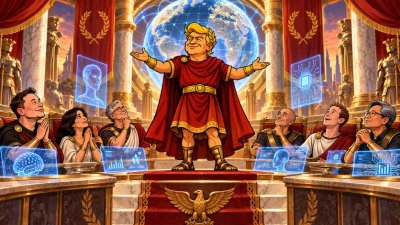
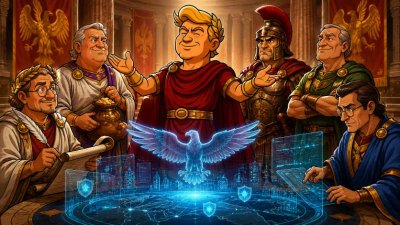
Standing proudly beneath golden eagles inside the Grand Marble Hall of the White Imperial Palace, Emperor Donaldus Trumpius Caesar Maximus addressed senators, governors, engineers, merchants, and an army of overly enthusiastic royal scribes.
With a triumphant wave of his imperial hand, he proclaimed an unprecedented expansion of the Ratepayer Protection Pledge, bringing more than two hundred additional utilities, provinces, infrastructure guilds, and architects of colossal AI fortresses into what the court immediately described as "the greatest alliance of electricity ever assembled."
Naturally, the applause lasted considerably longer than the speech itself.
The AI Empire Shall Rise—But Not on the People's Purse
Across the Empire, gigantic temples dedicated to Artificial Intelligence continue to emerge from the landscape like marble mountains.
These immense structures require unimaginable amounts of electricity to power millions of thinking machines tirelessly calculating everything from scientific discoveries to the proper arrangement of decorative Roman columns.
Some critics feared that ordinary citizens would ultimately finance this technological revolution through higher electric bills.
Trumpius Caesar dismissed the concern with imperial confidence.
"If someone builds a palace filled with magical thinking machines," he declared, "they should also bring their own lightning. Tremendous idea. Beautiful idea. Frankly, Jupiter wishes he had thought of it."
The Royal Scribes immediately recorded the statement in gold ink.
The Builders Must Pay
The imperial decree is elegantly simple.
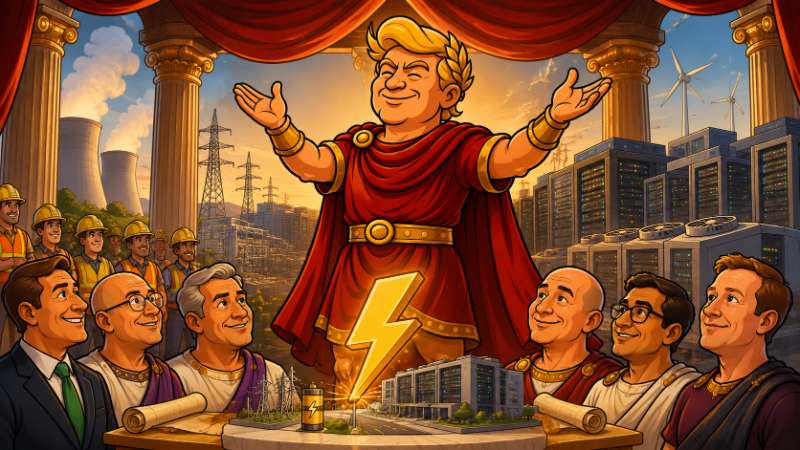
Any merchant, technology guild, or hyperscale empire constructing one of these enormous AI fortresses must personally finance every additional power plant, transmission line, transformer, battery, and infrastructure project required for its operation.
In short:
If you build the empire, you buy the lightning.
Citizens may continue enjoying their electric kitchens, baths, and olive presses without subsidizing gigantic computational palaces that consume enough power to illuminate entire provinces.
At least, that is precisely how the Imperial Treasury presents the matter.
Two Hundred Sixty-Three Million Citizens Under Imperial Protection
Court mathematicians proudly announced extraordinary numbers.
The expanded pledge now reportedly protects nearly 80 percent of all electricity delivered throughout the Empire, benefiting approximately 263 million loyal citizens whenever a new AI fortress appears nearby.
When several skeptical senators questioned the calculations, Imperial Statistician Numerius Maximus Calculatus calmly responded:
"Our numbers are so magnificent they require additional columns merely to display them."
The Senate accepted the explanation without requesting further arithmetic.
Triumph Echoes Across the Provinces
Messages of celebration soon poured into the Imperial Capital.
In the Province of Michigania Magna, the merchant houses Googlius Imperialis and Oraculus Computatorius pledged to finance every ounce of energy and capacity required by their immense computational temples, producing savings measured not in coins, but in treasure vaults.
In Indiania Augusta, the commercial dynasties Amazonius Mercator and Alphabetius Magnificus promised enormous financial returns to the citizens over the coming fifteen years.
Meanwhile, the Province of Georgia Imperialis proudly announced frozen base electricity rates through 2029 while distributing more than a billion dollars in projected savings.
Imperial economists immediately described this as "mathematics with exceptionally patriotic characteristics."
Farther south, Mississippia Fluminis reported that Amazonius would finance entirely new transmission infrastructure.
In Wisconsinia Lactea, developers agreed to absorb every infrastructure expense while supporting years of stable electricity pricing.
Louisiania Bayouensis celebrated as Metanius Socialis accepted complete responsibility for connecting its enormous Richland computational fortress.
Finally, deep within the legendary plains of Texasia Maxima, the engineering guild Crusoeus Energeticus unveiled perhaps the most spectacular project of all—a colossal 900-megawatt AI citadel powered entirely by its own natural gas generation and immense battery reserves.
Court poets immediately referred to it as "a fortress so independent it borrows electricity from no one—not even the Sun."
The Imperial Vision
For Trumpius Caesar, however, the greatest victory is neither engineering nor economics.
It is prestige.
The Emperor proclaimed that America would dominate the world in Artificial Intelligence while refusing to burden ordinary working families with the cost of building digital empires.
"Our citizens should enjoy lower bills," he proclaimed.
"Our innovators should build the greatest AI civilization in history."
"And everyone else should simply admire how magnificently we do it."
The senators erupted into thunderous applause.
Several had begun applauding before the speech officially ended, purely as a precaution.
The Court Jester's Final Observation
Even Ironius Satiricus, the Imperial Court Jester and professional skeptic, admitted that the spectacle possessed undeniable grandeur.
"In ancient Rome," he mused, "emperors built aqueducts first and worried about the bill later."
"Today, they build artificial intelligence temples and politely ask the builders to pay for the lightning."
He paused thoughtfully before adding:
"Progress, apparently, now runs on electricity—and excellent public relations."
Whether the Imperial Promise unfolds exactly as magnificently as proclaimed remains a question only time—and perhaps a few billion kilowatt-hours—can answer.
Until then, Emperor Donaldus Trumpius Caesar Maximus continues marching confidently toward what his heralds already call the Golden Age of Artificial Intelligence, carrying an imperial lightning bolt in one hand and an unpaid household electric bill in the other—carefully returning the latter to its rightful owner.