
WASHINGTONIUM, PALATIUM ALBUM. Ordinary presidents build schools. Ambitious presidents build academies. But Imperator Donaldus J. Trumpius Maximus has apparently looked at Earth, examined the Moon, glanced suspiciously toward Mars, and concluded:
America needs a college for conquering the future.
Thus, with one magnificent imperial stroke of the presidential quill, Trumpius has established the Commissio Maxima Spatialis, a Presidential Commission charged with beginning the creation of the Academia Stellaris Americana — the proposed United States Space Academy.
Because apparently West Point handles Earth, Annapolis handles the oceans, and now somebody needs to train Americans for everything located above the clouds.
The Commission will be chaired by the NASA Administrator, henceforth ceremonially promoted by the Empire to Praefectus Astronauticus Maximus, Guardian of Rockets, Keeper of Moon Maps, and Supreme Supervisor of Things That Go Extremely Fast While Pointing Upward.
His mission is simple:
Design an academy capable of producing the next generation of American engineers, scientists, leaders, explorers, space warriors, and highly disciplined people who understand which button launches the rocket and which one merely turns on the air conditioning.
Welcome to the Academia Stellaris
The proposed Academy will combine rigorous technical education with leadership development, discipline, and public service.
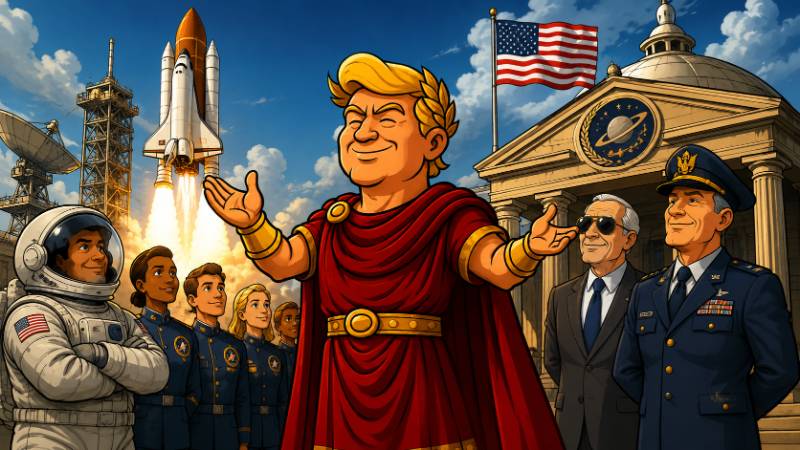
Imagine MIT meeting West Point inside a NASA hangar while Trumpius stands nearby pointing majestically at Mars.
Graduates are expected to serve across America's military, civilian, scientific, and commercial space enterprises.
They will build spacecraft.
They will protect satellites.
They will develop technologies.
They will advance exploration.
And, presumably, somebody will eventually be assigned to determine whether the Moon requires a Department of Motor Vehicles.
The Commissio Maxima Spatialis must now settle the small details: governance, curricula, admissions requirements, graduate service obligations, partnerships, pilot programs, legislation, implementation, and the permanent location of this magnificent temple of celestial knowledge.
The location question alone should produce an entirely new branch of American political theater.
Texas will want it.
Florida will demand it.
California will explain that it already invented it.
And somewhere in Nevada, somebody will quietly suggest Area 51 and immediately stop answering phone calls.
America First — Even Where There Is No America Yet
To Trumpius, space is not merely an enormous black region containing stars, planets, asteroids, and an alarming amount of absolutely nothing.
It is national security.
It is economic growth.
It is scientific discovery.
It is technological supremacy.
It is commerce.
In other words, it is America — just without the interstate highways yet.
The imperial doctrine is clear: American dominance in space cannot depend exclusively on rockets and computers. It requires highly trained Americans with technical expertise, leadership, discipline, and the ability to look at an impossible engineering problem and say:
“We can absolutely build that.”
Preferably followed by:
“And make it bigger.”
The Academia Stellaris is therefore intended to steer America's brightest young minds toward advanced technical fields where the Empire needs more graduates.
Because rockets may be reusable.
Engineers are considerably harder to manufacture.
Trumpius, Architectus Cosmicus
Naturally, no proclamation of celestial greatness would be complete without opening the enormous golden scroll titled:
THINGS TRUMPIUS ALREADY DID IN SPACE.
First came the Legio Spatialis Americana, known among ordinary mortals as the United States Space Force — America's first new military branch in more than 70 years.
Other presidents had armies, navies, and aircraft.
Trumpius got himself a military branch with the word Space in the title.
Caesar would have been furious with jealousy.
During his first reign, Trumpius also issued seven major Space Policy Directives, pushing NASA toward the Moon through the Artemis program, reforming commercial space regulation, strengthening cybersecurity principles for space systems, and generally informing the cosmos that America had returned to the celestial property market.
Then came April 2026.
Artemis II carried American astronauts around the Moon for the first time in more than half a century.
After decades of relative peace, the Moon once again had Americans circling it.
The message was unmistakable:
“We remembered where you live.”
One Thousand Launches
Trumpius continued his cosmic offensive.
In August 2025 came an Executive Order promoting competition in commercial space.
In December 2025 came an America First space policy aimed at ensuring American leadership in exploration, security, and commerce.
In July 2026, federal regulators proposed cutting environmental obstacles for launch infrastructure.
And in August 2026, Trumpius signed a National Security Presidential Memorandum designed to reinvigorate American space transportation.
The target?
More than 1,000 launches and reentries per year from American soil by 2030.
One thousand.
That is nearly three rocket events every single day.
At that pace, Americans may eventually stop asking:
“Was that thunder?”
And start asking:
“SpaceX, NASA, or the neighbors?”
The Empire Looks Up
The Academia Stellaris Americana therefore represents something larger than another federal institution.
It is the human infrastructure behind Trumpius' celestial ambitions.
Rome had roads.
Britain had ships.
America had highways.
And Trumpius?
Trumpius intends to have graduates with orbital mechanics degrees and government-issued rocket credentials.
The students will study.
The engineers will build.
The astronauts will fly.
The Space Force will guard.
The rockets will launch.
And Trumpius Caesar will presumably stand beneath an enormous American flag, staring heroically into the heavens as though personally waiting for Mars to surrender.
Because for Imperator Donaldus J. Trumpius Maximus, there is apparently only one acceptable direction for America:
Up.
And somewhere beyond the Moon, Mars has begun nervously Googling:
“Can planets impose tariffs?”