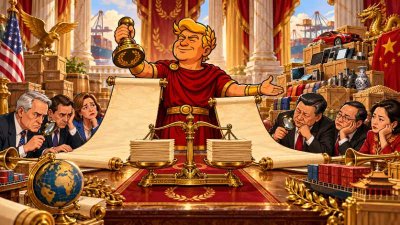

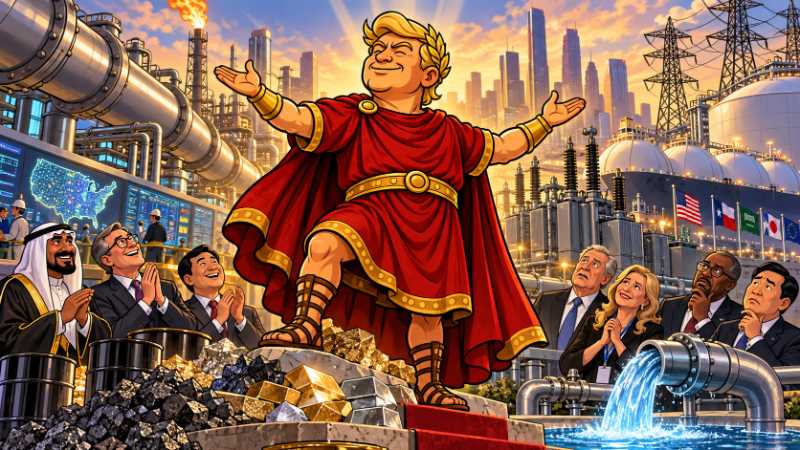

In the blazing imperial province of Houston, where the air-conditioning works harder than most diplomatic delegations and every second building appears connected to a pipeline, the energy ministers of the great nations gathered for the Grand Council of Limitless Energy Abundance, Dominance, Prosperity, Strength, Greatness, and Other Words Suitable for Very Large Banners.
The gathering had been summoned by the mighty institutions of the Trumpian Empire: the National Council for Dominance Over All Things That Burn, the Department of Digging Magnificent Things Out of the Ground, the Department of Energy So Powerful It Requires Another Department, and the Imperial Environmental Agency for Explaining Why Fewer Rules Are Actually Better Rules.
And then the unbelievable occurred.
The ministers agreed on things.
Several things.
At the same meeting.
Without anyone apparently invading anyone else’s chair.
Trumpius Caesar reportedly received the news with imperial satisfaction and immediately asked whether the agreement could officially be described as historic, unprecedented, extraordinary and possibly the greatest multilateral achievement since people first discovered fire.
Four Agreements Become an Imperial Golden Age
The assembled ministers reached consensus on energy access, infrastructure, water resilience and secure supply chains.
In ordinary diplomatic language, this would be called a ministerial outcome.
In the Palace of Trumpius, it immediately became:
THE DAWN OF THE AGE OF ENERGY ABUNDANCE.
Possibly with trumpets.
At the center of the imperial doctrine stood three sacred pillars:
Energy Security and Affordable Baseload.
Permitting and Regulatory Efficiency.
And Critical Minerals That Should Ideally Not All Come From One Place That Can Suddenly Stop Answering the Phone.
Trumpius Caesar was delighted.
Nothing excites the imperial court quite like discovering that a complicated geopolitical problem can be converted into three bullet points and printed beneath a golden seal.
Citizens Shall Receive Energy — Tremendous Energy
The ministers discussed ways to expand household energy access, including LPG where it offers a practical alternative to traditional biomass.
Trumpian scribes immediately translated this into the eternal doctrine of imperial energy policy:
If it burns, flows, spins, glows, explodes in a controlled manner or can be transported through sufficiently impressive steel tubing, the Empire is interested.
Very interested.
The philosophy is simple.
More energy means more prosperity.
More prosperity means more greatness.
More greatness means another press conference explaining how much greatness there is.
Thus the circle of energy policy is completed.
The Imperial War on Paperwork
Then came permitting reform.
For centuries, civilization had suffered beneath the terrible burden of documents.
Applications.
Environmental reviews.
Consultations.
Approvals.
Reviews of the approvals.
Approvals of the reviews.
And occasionally a committee established to determine why the previous committee had not yet approved the preliminary consultation concerning the application.
Trumpius Caesar had seen enough.
The ministers supported more predictable and efficient regulatory processes.
In the imperial translation:
BUILD THE THING.
Naturally, safeguards were still mentioned.
Very respectfully.
Usually near the end of the paragraph.
Administrator Leonius Zeldinus, Imperial Prefect of Fewer Pages, declared that environmental protection and prosperity could march together.
At the Palace, officials nodded gravely.
The economy would gallop forward.
The machinery would roar.
The smokestacks would stand proudly.
And environmental stewardship would accompany them somewhere nearby carrying a clipboard.
Water Is Ordered Back to Work
The Council also endorsed voluntary water reuse measures for communities, manufacturing, agriculture and energy production.
This impressed Trumpius Caesar immensely.
Until now, water had apparently been allowed to believe that after one use its duties to civilization were complete.
No longer.
Under the doctrine of imperial abundance, even water must demonstrate productivity.
“Excellent water,” Trumpius supposedly proclaimed.
“Hardworking water. Loyal water. We use it, and then — very smart — we use it again.”
Court economists immediately began investigating whether water could also be persuaded to work weekends.
The Sacred Minerals of Civilization
Then came critical minerals.
Lithium.
Copper.
Nickel.
Rare earths.
And various other substances whose names make them sound either strategically indispensable or capable of destroying Captain Kirk.
Secretary Douglas Burgumius, Lord Protector of Things Found Beneath Other Things, warned that modern energy systems, advanced manufacturing and digital infrastructure cannot rest on fragile mineral supply chains.
The imperial solution was magnificently uncomplicated:
More mines.
More suppliers.
More factories.
More investment.
More innovation.
More domestic capacity.
More regional capacity.
And, most importantly, fewer occasions when one supplier controls the cupboard and suddenly decides the cupboard is closed.
Trumpius Caesar loved the concept.
Diversity, after all, is apparently excellent when discussing mineral suppliers.
Christopher Wrightus Discovers Energy
Energy Secretary Christopher Wrightus Maximus then delivered the astonishing revelation that energy is extremely important to modern society.
The court was stunned.
Factories require energy.
Data centers require energy.
Infrastructure requires energy.
Homes require energy.
Even microphones used to announce energy dominance require energy.
Without electricity, there could theoretically even come a moment when a giant illuminated TRUMPIUS sign goes dark.
At that point the Empire understood the seriousness of the matter.
Treasure Chests Begin Opening
While diplomats discussed resilience, companies began announcing investments and projects involving transformers, LNG and energy development. The White House release cited announcements by Hitachi Energy, Caturus and Continental Resources.
Ordinary economists might describe these as corporate investment decisions.
Trumpius Caesar understood the deeper truth.
They were obviously personal tributes to imperial greatness.
A transformer factory?
Trumpius.
An LNG expansion?
Trumpius.
A memorandum concerning oil development?
Also Trumpius.
Soon even the discovery of a functioning wall socket risked being classified as another historic victory for the Energy Abundance Agenda.
Imperial accountants were reportedly instructed to prepare enough columns for all future victories.
Additional parchment had to be ordered.
Deregulation Enters Wearing a Laurel Crown
The Environmental Protection Agency also highlighted major reversals of previous power-sector greenhouse-gas requirements, presenting them as part of a broader push for cheaper and more reliable energy.
At the imperial court, this was not described merely as deregulation.
No.
It was liberation.
Regulations were cast aside like defeated barbarians at the gates of Rome.
Coal breathed deeply.
Natural gas adjusted its toga.
And somewhere, a compliance officer stared silently at a shelf of binders that had just experienced an existential crisis.
Trumpius Caesar surveyed the scene.
“Beautiful deregulation,” he may as well have said.
“The cleanest deregulation anybody has ever seen.”
The Entire World Arrives to Witness the Greatness
Representatives from a wide range of G20 countries, partner nations and international groupings attended the Houston ministerial.
They came from Europe.
Asia.
Africa.
North America.
South America.
Kingdoms.
Republics.
Unions.
Federations.
Places with enormous energy reserves.
Places that would very much like enormous energy reserves.
And places whose primary diplomatic objective was presumably getting through the closing communiqué without triggering seventeen emergency phone calls.
They discussed infrastructure.
Supply chains.
Minerals.
Water.
Regulation.
Energy security.
Affordability.
And the unique diplomatic art of writing sentences everyone can interpret as meaning approximately what they wanted in the first place.
By the end, consensus had been achieved.
For normal governments, that meant a successful ministerial.
For Trumpius Caesar, it meant civilization had once again been personally rescued.
The imperial scribes prepared the proclamation:
THE WORLD HAS CHOSEN ENERGY.
A bold conclusion, considering the alternative would have been voluntarily returning to candles.
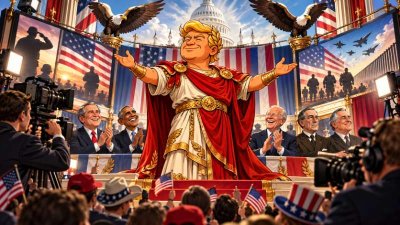
Trumpius Caesar finally appeared before the marble columns of the Palace and proclaimed:
“We have energy. We have minerals. We have water. We even have reused water. We have permits that may soon need fewer permits. Nobody has ever had this much abundance. Possibly too much abundance. But we can handle it.”
The senators applauded.
The pipelines hummed.
The transformers transformed.
And somewhere in the Empire, a bureaucrat quietly removed page 437 from a permit application.
Thus began the Golden Age.
Again.
For approximately the fifth time that month.