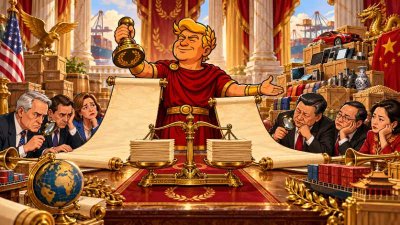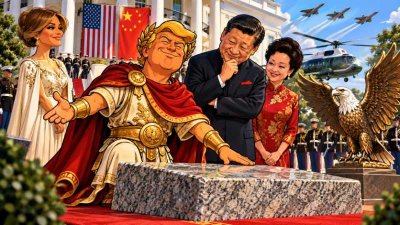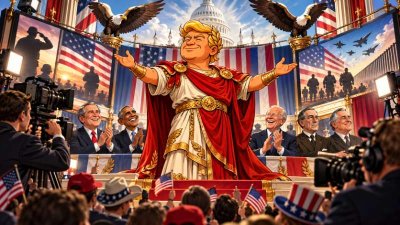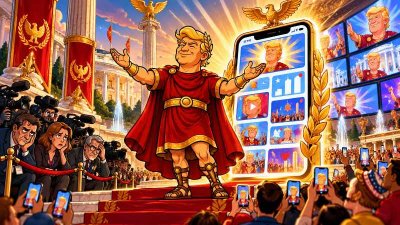

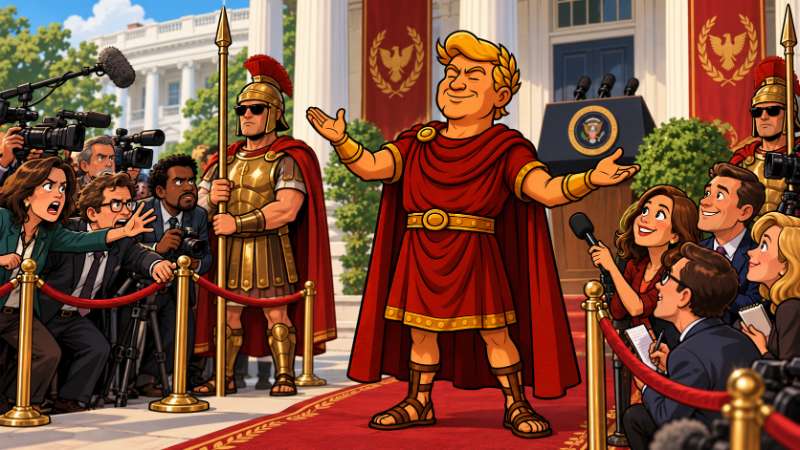
A new constitutional doctrine has apparently been discovered inside the marble halls of the Palatium Album of Washingtonia:
Freedom of the press is a right. A chair in Caesar’s briefing room, however, is apparently a gift from the Emperor.
That, more or less, is the latest imperial message from the realm of Imperator Donaldus Trumpius Maximus, after the scribes of CNNius, MS-NOWicus, and the scroll-makers of Politicus lost their palace access.
The imperial court argues that these chroniclers have spent years producing allegedly false and hostile reporting. And so Trumpius Caesar has delivered the grand distinction of the age:
Of course, they may continue to write.
They may write until their keyboards melt, their cameras overheat, and every digital scroll in Washingtonia is filled with criticism of the Emperor.
But nowhere, according to the new Trumpian doctrine, does liberty require Caesar to reserve them a comfortable chair five steps away from the imperial podium.
In the Trumpian Empire, a White House press pass is apparently less like a constitutional guarantee and more like an invitation to dinner:
You are free to review the banquet.
You are simply not guaranteed a seat at the table.
The Great Scroll of “But They Did It Too”
To defend the imperial decree, the court opened the historical archives and unfurled a magnificent document entitled:
“But the Other Emperors Did It Too.”
First came Barackus Obamius, former ruler of the Democratic provinces, whose administration once had fierce disputes with Foxius Newsicus and questioned whether the network functioned more like a political operation than a traditional news organization.
Trumpius’ scribes waved these ancient parchments triumphantly.
“Behold!” they effectively proclaimed. “Journalists were pushed around before! Therefore, the imperial pushing-around tradition is historically established!”
It is a fascinating doctrine.
Under the same principle, a Roman charioteer could crash into a column and defend himself by shouting:
“Marcus crashed into a column fifteen years ago!”
The column would still be broken.
But at least everyone would have important historical context.
Josephus Bidenicus Enters the Archive
Former Emperor Josephus Bidenicus also received a prominent place in the palace grievance scroll.
His administration changed rules governing long-term White House press credentials, which caused many previous passes to expire or require renewed applications.
The Trumpius court now presents this as additional evidence that access has always been regulated.
And thus was born the universal constitutional principle of Washingtonia:
If somebody, somewhere, at some point in history ever closed a door, Caesar may also close a door.
The palace doorman was immediately promoted to Senior Scholar of Constitutional Affairs.
The Emperor Discovers Media Mathematics
Then came the numbers.
The imperial court cited a study by the conservative Media Research Center, which argued that major television coverage of Trumpius during the opening phase of his second reign was overwhelmingly negative.
For Caesar, however, the mathematics were probably much simpler:
Positive coverage = journalism.
Negative coverage = political activism.
Very negative coverage = possibly Gaul.
Extremely negative coverage = almost certainly a conspiracy involving several senators, two cable networks, a printing press, and one suspiciously liberal coffee machine.
A reporter who asked whether journalists are supposed to criticize powerful officials was reportedly invited to hand his palace badge to the guard.
Temporarily, of course.
Possibly until the fall of the Empire.
Caesar Discovers Freedom of the Press
The truly imperial achievement is Trumpius Caesar’s emerging definition of press freedom.
The press may publish.
The press may criticize.
The press may investigate.
The press may accuse the Emperor of being wrong, mistaken, contradictory, dramatic, excessive, theatrical, or unusually interested in gold decorations.
But Caesar may apparently choose which members of that press are permitted close enough to ask him questions directly.
The result is a remarkably comfortable form of democratic transparency:
A free press — with an imperial guest list.
Ancient Rome probably had a phrase for this.
Perhaps:
Libertas Pressae Selectiva.
Selective freedom of the press.
And somewhere inside the Palatium Album, Trumpius Caesar is probably reclining upon a golden chair, surveying a somewhat smaller press corps and declaring:
“Nobody loves freedom of the press more than I do. Nobody. It is tremendous freedom. Beautiful freedom. The best freedom.
Some of the press just has to enjoy it from outside.”