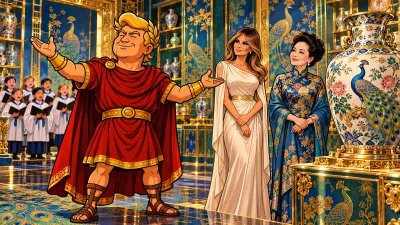

WASHINGTONIA/NUUKIA — It was a tremendous day for the Empire, perhaps the greatest day ever experienced by a sheet of ice. Trumpius Caesar Magnus announced that the United Provinces of America Maxima, the Kingdom of Denmarkia, and the frozen realm of Greenlandia had signed an agreement whose title was longer than the average Arctic winter.
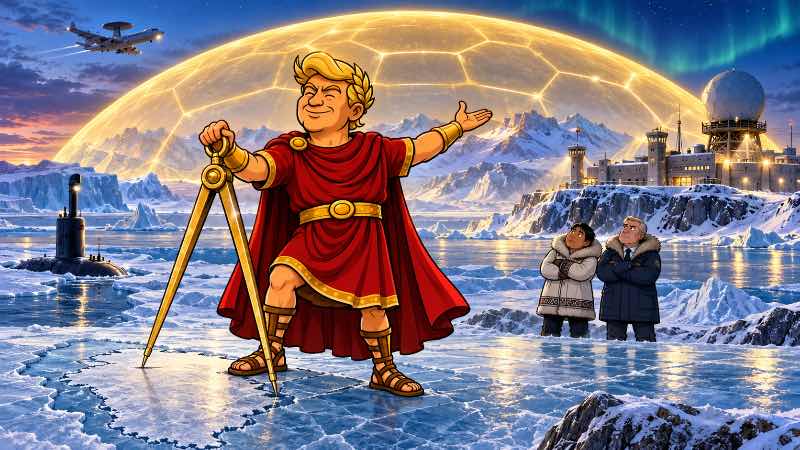
The imperial scribes began with a magnificent preamble affirming democracy, human rights, international law, sovereignty, self-determination, environmental protection, fishing, hunting, culture, education, and possibly the personal dignity of every sled dog in Greenlandia. Above all, however, the agreement affirmed America Maxima’s desire for a little more room—for aircraft, ships, satellites, radar stations, military bases, and the glorious Golden Dome of Trumpius.
“We are not taking Greenlandia,” Trumpius Caesar declared with historic generosity. “We are merely modernizing it so completely that nobody will be able to tell the difference. Very respectful. Possibly the most respectful occupation that is definitely not an occupation.”
The existing Imperial Space Fortress at Pituffikia may now be expanded, polished, reinforced, and presumably decorated with sufficient gold to become visible from orbit. New defense domains will also arise near Narsarsuarum and Mestersvigium, while further areas may be added whenever the Empire discovers another portion of Greenlandia insufficiently defended by America Maxima.
Naturally, every future expansion will require mutual consultation. The Empire will submit a proposal, the Permanent Committee will study it, ministers will discuss it, deputy ministers will discuss why the ministers discussed it, and eventually everyone will agree that the runway should already have been completed.
Unmanned military installations will receive accelerated approval. This is extremely efficient because unmanned installations do not complain about the cold, demand hazardous-duty pay, join labor unions, or ask why Trumpius Caesar needs a radar tower beside a fishing village.
Imperial aircraft may fly across Greenlandia and land throughout its territory. Imperial ships may travel through its waters, while other vessels may move beneath them with the majestic discretion traditionally associated with submarines. All of this shall respect Greenlandic society “to the maximum extent possible”—a wonderfully flexible phrase meaning that hunters, fishermen, seals, warships, drones, and nuclear submarines will share the Arctic in perfect harmony, provided none of them blocks the imperial flight schedule.
Trumpius Caesar praised the economic blessings hidden inside the agreement. Contracts for construction, maintenance, servicing, and dismantling should be awarded to Greenlandian businesses whenever possible.
“Local jobs!” cried the Caesar. “The greatest local jobs ever created by enormous foreign military installations!”
Should Greenlandian firms happen to lack experience building orbital detection systems, subterranean command centers, or gold-plated missile shields, America Maxima will selflessly arrive with contractors, consultants, subcontractors, deputy consultants, and invoices large enough to provide emergency heating for the entire island.
The agreement also introduces powerful protections against espionage. No building near an imperial defense area may be constructed, modified, or used in a suspicious manner. Any citizen erecting a shed may therefore be asked to prove that it contains only fishing equipment—not hostile agents, surveillance technology, or a refrigerator manufactured in a strategically questionable nation.
States outside the sacred Atlantic Club may not establish permanent military facilities in Greenlandia. Foreign investors from geopolitically incorrect kingdoms must likewise be kept away from sensitive infrastructure, minerals, resources, and confidential information. Money remains welcome, of course, but it must arrive carrying the correct flag and preferably wearing a NATO lapel pin.
Most magnificently, the agreement has no expiration date. It shall endure through winter, spring, independence, changing governments, melting glaciers, and possibly several civilizations. Even if Greenlandia one day becomes fully independent, it must inherit the entire arrangement, remain within the Atlantic alliance, and continue honoring all imperial defense obligations.
Thus, Greenlandia may freely determine its own destiny—as long as destiny selects the already approved option.
At the ceremonial conclusion, Trumpius Caesar ordered his servants to unroll a giant golden map. Greenlandia had not been painted as imperial territory. It was merely covered with American flight paths, naval corridors, defense zones, radar stations, security perimeters, and one enormous Golden Dome.
“You see?” Caesar proclaimed proudly. “Completely sovereign. Beautifully independent. You simply cannot see it anymore because of all the freedom protecting it.”