
Another glorious sunrise illuminated the golden domes of Washingtonium Maximus, where Emperor Trumpius Caesar Magnus Dealimus gathered senators, merchants, generals, economists, and at least three people whose only job appeared to be applauding.
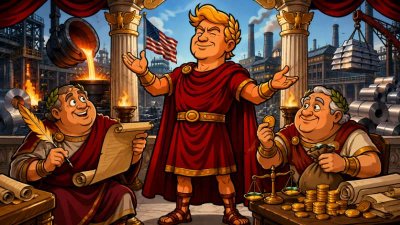
With supreme confidence, the Emperor raised three magnificent scrolls sealed with imperial gold.
"My fellow citizens," he proclaimed, "today we restore fairness. Also tariffs. Mostly tariffs."
The Senate erupted into thunderous applause that historians later described as "economically enthusiastic."
Operation Maple Hammer
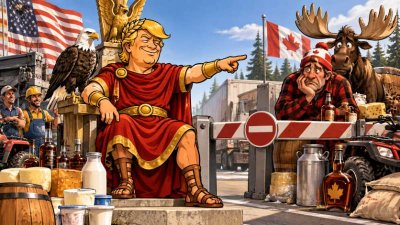
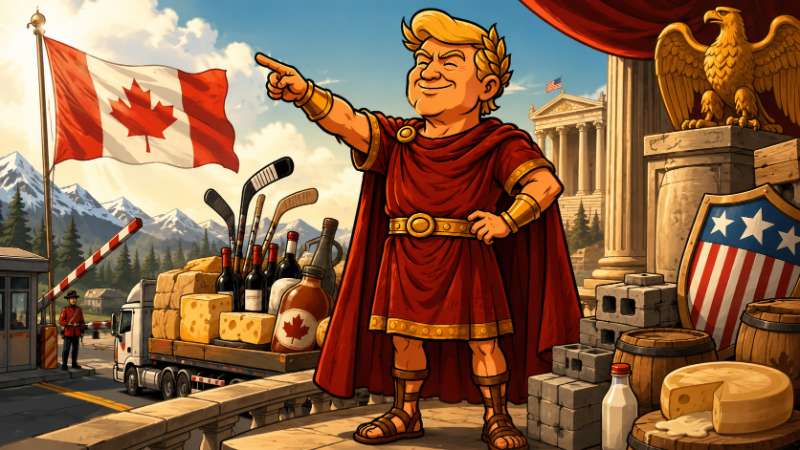
The Imperial Treasury unveiled a list of products arriving from the northern Kingdom of Mapleland, known by ordinary cartographers as Canada.
The list included:
- Wine
- Spirits
- Cheese
- Cement
- Hockey sticks
- Various additional northern goods
One confused senator cautiously raised a hand.
"Your Majesty... hockey sticks?"
Trumpius smiled.
"Exactly."
The chamber fell silent.
"Empires have collapsed for ignoring smaller pieces of wood."
Nobody questioned him further.
The Great Cheese Insult
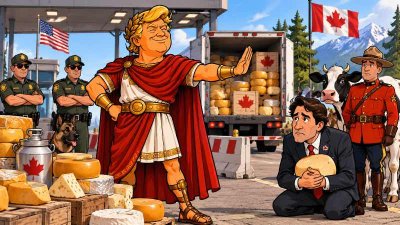
According to the Imperial Court, Mapleland had committed one of history's greatest diplomatic offenses.
American cheese was allegedly being treated less favorably than European cheese.
Trumpius looked deeply offended.
"Our cheddar built civilizations."
"Our cheese deserves respect."
"If foreign cheese gets a better welcome than Imperial cheese, then civilization itself is clearly in danger."
Several senators immediately requested the creation of the Royal Committee on Cheese Justice.
The Bourbon Tragedy
The Emperor also lamented the shocking treatment of Imperial beverages.
Mapleland had removed many American alcoholic products from store shelves while allowing drinks from other kingdoms to remain.
"This," declared Trumpius dramatically, "is discrimination against freedom itself."
The Imperial Minister of Celebration attempted to comfort everyone by opening a ceremonial bottle of bourbon.
Unfortunately, it had already become part of the customs investigation.
The Chariot Crisis
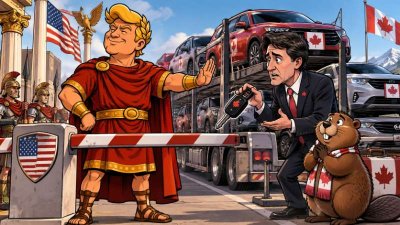
Imperial advisors presented alarming numbers showing declining exports of American automobiles into Mapleland while vehicles from other kingdoms continued entering the market.
Trumpius shook his head.
"Our chariots are magnificent."
"They're beautiful."
"They have the greatest wheels."
"If fewer are being sold, something suspicious must be happening."
The Senate agreed immediately.
One economist quietly whispered the word "competition."
He was instantly reassigned to the Department of Quiet Thinking.
The Golden Tariff Machine
Inside the Imperial Customs Office, chaos erupted.
Officials began inspecting hockey sticks with military seriousness.
Cheese wheels were classified according to strategic importance.
Wine barrels underwent "enhanced patriotic evaluation."
One particularly ambitious customs officer attempted to impose a tariff on a moose.
The moose refused to declare any commercial intent and walked away undefeated.
The Sacred Scroll of Section 338
Trumpius based his magnificent action upon the legendary Imperial authority known as Section 338.
Court scholar Paragraphius Interpretatius Maximus explained its majestic simplicity.
"If another kingdom burdens Imperial merchants..."
"...the Emperor may burden theirs until everyone feels equally burdened."
The Senate unanimously declared this "perfectly symmetrical diplomacy."
Selective Imperial Mercy
Not every product faced the Golden Hammer.
Energy.
Potash.
Critical minerals.
Fish.
These remained untouched.
When asked why, Imperial strategist Strategicus Commonsensius replied:
"Even an Emperor understands that simultaneously taxing electricity, fertilizer, dinner, and industrial supply chains may complicate breakfast."
The explanation received a standing ovation.
America Prima Imperialis
Trumpius reminded everyone that his legendary trade doctrine had already produced glorious victories.
Factories returning home.
Jobs returning home.
Investments returning home.
Tariffs definitely staying home.
The Emperor proudly announced:
"Other rulers collect treaties."
"I collect victories."
"And occasionally tariffs."
Imperial historians eagerly updated the official records.
Mapleland Refuses to Kneel
According to the Imperial Court, only two great powers had consistently chosen retaliation over negotiation.
The Eastern Empire of Sinicus Draconis...
...and Mapleland.
One senator leaned toward another.
"That's unusual company."
His colleague nodded.
"One exports electronics."
"The other exports maple syrup."
"History works in mysterious ways."
The Age of Imperial Reciprocity
As diplomats rushed through endless trade documents and merchants recalculated shipping costs with increasingly nervous expressions, Trumpius Caesar calmly admired his freshly signed golden proclamations.
"A fair marketplace," he declared, "begins with an unfair amount of paperwork."
No one could determine whether this was economic philosophy or simply another masterpiece of imperial confidence.
One thing, however, had become unmistakably clear.
Inside the Golden Empire of Trumpius Caesar, nothing remained ordinary.
Cheese became a geopolitical instrument.
Bourbon evolved into foreign policy.
Cement acquired strategic significance.
Even an innocent hockey stick could suddenly find itself standing before Imperial Customs, nervously attempting to explain its intentions while a golden-armored inspector measured its blade with extreme suspicion.
Such is life under the glorious reign of Trumpius Caesar, where every tariff is a royal decree, every trade dispute becomes an epic campaign, and every customs officer secretly dreams of one day being promoted to Supreme Guardian of Maple Imports.
For in the Empire, greatness is measured not only by monuments or armies—but also by the magnificence of one's tariffs.