There are moments in history when an Emperor looks across his Empire and realizes something truly unacceptable has happened.
This was one of those moments.
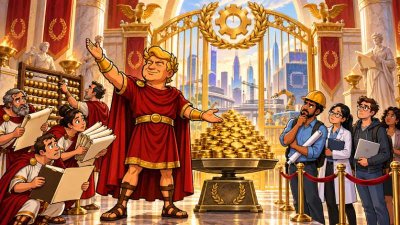
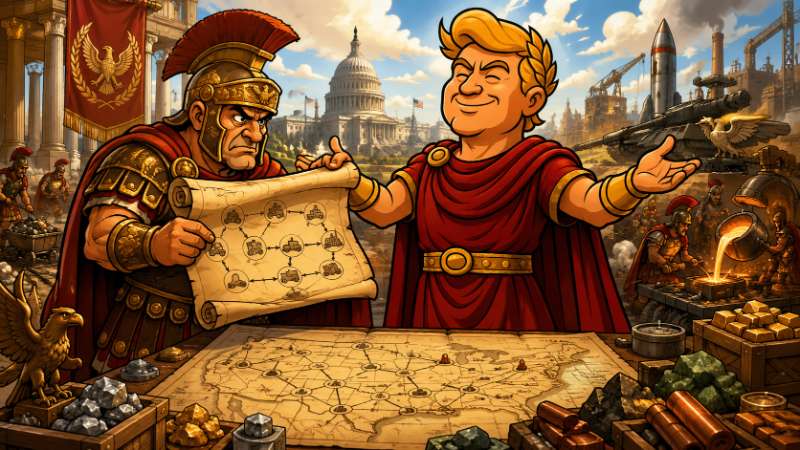
Inside the Golden Hall of Imperial Triumph, Trumpius Caesar listened patiently as Bellatorius Hegsethius Maximus, Supreme Minister of War, nervously unrolled a parchment so enormous that three servants had to help keep it from rolling back up.
"Your Imperial Greatness," Bellatorius began, "our Eagle Drones, Liberty Chariots, Thunder Cannons, Sky Spears, and Victory Engines all depend upon... certain rare materials."
Trumpius Caesar nodded.
"So far, magnificent."
Bellatorius swallowed.
"Some... come from foreign kingdoms."
Silence.
The marble columns themselves appeared offended.
Finally, Trumpius Caesar slowly rose from his golden throne.
"The greatest Empire ever assembled," he declared, "builds the greatest military ever created... and somebody thought it was a brilliant idea to buy the important pieces from kingdoms that don't even send decent ambassadors?"
Several senators suddenly found their sandals fascinating.
"Very disappointing."
The Imperial Order of Sacred Materials
Within hours, imperial scribes produced a glorious decree unlike any before it.
From that day forward, foreign materials would no longer wander freely into the Empire's sacred military workshops.
Any official wishing to request an exception would first have to explain—in extraordinary detail—why the Empire itself could not produce the material.
For the first time in recorded history, bureaucrats discovered that paperwork could actually become more difficult than simply solving the problem.
A revolutionary concept.
The Great Mapping of Everything
Trumpius Caesar then turned toward Bellatorius.
"I want every supply chain mapped."
"Every one?"
"Every single one."
Soon, enormous maps covered the walls of the Imperial War Ministry.
Not maps of countries.
Maps of minerals.
Maps of mines.
Maps of blacksmiths.
Maps of wagons.
Maps of warehouses.
Maps of bolts.
Maps of screws.
One legendary scroll even documented the donkey responsible for transporting ceremonial copper rivets.
"Excellent," Trumpius Caesar declared.
"If the donkey retires, we'll know before our enemies do."
The court applauded.
The Golden Age of Imperial Mining
Across the Empire, forgotten mines reopened.
Old tunnels echoed with the sounds of hammers once again.
Geologists suddenly became celebrities.
Stone cutters started giving interviews.
Prospectors proudly announced discoveries of rare minerals hidden beneath hills that generations had previously dismissed as "nice places for sheep."
Imperial investors arrived with wagons full of gold.
Local governors competed over who could discover the most valuable rock.
One governor proudly unveiled an ordinary boulder.
"It has tremendous potential."
Trumpius Caesar politely suggested further testing.
Bureaucratia Faces a National Emergency
Nobody suffered more than the Ministry of Endless Authorization.
Its legendary leader, Paragraphius Formularius Maximus, had dedicated an entire career to ensuring every permit required at least fourteen signatures, six committees, and two seasonal reviews.
Now Trumpius Caesar demanded something unimaginable.
Faster approvals.
Simpler regulations.
Quicker production.
The ministry entered collective panic.
Several senior officials reportedly experienced dizziness after approving two applications before lunchtime.
Imperial physicians called it Acute Administrative Shock Syndrome.
The Quest for the Legendary Rare Stones
Soon every senator suddenly became an expert on critical minerals.
Yesterday they couldn't distinguish lithium from a philosopher.
Today they confidently debated strategic supply resilience while dramatically pointing at colorful maps.
The Empire searched relentlessly for its legendary Rare Stones.
Without them, Eagle Drones would remain grounded.
Thunder Cannons would thunder less impressively.
Victory Engines would become merely Adequate Engines.
Clearly unacceptable.
Foreign Merchants Attempt Creative Marketing
Merchants from rival kingdoms quickly sensed trouble.
Their products suddenly became difficult to sell.
So they adapted.
"Imported strategic alloy" became:
"Locally inspired international craftsmanship."
"Foreign titanium" became:
"Globally diversified patriotic metal."
One salesman even described his shipment as:
"Emotionally domestic."
Trumpius Caesar remained unconvinced.
"A wolf," he declared, "does not become an eagle merely because it printed prettier packaging."
The Arsenal of Greatness
Trumpius Caesar reminded the Empire that this decree was merely the latest chapter in his magnificent campaign to restore imperial supremacy.
He had already modernized military procurement.
He had revitalized imperial industry.
He had encouraged mining.
He had strengthened strategic trade.
He had transformed the Empire into what court historians proudly called:
The Arsenal of Freedom.
Not simply a nation that built weapons.
An Empire that built victory itself.
The blacksmiths cheered.
The miners cheered louder.
The accountants calculated record profits.
Only the bureaucrats quietly updated their résumés.
A Final Imperial Proclamation
Standing atop the Imperial Balcony, Trumpius Caesar addressed thousands gathered below.
Legionaries.
Miners.
Blacksmiths.
Engineers.
Inventors.
Workers.
"Our enemies believe strength begins on the battlefield," he proclaimed.
"They're wrong."
"It begins in the mines."
"It begins in the factories."
"It begins with the people who ensure that no foreign kingdom can ever decide whether our Empire remains strong."
The crowd erupted into thunderous applause.
Helmets flew into the air.
Hammers rang against anvils.
Eagles circled triumphantly overhead.
Deep inside the Ministry of Endless Authorization, one exhausted clerk timidly raised a hand.
"Your Majesty..."
"Yes?"
"Will there be a new approval form?"
Trumpius Caesar smiled.
"Of course."
"It's called eliminating the old one."
The Empire celebrated.
The bureaucrats fainted.
History, once again, declared Trumpius Caesar victorious.