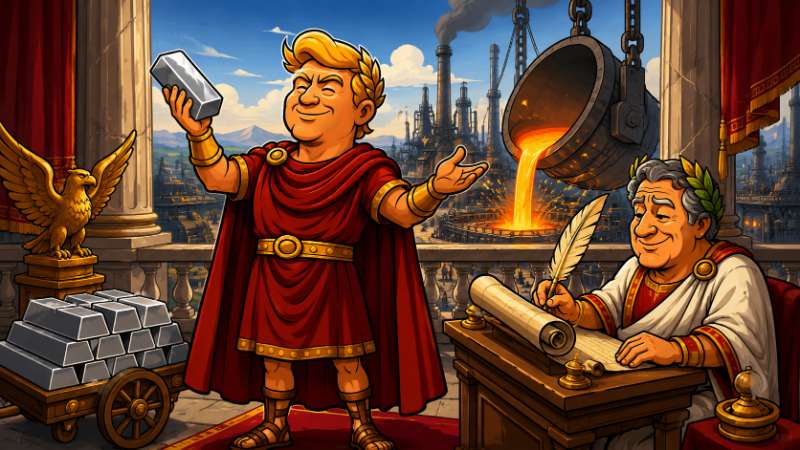
Another glorious morning dawned over the Imperial Capitol as thousands gathered beneath towering marble columns, eagerly awaiting the next decree from the one, the only, Trumpius Caesar.
Rumors had spread throughout the Empire.
Some expected a declaration about gold.
Others predicted silver.
A few optimistic senators even whispered about platinum.
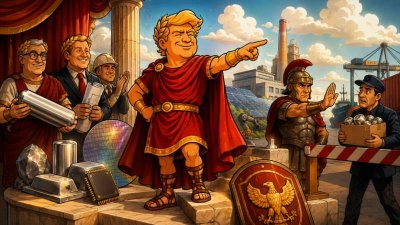
Instead, Trumpius Caesar emerged carrying the legendary Golden Tariff Hammer and proclaimed with absolute confidence:
"The future of civilization is aluminum. Everyone knows it. The Romans would've used it if they'd invented it first."
Thunderous applause echoed across the Forum.
Several senators immediately stood to cheer, although a few quietly admitted they weren't entirely sure what aluminum actually looked like.
The Barbarian Aluminum Invasion
For years, caravans from distant kingdoms had delivered mountains of aluminum into the Empire.
Ships arrived daily.
Merchants negotiated endlessly.
Warehouses overflowed.
To ordinary citizens this looked suspiciously like international trade.
To Trumpius Caesar, however, it was clearly a strategic invasion disguised as commerce.
No Empire could truly be great, he declared, if its most important metal came from foreign lands.
Thus, the mighty Imperial Tariff Wall had already been raised years before.
Now, according to Trumpius Caesar, it was time to build something even greater.
Not another wall.
An empire of smelters.
Build More. Melt More. Win More.
Standing beside him was the legendary Minister of Commerce, Mercatorius Tarifus Maximus, proudly carrying an enormous scroll containing what palace officials called:
"The Greatest Industrial Incentive in the History of Civilization."
The plan was brilliantly simple—at least according to everyone paid to applaud.
Companies willing to build new aluminum smelters inside the Empire...
Modernize aging facilities...
Or expand existing production...
Would receive an extraordinary imperial privilege.
They could import limited quantities of aluminum at only half the normal tariff rate.
The Senate immediately erupted into confused whispers.
One elderly senator cautiously raised his hand.
"Your Majesty... aren't tariffs supposed to be higher?"
Trumpius Caesar smiled.
"Exactly. That's why lowering them makes them even stronger."
Nobody dared ask a follow-up question.
The Great Imperial Construction Race
Naturally, no company could simply claim to be building greatness.
Applicants would first submit a magnificent Imperial Onshoring Scroll describing every glorious detail.
Construction deadlines.
Production forecasts.
Investment plans.
Expected output.
Financial calculations.
Projected economic triumphs.
The scrolls would then be reviewed by the highly respected Ministry of Strategic Smelting Excellence, whose officials reportedly considered spreadsheets a sacred form of literature.
Every proposal would be judged according to one simple question:
"Will this make the Empire even greater?"
If yes...
Approval.
If maybe...
More paperwork.
If no...
Even more paperwork.
Trust... But Verify Everything
Trumpius Caesar made one point perfectly clear.
The Empire rewards loyalty.
It also rewards production.
But it absolutely loves audits.
Every approved company would submit regular progress reports.
Government inspectors could appear at any time.
Independent auditors would verify construction.
Financial records would be examined.
Production promises would be monitored.
And anyone caught exaggerating their glorious ambitions could lose every tariff benefit.
Retroactively.
With penalties.
Additional tariffs.
And what palace insiders dramatically referred to as:
"An exceptionally unpleasant meeting with the Imperial Customs Legion."
Aluminum Becomes a National Philosophy
Soon, aluminum stopped being merely a metal.
Court philosopher Contextia Relativissima announced that it now represented the very soul of the Empire.
Strength.
Security.
Industry.
Jobs.
Victory.
Someone quietly suggested titanium might also be useful.
The room became uncomfortably silent.
That senator later apologized publicly and promised never again to question the sacred hierarchy of strategic metals.
The Smelters Rise
Across the Empire, construction crews immediately celebrated.
Blueprints appeared overnight.
Engineers designed towering furnaces.
Investors calculated profits.
Lawyers drafted contracts.
Consultants formed committees to supervise committees responsible for overseeing additional committees.
Meanwhile, the parchment industry experienced its strongest economic quarter in recorded history.
The Grand Imperial Finale
As the sun set behind the Capitol, Trumpius Caesar stepped onto the palace balcony one final time.
Behind him stood an enormous polished sheet of aluminum reflecting golden rays across the city.
He raised the Golden Tariff Hammer triumphantly.
"People say aluminum is lightweight."
He paused dramatically.
"Our Empire isn't."
The crowds roared.
The blacksmiths cheered.
The customs officers applauded louder than anyone.
And somewhere, deep within the Empire, another aluminum smelter broke ground—accompanied by engineers, inspectors, accountants, auditors, lawyers, and enough paperwork to build an entirely separate bureaucracy.
For under the glorious reign of Trumpius Caesar, even a simple piece of aluminum could become an instrument of imperial destiny.
And in the Empire of Trumpius, greatness isn't measured in ounces.
It's measured in tariffs, furnaces, and proclamations engraved forever into marble.