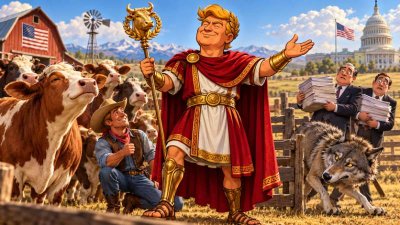
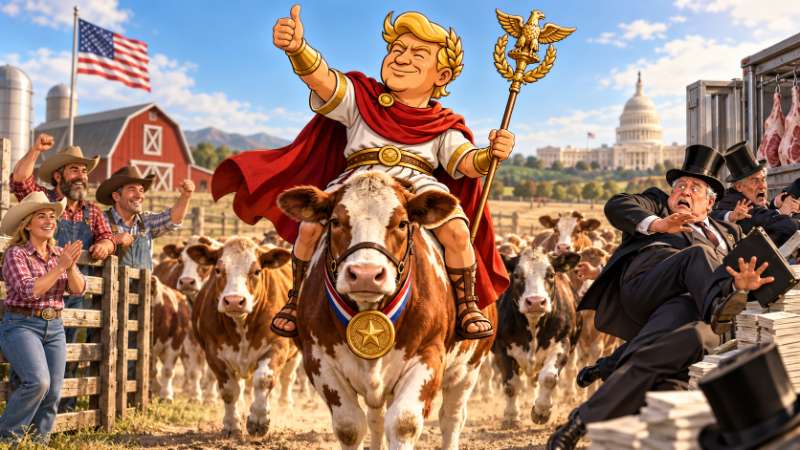

It came to pass in another spectacular year of the Empire that Imperator Donaldus Trumpius Caesar Maximus, Defender of the Golden Steak, Conqueror of Bureaucracy, and Supreme Pontiff of the Sacred Grill, gazed across the magnificent cattle plains of America.
And behold:
The cattle were troubled.
Not by drought.
Not by coyotes.
Not even by suspiciously ambitious vegetarians.
No, the great bovine citizens of the Republic were allegedly suffering under something far more terrifying:
The Beef Barons.
These mighty lords of slaughterhouses, processing plants, contracts, market shares, and spreadsheets had grown so powerful that the humble Rancherus Americanus could sometimes feel less like the owner of his cattle and more like a temporary subcontractor to the Imperial Department of Hamburger Destiny.
Trumpius Caesar therefore raised his golden pen and thundered from the Marble Palace:
“Enough! Let American beef roam free!”
And thus was born the magnificent Edictum Carnis Americanae — the Imperial Edict of American Meat.
The Imperial Legions March on the Beef Barons
At the heart of the decree stands a fearsome promise:
More competition.
More enforcement.
More opportunities for ranchers.
And considerably less happiness for anyone whose business strategy begins with the phrase, “What if we controlled almost everything?”
The ancient and mighty Packerius et Stockyardus Actus of 1921 shall therefore be dusted off, polished, sharpened and returned to battle.
Officials of the Departmentum Agriculturae Maximus are ordered to investigate unfair, deceptive, discriminatory and monopolistic practices throughout the livestock empire.
More investigators shall be summoned.
More enforcement shall be unleashed.
More suspicious spreadsheets shall tremble before Washington.
The warriors of the Departmentum Justitiae will also join the campaign, coordinating with the agricultural legions wherever the dark spirits of price manipulation or anticompetitive conduct may lurk.
And within 60 days, Trumpius demands reports detailing investigations, staffing requirements and enforcement plans.
Because nothing says:
“We are cutting bureaucracy!”
quite like ordering several new federal reports with a 60-day deadline.
Let the Steak Cross State Lines
But Trumpius Caesar does not merely punish.
He liberates.
The imperial vision calls for more states to participate in cooperative meat-inspection programs so smaller processors can sell their products across state borders.
Technical assistance and training are to be expanded for small and very small establishments.
And the government must create an accessible digital resource showing ranchers where slaughter and processing capacity is available.
In other words:
Imperial Google Maps for cows.
“Your destination is 31 miles ahead.”
“Continue straight past the grain silo.”
“At the next intersection, turn left toward federally inspected beef processing.”
“Recalculating moo.”
The Emperor also commands the modernization of meat inspection itself.
Reporting requirements and overly prescriptive rules that do not meaningfully improve food safety are to be reviewed and reduced.
Trumpius doctrine is simple:
Inspect the steak. Protect the public. But do not make the butcher submit a doctoral dissertation before slicing the ribeye.
Behold: The Coordinator Carnis Maximus
Every truly magnificent imperial campaign requires a coordinator.
Therefore the Department of Agriculture shall designate an official responsible for helping ranchers and smaller processors navigate government programs, regulations and processing challenges.
Thus enters the legendary:
Coordinator Carnis Maximus.
Part bureaucrat.
Part navigator.
Part translator of federal regulations.
His sacred mission:
To solve problems before a frustrated cattle rancher decides it would be easier to personally ride a bull into Washington, D.C.
Gold for the Processing Provinces
Then comes the treasure.
The decree calls for support through a loan-guarantee initiative known as Strengthening Processing for U.S. Ranchers, designed to help smaller and regional processors survive, expand and diversify their operations.
In classical Trumpius Latin:
Pecunia Pro Carnibus Magnificus.
Or, translated for ordinary citizens:
Money for businesses that turn something standing peacefully in a pasture into something later photographed next to fries.
The goal is clear.
More processing options.
More regional capacity.
More competition.
More resilience.
And fewer situations in which four enormous companies appear to possess all the knives.
America First — Including the Cow
At the center of the imperial philosophy lies a beautifully simple vision:
American ranchers should have more opportunities to raise American cattle, process American beef and sell American products to American consumers.
Born in America.
Raised in America.
Processed in America.
Grilled in America.
And, if Trumpius Caesar had his way, probably served beneath a gigantic golden banner reading:
THE MOST MAGNIFICENT BEEF IN HUMAN HISTORY.
For the Emperor does not merely see cattle.
He sees an industry.
He sees competition.
He sees national resilience.
And somewhere beyond the horizon, beneath the setting sun of the Great American Plains, he almost certainly sees a cheeseburger.
Thus concludes the great Edictum Carnis Americanae.
The Beef Barons have been warned.
The ranchers have been summoned.
The investigators are sharpening their statutes.
And the cattle?
They remain silent.
But somewhere in the distance, from Nebraska to Texas, the Empire swears it can hear one enormous, patriotic:
MOOOO.