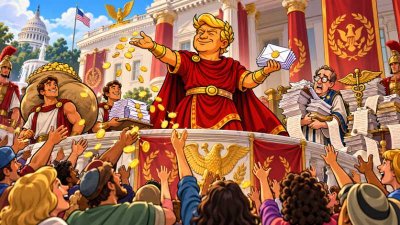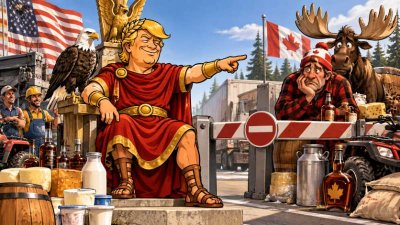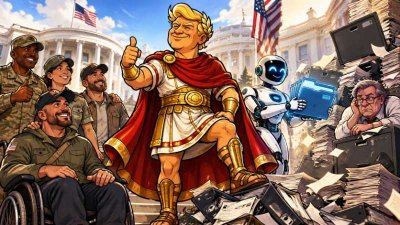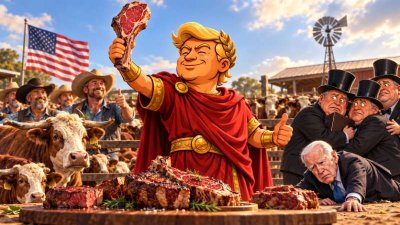

In the most glorious empire ever to stretch from sea to shining sea, Imperator Donaldus Trumpius Maximus, First of His Name, Defender of the Burger, Protector of the Rancher and Supreme Commander of the Golden Steak, has issued a new imperial decree:
America shall have more cattle.
The ranchers shall prosper.
The bureaucrats shall retreat.
And the wolves may soon be summoned for a very uncomfortable performance review.
According to the imperial scrolls, the American cattle herd has fallen to its lowest level in roughly 75 years. Demand for beef, meanwhile, has risen by nearly ten percent over the past decade.
To ordinary mortals, this might sound like agricultural economics.
To Trumpius Caesar, it is nothing less than an imperial emergency involving cows, hamburgers, national greatness and possibly civilization itself.
Drought, wildfires, high feed costs and regulatory burdens have all contributed to shrinking herds. Naturally, the court historians of Trumpius also reserve a prominent marble pedestal of blame for the previous reign of Josephus Bidenus Somnolentus, under whom, according to the imperial narrative, inflation, environmental regulation and assorted Washington scroll-pushers were apparently allowed to roam freely across the prairie.
Trumpius has therefore deployed the mightiest weapon known to the modern American emperor:
The Executive Order Pergamentum Maximus.
Federal agencies are being instructed to examine rules and regulations that may burden ranchers, restrict grazing, increase costs or otherwise interfere with the sacred journey from pasture to cheeseburger.
The Departments of Agriculture, Interior and Commerce, together with other imperial ministries, are expected to identify obstacles standing between the American rancher and maximum bovine greatness.
Operation Lupus Interruptus
Then there are the wolves.
Gray wolves and Mexican wolves, magnificent creatures of nature though they may be, have apparently failed to fully appreciate the economic priorities of the Trumpius administration.
The imperial Praefectus Interioris is therefore instructed to review whether these wolves should remain protected under the Endangered Species Act or whether their status should be downgraded or removed.
Recommendations may also be sent to the Senate, while individual states are encouraged to examine similar measures.
In other words:
The wolf is getting an annual job evaluation.
Should Lupus Maximus fail to explain why he continues eating imperial livestock without first completing the appropriate federal paperwork, his future career prospects may become increasingly complicated.
The administration also wants ranchers compensated more effectively for predator losses and seeks easier authorization, where appropriate, for the lethal removal of problem predators.
For the first time in history, the wolf may discover that Washington paperwork can bite back.
Whose Steak Is This, Anyway?
Country-of-origin labeling is also returning to the imperial banquet table.
The Department of Agriculture has been ordered to consider whether additional rules are needed so consumers can better determine whether the beef before them truly grew up beneath the Stars and Stripes or spent its formative years in some distant and suspiciously beef-producing foreign kingdom.
Since January 2026, a strengthened “Product of USA” label has applied to meat, poultry and eggs that are entirely born, raised, slaughtered and processed within the United States.
But in the Empire of Trumpius, there is always room for greater patriotic precision.
If a package of ground beef can salute the flag before reaching the supermarket shelf, so much the better.
Let the Rancher Invest, and Let the Tax Collector Be Silent
Trumpius also points proudly to his imperial tax policies.
New business investments may qualify for faster write-offs. Certain expenses can be deducted immediately. A 20 percent deduction for many small businesses has been made permanent.
Estate tax exemptions have also been increased, helping ranching families pass land and operations to the next generation without first sacrificing half the herd to the gods of taxation.
Additional tax incentives for lenders are intended to make loans involving ranch land more attractive.
The imperial doctrine could hardly be clearer:
More cows. More investment. Fewer accountants hiding behind the barn.
The Great Expansion of the Imperial Herd
Trumpius has also moved to expand access to federal grazing lands.
Millions of acres remain available for livestock grazing, while federal agencies are being pushed to streamline permits and reduce delays.
Cattle are even being promoted as tools for reducing excess vegetation and wildfire risk.
Thus the American cow has officially become a multi-role national asset:
food producer, economic engine, landscape manager and possibly four-legged federal fire prevention unit.
Soon, one imagines, cattle may qualify for commemorative medals.
The Screwworm Legions Must Fall
Another enemy has also entered the imperial story: the New World screwworm.
According to the administration, only two active cases remained in the United States at the time of the fact sheet, while efforts were underway to expand sterile-fly production facilities.
This extraordinary method of pest control involves releasing vast numbers of sterile male flies in order to collapse the parasite population.
Even Trumpius himself could hardly invent a strategy more theatrically American:
When confronted by hostile insects, manufacture millions of infertile reinforcements and overwhelm them with logistics.
The Pentagon is undoubtedly taking notes.
Fertilizer, Schools and the Sacred Lunchroom Steak
The decree also arrives alongside a larger collection of measures aimed at farmers and ranchers.
Tax relief has been extended for ranchers forced to sell livestock because of drought.
A “Ranchers First” initiative seeks to rebuild the national cattle herd.
The administration has ordered action against price fixing and anti-competitive practices in food markets.
Certain duties on phosphate fertilizer from Morocco were temporarily suspended, while hundreds of millions of dollars have been directed toward expanding domestic fertilizer production.
And then there is “Harvest to Hallways,” an initiative designed to place more American-grown food, including beef, into school meals.
At last, the school cafeteria may become a strategic institution of national power.
Mathematics: difficult.
Chemistry: confusing.
History: disputed.
Lunch:
AMERICAN BEEF.
The Gospel of Beefus Americanus
Behind the many provisions, reviews, tax incentives and regulatory instructions lies a very Trumpius philosophy:
America should produce more of its own food, ranchers should face fewer obstacles, and anything capable of carrying the words “American Made” should probably do so in letters visible from orbit.
The rancher is no longer merely a livestock producer.
He is a guardian of food security.
The cow is no longer merely livestock.
She is an economic instrument of imperial destiny.
And Trumpius Caesar?
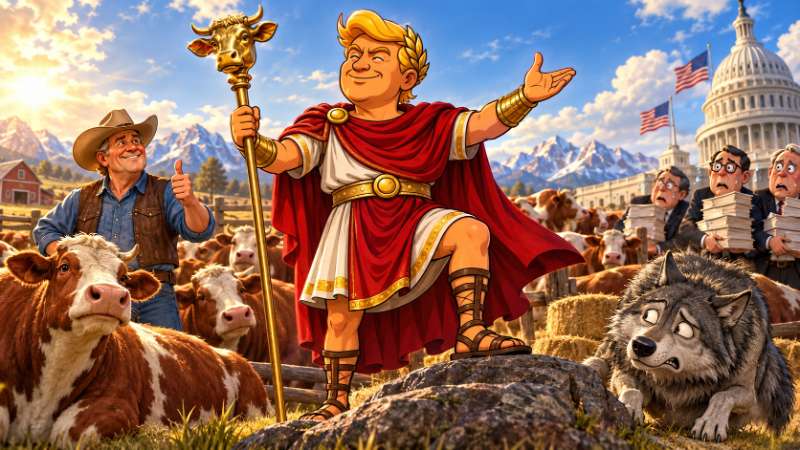
One can almost see him standing upon a golden balcony overlooking the prairie, cape fluttering in the wind, as thousands of cattle move majestically across the horizon.
He raises one imperial hand.
The trumpets sound.
The court falls silent.
And the Caesar proclaims:
“Behold! The cows are coming back. Beautiful cows. Tremendous cows. Possibly the greatest cows anyone has ever seen.”
Whether all these measures ultimately lower beef prices for American consumers remains a question for markets, ranchers and time. The executive order itself specifically directs agencies to consider consumer affordability when implementing its policies.
But within the Empire of Trumpius, the objective has already been carved into marble.
The ranchers shall prosper.
The herds shall grow.
The wolves shall study their résumés.
And somewhere deep inside the imperial Department of Agriculture, a golden banner is surely being prepared: