A state of tremendous emergency has once again descended upon the glorious Empire of Trumpia.
Not because of an invasion.
Not because of a financial collapse.
Not even because an unusually aggressive legion of tax forms has crossed the Potomac.
No.
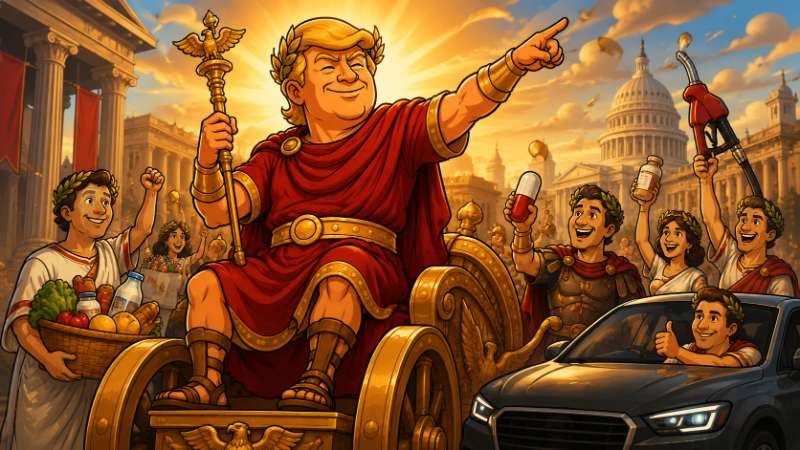
For years, the greatest enemy of the people had been the terrifying beast known throughout the provinces as Inflatia Maxima — a voracious economic monster capable of transforming bread, butter, gasoline, medicine, and occasionally even toilet paper into luxury goods suitable only for senators, emperors, and people with exceptionally generous credit limits.
Then came Trumpius Caesar Maximus.
Upon returning to the Golden Throne of Washingtonium, the Emperor reportedly inspected the treasury.
Then he inspected the economy.
Then he inspected the price tags.
According to highly reliable imperial historians — meaning people standing reasonably close to the palace — Trumpius stared at them for several seconds before delivering one of the shortest economic doctrines in imperial history:
"Terrible prices. Absolutely terrible."
And thus began the greatest discount offensive since the invention of the clearance aisle.
Operation Shopping Cartus
The first to mobilize were the mighty supermarket legions.
Gigantus Aquilus, known in the barbarian provinces as Giant Eagle, announced reductions averaging more than ten percent across hundreds of popular products.
Meat!
Produce!
Pantry supplies!
The citizens rejoiced.
Some allegedly entered the store simply to admire the price tags.
Then came the enormous commercial fortress of Walla-Martius Maximus, lowering prices on thousands of everyday products across the empire.
Ground beef became cheaper.
Fresh corn became cheaper.
Drinks became cheaper.
Even paper plates joined the revolution.
Trumpius Caesar had apparently achieved what generations of emperors could not:
He had made disposable dinnerware part of national economic strategy.
The exclusive membership order known as Samus Clubbus followed with reductions on hundreds of household essentials.
Then came Meijerius, Targetius Magnus, Krogerius Rex, Albertsonius, H-E-Bius, Costconius Maximus, and numerous other merchant houses.
Across the provinces, imperial scribes could barely replace the price labels quickly enough.
One anonymous palace economist was rumored to have warned:
"If this continues, the Emperor may accidentally put the entire country on clearance."
Even the mighty snack empire of Pepsicus Maximus entered the campaign, lowering retail prices on major snack brands.
Future historians may remember this moment as the Great Potato Chip Peace of 2026.
For once, the crunch heard across America was not inflation.
It was lunch.
TrumpRxius and the Battle of the Apothecaries
But Trumpius Caesar was not satisfied.
Supermarkets were only the beginning.
The Emperor turned toward the marble temples of pharmaceutical commerce and asked the terrifying imperial question:
"Why does medicine cost so much here?"
Several accountants immediately disappeared behind columns.
Thus came the doctrine of Favoritus Nationis Maximus — the imperial Most Favored Nation approach designed to bring American drug prices closer to the lowest prices paid by comparable developed nations.
And suddenly the pharmaceutical legions discovered an ancient economic technology previously believed lost:
Lower prices.
Novus Nordiskus dramatically reduced prices on several major treatments.
Pfizerius Magnificus offered substantial savings through the imperial marketplace known as TrumpRxius.
Amgenius lowered prices on important medicines.
Lillyus Medicus joined the procession.
And soon the great healing houses of Merckius, AstraZenecus, Sanofius, Johnsonus & Johnsonius, AbbVius, Novartius, and many others were appearing before the imperial gates bearing discounts rather than tribute.
Trumpian historians immediately declared it the greatest surrender of pharmaceutical price tags since Hippocrates accidentally invented the coupon.
The Energy Gods Hear the Emperor
Trumpius Caesar next turned his golden gaze toward energy.
Gasoline!
Electricity!
Utility bills!
The three horsemen of the monthly household budget.
The Freedom Fuel Legion lowered gasoline prices by roughly half a dollar per gallon at participating stations around Philadelphia.
Georgia Powerius promised residential savings.
Alliantus Energius froze residential rates in Iowa.
Other energy houses prepared enormous customer returns through agreements connected to new industrial projects.
Suddenly billions of dollars were being discussed not merely as corporate investments, but as potential savings for ordinary customers.
Across Trumpia, citizens stared suspiciously at their utility bills.
Could this be?
Could a bill actually become less horrifying?
Priests were summoned.
Economists were consulted.
Several calculators fainted.
The Imperial Chariots Become Affordable
Then came the automakers.
The legendary workshops of Fordius Motoricus extended employee-style pricing to ordinary American customers.
The engineers of Stellantius marched forward carrying banners reading, metaphorically at least:
ZERO PERCENT!
PAY LATER!
DRIVE NOW!
Meanwhile, Chevroletius revived the ancient patriotic spell known as the Heartbeat of America, offering deferred payments and multi-year zero-percent financing options.
The imperial chariot market had officially entered the campaign.
Citizens who once approached dealerships with the nervous expression of gladiators entering the Colosseum could suddenly discover financing offers that did not immediately require sacrificing their firstborn goat.
Trumpius Caesar reportedly approved.
"Beautiful cars," imperial legend has him saying. "Beautiful prices. Maybe the most beautiful financing Rome has ever seen."
Rome, of course, did not have automobile financing.
Such details have never troubled imperial legend.
Ave Discountus!
Back at the Golden Palace of Washingtonium, Trumpius Caesar surveyed the battlefield.
Supermarket prices were falling.
Drug prices were being reduced.
Energy companies were announcing savings.
Automakers were launching incentives.
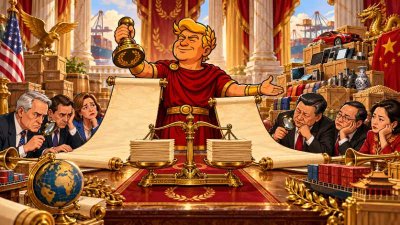
The imperial scribes prepared enormous scrolls documenting every reduction.
The trumpeters polished their instruments.
The economic victory banners were unfurled.
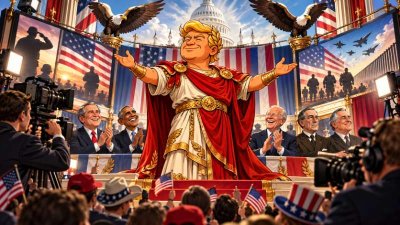
And Trumpius Caesar stepped onto the balcony.
"Look at the prices!" proclaimed the Emperor.
"Everybody said it couldn't be done. The merchants are cutting. The pharmacists are cutting. The energy people are cutting. Even the potato chips are cutting. Tremendous cutting!"
Below him, the Imperial Discount Legions erupted:
AVE TRUMPIUS!
AVE DISCOUNTUS!
DOWN WITH INFLATIA MAXIMA!
Naturally, somewhere beyond the palace walls, economists quietly noted that prices in a vast market economy move for countless reasons: competition, commodity costs, supply chains, consumer demand, corporate strategies, interest rates, energy markets, and broader economic conditions.
But such nuance is terribly inconvenient when commissioning a 40-foot marble statue.
In the majestic chronicles of Trumpius Caesar, the explanation is considerably simpler.
Prices were high.
Trumpius appeared.
Prices went down.
Therefore, naturally:
Trumpius defeated the prices.
It is economics according to the ancient imperial school of Post Hoc Maximus Magnificus.
And so another glorious day ends across Trumpia.
The citizens return home carrying groceries.
The pharmacists polish their discount tablets.
The gasoline pumps whisper numbers slightly less terrifying than before.
The automobile dealers prepare their zero-percent scrolls.
And somewhere beneath the golden sunset of Washingtonium, an abandoned shopping cart slowly turns one squeaking wheel toward the Imperial Palace.
Almost as if saluting its Emperor.
Trumpius Caesar smiles.
The chroniclers raise their quills.
And the Empire records another immortal economic proclamation:
Veni.
Vidi.
Discounti.