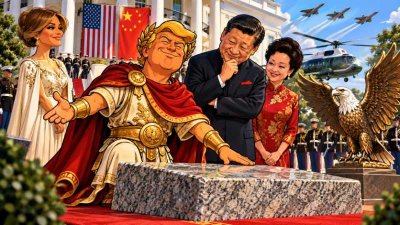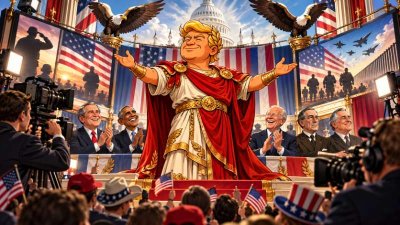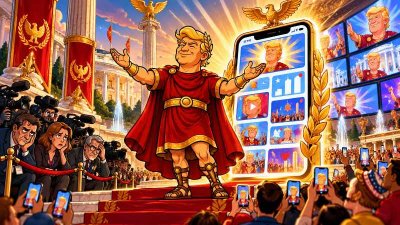

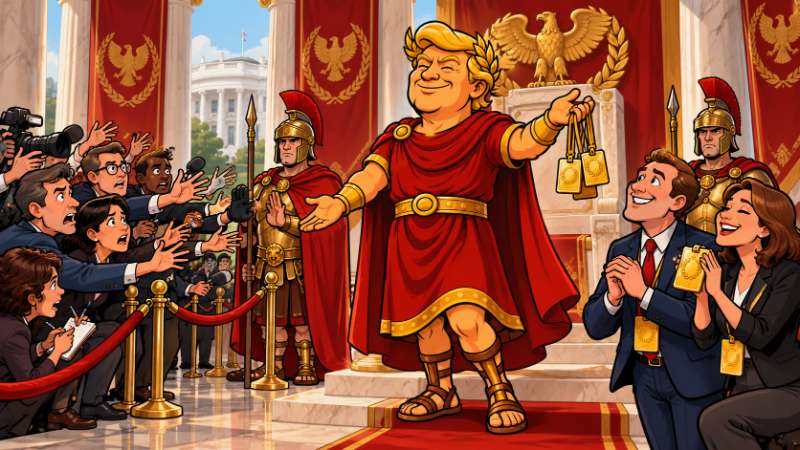

In the magnificent marble kingdom of the Palatium Albicum, where chandeliers shine brighter than inconvenient facts and every corridor echoes with the reassuring sound of Caesar agreeing with himself, a new doctrine of liberty has been proclaimed.
It is elegant.
It is historic.
It is tremendously constitutional, according to the man who benefits from it most.
The doctrine is this:
Freedom of the press is an absolute right. Access to Trumpius Caesar is an absolutely revocable favor.
Thus declared Donaldus Trumpius Caesar Maximus, Emperor of the Golden Ballroom, Defender of Friendly Headlines, Conqueror of Difficult Follow-Up Questions, Supreme Arbiter of Which Microphones Are Respectful Enough and Eternal Protector of the Sacred Presidential Ego.
Under the new imperial order, journalists remain completely free to report on the Palace.
They may write.
They may broadcast.
They may investigate.
They may criticize.
They may even commit the unforgivable journalistic offense of remembering what Caesar said yesterday.
They simply may not assume they will be allowed close enough to ask him about it today.
This, the Palace explained, is not censorship.
It is freedom with architectural distance.
The First Amendmentum, Revised by the Department of Caesar
The First Amendmentum, imperial scholars explained, guarantees freedom of speech and freedom of the press.
It does not guarantee:
a chair,
a credential,
a briefing-room seat,
a place in the press pool,
proximity to the throne,
or the dangerous democratic luxury of asking a second question after Caesar disliked the first one.
This distinction is apparently vital.
Because under the emerging philosophy of Trumpius Caesar, constitutional liberty works much like a luxury hotel:
Everyone has the right to admire it from the street. Access to the lobby depends on management.
The Palace therefore insists that nothing has been taken away.
The journalists still possess all their rights.
Their rights are simply expected to remain outside with them.
CNN was duly redesignated Chronica Negativa Nuntiorum, Politico became the Politicorum Scroll of Suspicious Curiosity, and MS NOW was entered into the imperial registry as Murmurans Senatus Nuntiorum, guilty of repeatedly acting as though journalism involved more than applauding government announcements in attractive lighting.
The Crime of Insufficient Admiration
The central offense of modern imperial journalism is not lying.
It is not fabrication.
It is not even error.
It is insufficient admiration.
For in the Empire of Trumpius, a negative article is never merely a negative article.
It may be evidence of bias.
A second negative article suggests coordination.
A third suggests conspiracy.
By the fourth, Caesar may begin speaking as though a newsroom has deployed cavalry.
The Palace has therefore developed a revolutionary classification system:
Positive coverage: journalism.
Neutral coverage: suspicious.
Critical coverage: activism.
Repeated critical coverage: organized hostility.
Fact-checking Caesar in public: possible insurrection with punctuation.
This system offers extraordinary efficiencies.
The government no longer needs to answer criticism.
It merely needs to classify the critic.
A difficult question can therefore be defeated not with an answer, but with an adjective.
“Dishonest.”
“Hostile.”
“Fake.”
“Radical.”
“Nasty.”
The vocabulary changes.
The miracle remains the same.
The question disappears beneath the accusation.
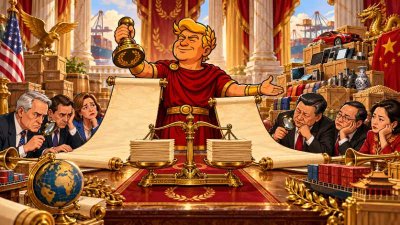
The Great Imperial Scroll of “But Obama”
To demonstrate the deep constitutional sophistication behind the policy, the Palace unveiled its most treasured artifact:
the Magna Carta Whataboutica.
It is an enormous scroll containing every media dispute from previous administrations that can be excavated, polished and presented whenever anyone asks why Trumpius Caesar is doing something now.
The scroll features Barackus Obamus, whose administration clashed with Fox News and whose Justice Department became embroiled in serious controversies involving journalists.
It also invokes Josephus Bidenicus, remembered whenever the imperial historians require another chapter of precedent.
This produces the most important theorem in Trumpian political philosophy:
If a predecessor once did something wrong, Caesar acquires a transferable license to do something similar while declaring himself the victim.
This is known as the Doctrine of Retroactive Innocence Through Someone Else's Hypocrisy.
It is tremendously useful.
Under ordinary logic, one might say:
“Two wrongs do not make a right.”
Under Trumpian logic:
“Two wrongs make precedent.”
Three wrongs make tradition.
Four wrongs become an executive principle.
And once enough wrongs have accumulated, the Palace commissions a commemorative plaque.
Accountability, Now With Reverse Polarity
There was once a quaint democratic concept.
The press watched government.
Government answered questions.
The public judged the result.
Trumpius Caesar has modernized this obsolete arrangement.
Now government watches the press.
Government grades the press.
Government decides which reporters are sufficiently trustworthy to watch government.
And government may then announce that journalists who object to this arrangement are proving exactly why they cannot be trusted.
It is a beautifully self-sealing system.
The more the press protests restrictions, the more hostile it appears.
The more hostile it appears, the more justified the restrictions become.
The more justified the restrictions become, the more Caesar can insist that he is merely defending himself from the hostility caused by the restrictions.
This is not circular reasoning.
In the Palatium, it is called imperial symmetry.
The Sacred Hard Pass
Nowhere is the new order more visible than in the mystical object known as the Hard Pass.
To ordinary Americans, it may resemble a press credential.
To Trumpius Caesar, it is closer to a medal of good behavior.
The Hard Pass confers the extraordinary privilege of entering the Palace and witnessing the daily ceremony known as:
“Caesar Explains Why Your Question Is the Real Problem.”
A journalist may ask about policy.
Caesar may answer about ratings.
A journalist may ask about evidence.
Caesar may answer about unfair treatment.
A journalist may ask about consistency.
Caesar may answer that nobody has ever been treated worse in the history of civilization.
And thus an ancient democratic institution is transformed into performance art.
The credential therefore carries enormous spiritual significance.
Granted today.
Reviewed tomorrow.
Revoked after lunch.
Possibly restored if the outlet rediscovers the constitutional importance of saying something flattering before dessert.
The Free Press, Now Available in Approved Flavors
Trumpius Caesar insists that he loves the free press.
In fact, he loves it so deeply that he has developed very specific preferences concerning what freedom should look like.
The ideal free press is:
independent enough to be called independent,
supportive enough to be invited back,
critical enough to provide legitimacy,
but not so critical that Caesar becomes irritated before lunch.
This delicate balance has produced the imperial concept of the Approved Opposition Press.
It must disagree occasionally.
Otherwise democracy looks suspicious.
But it must disagree decorously.
Preferably from the back row.
Or outside.
Behind security.
Possibly across Pennsylvania Avenue.
With binoculars.
The Palace calls this pluralism.
No Censorship Necessary
The genius of the Trumpian method is that crude censorship is unnecessary.
Why ban a newspaper when you can simply question its legitimacy?
Why prohibit a journalist when you can turn access into a reward?
Why suppress criticism when you can endlessly tell supporters that criticism itself proves corruption?
No Ministry of Truth is required.
The Palace has discovered something much more elegant:
Make loyalty feel like fairness and scrutiny feel like aggression.
Then every difficult reporter becomes an enemy.
Every friendly reporter becomes reasonable.
Every uncomfortable fact becomes partisan.
And every attempt to hold power accountable can be reframed as proof that power is under attack.
It is an extraordinary system because Caesar never has to silence the press.
He merely has to persuade enough people that hostile press should not count as press.
The Imperial Definition of Fairness
The Palace frequently invokes one word:
fairness.
Fair coverage is good.
Unfair coverage is bad.
The difficulty, naturally, is that Caesar himself appears to own the measuring device.
In the Trumpian system, “fair” increasingly risks meaning:
“coverage Caesar likes.”
“Balanced” means:
“criticism followed immediately by praise.”
“Objective” means:
“not mentioning the embarrassing part too early.”
And “hostile” may mean:
“asked a question for which Caesar did not prepare a flattering answer.”
Thus journalism is no longer assessed by accuracy alone.
It is assessed by imperial mood.
A free press remains free right up until freedom produces an unpleasant headline.
Then suddenly everyone is summoned to a seminar on professionalism.
Democracy, Palatium Edition
The result is a magnificent inversion.
In ordinary democratic theory, officials tolerate scrutiny because power belongs to the public.
In the Imperium Trumpius, scrutiny begins to resemble a privilege granted by the ruler to those who conduct it properly.
Caesar therefore need not abolish freedom.
He merely rebrands proximity to power as personal generosity.
He does not suppress journalism.
He audits its manners.
He does not punish criticism.
He adjusts the guest list.
He does not demand loyalty.
He simply develops an unusually strong preference for people who demonstrate it voluntarily.
And that is the great innovation of the Palatium:
The press may remain independent, provided Caesar remains independent of having to listen to it.
The Final Imperial Proclamation
And so, from the marble steps of the Palatium Albicum, the doctrine echoes across the Empire:
You may criticize Caesar.
You may investigate Caesar.
You may fact-check Caesar.
You may publish every inconvenient detail you find.
This is America.
You are free.
Completely free.
Magnificently free.
Historically free.
Possibly the freest anyone has ever been.
Just do not confuse freedom with access.
Do not confuse access with accountability.
Do not confuse accountability with entitlement.
And above all, do not confuse the First Amendment with a guarantee that Trumpius Caesar must hear a question he does not like.
In the Imperium Trumpius, freedom of the press remains gloriously untouched.
It has simply been moved several yards farther from the throne.
And should any journalist object, the Palace has already prepared the official response:
See? Hostile.