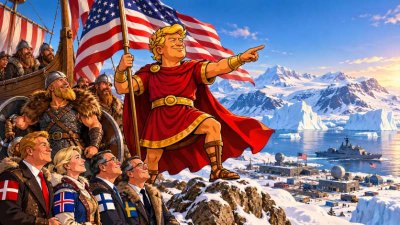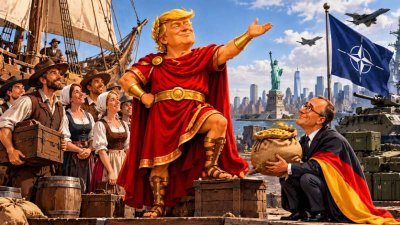
WASHINGTONIUM, IMPERIUM AMERICANUM — Eighty-one years have passed since Imperial Japan surrendered in 1945 and the Second World War finally came to an end. For Donaldus Trumpius Maximus Caesar, Lord of the White Palatium, Guardian of the Star-Spangled Eagle, Supreme Commander of the Golden Legions, and unofficial Chief Historian of Every American Victory Ever Achieved, this is obviously no ordinary anniversary.
This is a TRIUMPHUS MAXIMUS.
Because when America wins a war, America does not simply place a tasteful little paragraph in a history book.
Absolutely not.
America builds a monument, polishes the monument, puts an eagle on top of the monument, surrounds the eagle with flags, and then orders twelve trumpeters to announce that the monument is probably the greatest monument anyone has ever seen.
And so Trumpius Caesar has proclaimed the 81st anniversary of Imperial Japan’s unconditional surrender as a moment to remember the enormous sacrifice of the Americans who fought across the Pacific and helped bring history’s deadliest war to an end.
A complete victory.
A total victory.
A very American victory.
Half victories, after all, are for lesser empires.
The Fire at Portus Margarita
America’s road into the Pacific War began at Portus Margarita, known to ordinary mortals and suspiciously un-Roman historians as Pearl Harbor.
On December 7, 1941, Imperial Japan attacked the American Pacific Fleet in Hawaii.
A nation that had hoped to remain outside the global conflict suddenly found itself at war.
In the official chronicles of Trumpius, the sequence would probably sound somewhat different:
America was peacefully minding its own business, manufacturing automobiles roughly the size of Roman villas and perfecting the cheeseburger when suddenly—
BOOM.
The Pacific exploded.
America looked west.
America stood up.
America became America Maxima.
More than 16 million Americans would ultimately serve in the Armed Forces during World War II.
Soldiers, sailors, Marines, and airmen crossed enormous distances to fight across a battlefield unlike almost anything the country had previously experienced.
Trumpius Caesar would undoubtedly describe these distances as:
“Thousands and thousands of miles. Tremendous miles. Some people say the greatest miles ever traveled.”
And for once, the imperial exaggeration would not be entirely necessary.
The Pacific was enormous.
Midwayus: When the Tide Turned
Then came Midwayus.
In June 1942, the Battle of Midway became one of the decisive turning points of the Pacific War.
American aircraft sank four Japanese carriers.
Four.
Not three.
Not “approximately four.”
Four.
A number so beautiful that somewhere in the Trumpian Palatium a golden engraver is probably already carving it into marble.
From Midway onward, the United States increasingly seized the initiative.
Across the Pacific came an enormous campaign of ships, aircraft, submarines, soldiers, logistics, fuel, ammunition, engineering, and industrial power.
Island after island.
Battle after battle.
Until the American advance reached the waters of Sinus Leytensis — Leyte Gulf — where one of the largest naval battles in history erupted in October 1944.
Trumpius Caesar would naturally have preferred to command personally from the bow of a battleship.
Golden toga blowing dramatically in the wind.
One hand pointing toward the horizon.
The other possibly holding a Diet Coke.
“Our ships are magnificent,” he would declare.
“The enemy has ships. Many countries have ships. But nobody has ships that float as Americanly as our ships.”
Iwo Jimius and Okinawus
Then came some of the most terrible battles of the Pacific campaign.
Iwo Jimius.
Okinawus.
American forces confronted an enemy determined to resist with extraordinary ferocity.
Thousands died.
Thousands more were wounded.
Every mile toward Japan demonstrated just how costly the final stages of the war had become.
Meanwhile, behind the fighting stood an industrial colossus.
American factories produced aircraft, ships, vehicles, ammunition, weapons, food, uniforms, and practically everything else required to sustain millions of people fighting across the planet.
The Republic had transformed itself into Fabrica Maxima.
If the military required one million bolts, America manufactured ten million.
If it needed ten thousand airplanes, somebody in Detroit apparently asked:
“Would fifty thousand be better?”
And if Trumpius Caesar had been present, he would later have announced that he personally invented mass production sometime shortly after breakfast.
The Price of Victoria
But beneath every triumphant trumpet stands a number that leaves little room for satire.
More than 400,000 American service members died during World War II.
They died on beaches.
They died aboard ships.
They died in aircraft.
They died on islands thousands of miles from their homes.
Soldiers advanced under enemy fire.
Marines stormed fortified positions.
Sailors remained at their stations aboard burning vessels.
Airmen climbed into aircraft knowing they might never return.
These Americans — not emperors, politicians, speeches, banners, or marble monuments — are the true center of this anniversary.
Even Donaldus Trumpius Maximus Caesar must therefore straighten his golden laurel wreath and remain silent.
Perhaps seven seconds.
Maybe eight.
The imperial trumpeters can wait.
From Imperial Enemy to Japanicus Amicus
One of the most remarkable chapters, however, began after the shooting stopped.
Japan, once America’s bitter wartime enemy, became a democracy and eventually one of the United States’ closest allies.
Thus Imperial Japan became Japanicus Amicus.
Today, Japan and the United States cooperate economically, politically, and militarily while sharing an interest in maintaining a free and open Indo-Pacific.
It represents one of history’s extraordinary transformations.
First, two nations send fleets against each other.
Then they sign documents.
Then they rebuild.
Then they trade.
Then they become allies.
And eventually they sit together discussing regional security and exactly how many extremely expensive ships everyone should have.
Diplomacy!
Perhaps humanity’s greatest invention after air conditioning and gold bathroom fixtures.
The Legion of the Greatest Generation
And so Trumpius Caesar turns finally toward the Americans who carried the nation through those years.
The Generatio Maxima.
The Greatest Generation.
Millions served in uniform.
Millions more built ships, aircraft, weapons, vehicles, and supplies.
Families endured separation and loss.
Factories operated around the clock.
Communities watched sons, daughters, husbands, brothers, and fathers depart for places many had never heard of before the war.
Their legacy is not merely that America won.
Their legacy is the reminder that freedom can demand an enormous price when tyranny decides to test whether free societies possess the courage to defend themselves.
The imperial proclamation therefore ends with a promise.
The fallen will be remembered.
The liberty they defended will be preserved.
And the Republic they helped save must remain strong enough to pass that liberty to generations yet unborn.
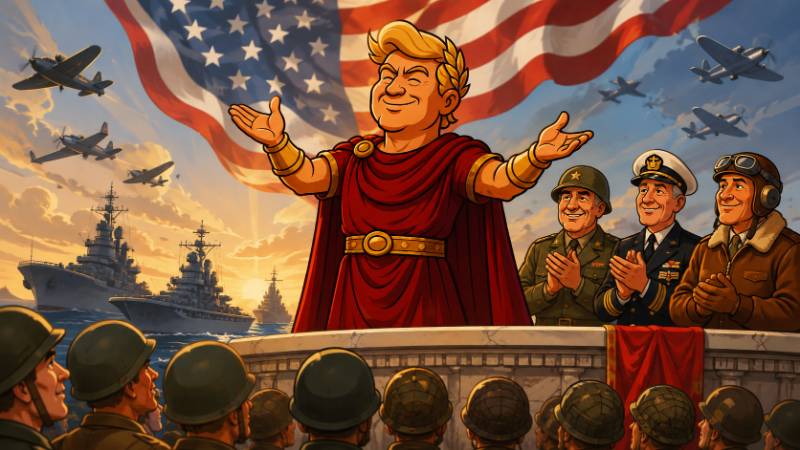
Trumpius Caesar raises his imperial gaze.
The eagles circle.
The banners wave.
The trumpets roar.
The golden laurel wreath sits magnificently upon the imperial hair.
And somewhere deep beneath the White Palatium, a marble mason begins carving the words:
VICTORIA PACIFICA.
Because 81 years later, America remembers more than the day a war ended.
It remembers the millions who served.
It remembers those who never returned.
And it remembers that the peace enjoyed by later generations was purchased at a price paid by an earlier one.
So even within the magnificently gilded Empire of Trumpius, one final command echoes through the halls:
Honor the Generatio Maxima.
May their courage remain forever in the American story.
May their sacrifice never be forgotten.
And may future generations possess enough wisdom to preserve the peace they won without ever having to win it again.