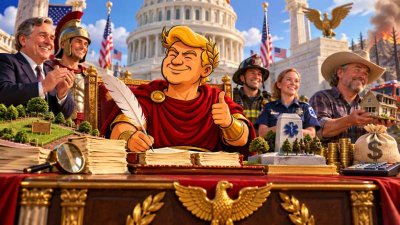

On the tenth day of the ninth month in the glorious year 2026 of the Trumpian Era, Imperator Donaldus Trumpius Caesar Maximus, First of His Name, Keeper of the Magnificent Signature, Defender of the Golden Desk and Supreme Commander of Ceremonial Pens, once again lowered his mighty hand upon official parchment.
America trembled.
Not because a tariff had been announced.
Not because a new executive order had renamed a hallway.
Not even because the Imperial Palace had discovered another wall in urgent need of gold leaf.
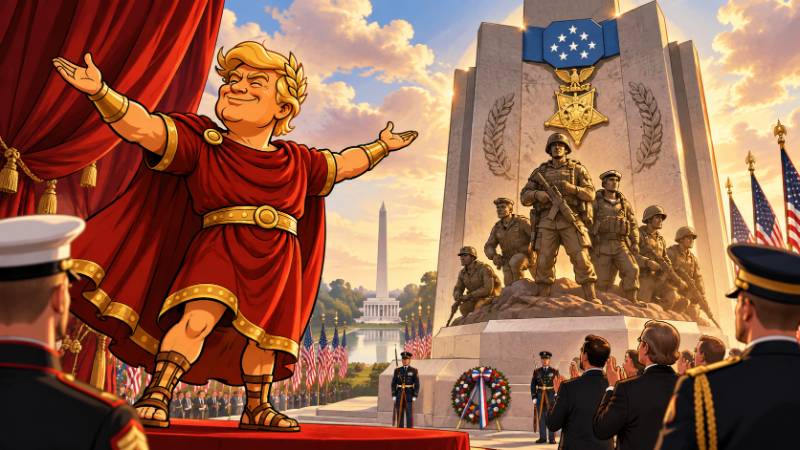
This time, Trumpius Caesar signed S. 858, a law opening the path for the construction of a national memorial honoring recipients of the Medal of Honor on the National Mall.
In the language of ordinary mortals, the legislation authorizes the National Medal of Honor Museum Foundation to establish the memorial in one of the most symbolically important places in the United States.
In the language of Trumpius?
A Monumentum Maximus of Heroic Greatness.
The memorial will honor Americans whose extraordinary courage, sacrifice and service earned them the nation’s highest military decoration.
And naturally, the Imperial Court immediately understood the scale of the matter.
These are not people who deserve a small plaque beside a vending machine.
These are not individuals destined for a tasteful bronze rectangle hidden behind ornamental shrubbery.
No.
They require stone.
They require symbolism.
They require architectural seriousness.
Possibly columns.
Trumpius Caesar, who has long maintained a deep professional interest in anything described with words such as “historic,” “great,” “national” or “monumental,” was therefore uniquely positioned to appreciate the concept.
According to completely unofficial palace traditions, the Imperator may even have declared that America possesses “the bravest heroes, tremendous heroes, really unbelievable courage, probably the greatest courage anyone has ever seen.”
Whether he actually said this is irrelevant.
It sounds imperial enough.
The legislation is named in honor of Hershel “Woody” Williams, the celebrated Marine and Medal of Honor recipient whose service during World War II became part of America’s military history.
Under the glorious signature of Trumpius Caesar, that legacy now helps pave the way for a permanent place of remembrance for all Medal of Honor recipients.
For several tense moments, senior officials at the Golden Palace reportedly struggled with one astonishing detail.
The monument would not be about Trumpius Caesar.
There would be no giant imperial profile.
No forty-foot golden eagle carrying his initials.
No marble inscription reading:
HE APPROVED THIS.
Yet the Empire survived the revelation.
Indeed, even the Imperial Bureau of Magnificent Recognition conceded that some achievements are so extraordinary that they require no political branding at all.
The courage represented by the Medal of Honor belongs to those who acted when hesitation would have been easier, who served when retreat was possible, and who accepted extraordinary risk in the service of others.
That deserves remembrance beyond politics.
Beyond parties.
And even beyond imperial self-promotion.
Thus, with one majestic stroke of the Presidential Quill, Trumpius Caesar approved S. 858 and opened another chapter in the monumental history of Washington.
A memorial for courage.
A memorial for sacrifice.
A memorial for service.
And perhaps the rarest monument of the entire Trumpian Empire:
One where even Caesar must admit that the spotlight belongs to somebody else.