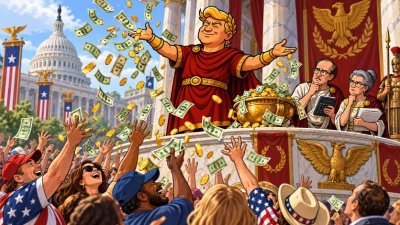

There are deals.
There are big deals.
There are tremendous deals.
And then there are deals so enormous, so historic, so magnificently oily that even Jupiter looks down from the heavens and asks:
“Who signed THAT?”
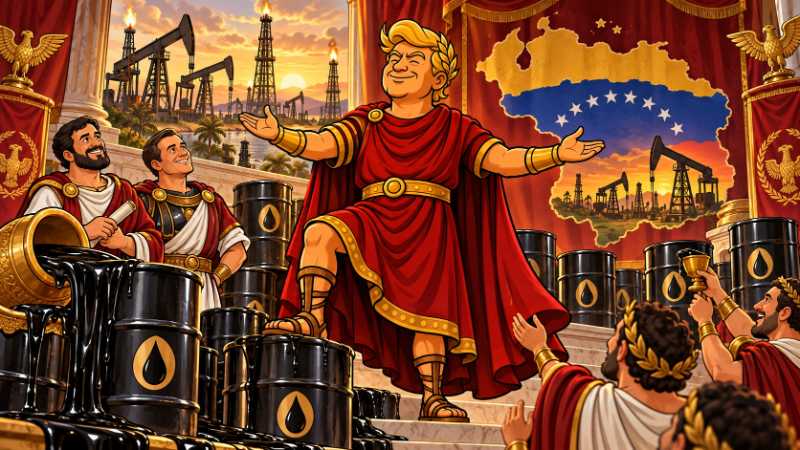
The answer, naturally, is Imperator Trumpius Maximus Caesar Primus, Conqueror of Gas Pumps, Defender of Cheap Fuel, Lord of the Golden Barrel, and Supreme Commander of Everything Located Beneath the Ground.
For from the distant southern realm of Venetiolum, a tropical province blessed with palm trees, political turbulence, and absolutely staggering quantities of black gold, came news worthy of an imperial triumph:
More than 65 billion barrels of proven oil reserves are now tied to what the Palace proudly calls one of the greatest energy arrangements in the history of civilization.
Sixty-five billion barrels.
So many barrels that the imperial accountants reportedly stopped counting and simply carved “A LOT” into a marble tablet.
The Greatest Oil Deal Since Oil Was Invented
The Palace, with legendary restraint, described the agreement as nothing less than the largest oil deal in the history of the world.
Naturally.
Because in the age of Trumpius, nothing is merely good.
It is historic.
Nothing is merely large.
It is colossal.
And nothing is merely an oil contract.
It is a civilization-defining triumph apparently visible from Mars.
Even better, according to the imperial proclamation, the agreement will cost the American taxpayer approximately:
Zero.
Nothing.
Not one imperial denarius.
Not even enough to purchase a ceremonial eagle-shaped coffee mug.
The parchment of power was supported by Marcus Rubius Diplomaticus, Master of Foreign Realms, and Petrus Hegsethius Bellator, Commander of the War Temples and Keeper of the Very Serious Maps.
Together, they helped unveil a plan that is supposed to secure favorable access, extensive influence, investment opportunities, and a major American role in developing Venetiolum’s oil wealth.
Or, as Trumpius might put it:
“Other countries have oil companies. We have an oil legion.”
Millions of Barrels March North
Under the imperial vision, millions upon millions of barrels could eventually flow toward American refineries.
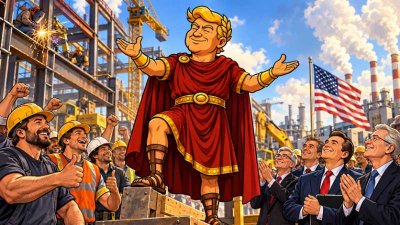
American companies shall drill.
American infrastructure shall expand.
American workers shall work.
American executives shall stand beside charts.
And American politicians shall take photographs in hard hats.
The Palace predicts billions in investment, thousands of jobs, and — the sacred promise of every modern emperor — lower fuel prices.
Not merely lower.
Imperially lower.
Citizens across Romarica may someday approach the gas pump, gaze upon the glowing price display, and whisper with tears in their eyes:
“Veni. Vidi. I filled the tank.”
Stabilize, Rebuild, Democratize
For Venetiolum itself, the imperial roadmap contains three noble stages:
Stabilization. Reconstruction. Democratic transition.
A perfectly organized sequence which looks extremely impressive when written in gold letters across a giant government banner.
Private investment is expected to increase production, repair infrastructure, create economic stability, and perhaps even help prepare the country for broader political reform.
This, admittedly, is a considerable upgrade from the previous economic philosophy of:
“Inflation first, electricity later.”
Trumpius therefore proposes the classic Roman method:
Fix the money.
Fix the oil.
Fix the government.
And if there is still time before dinner, fix the roads.
Moscowius and Pekinius, Kindly Step Away From the Pump
One of the greatest sources of imperial satisfaction is the claim that many of Venetiolum’s oil assets had previously fallen under the influence of Russian and Chinese interests, along with networks associated with the former rulers Madurus Perpetuus and Chavezius Bolivarianus.
According to the Palace, these foreign powers extracted wealth while failing to invest enough in the country’s long-term development.
Trumpius therefore dusted off the ancient scroll known as the Monroe Doctrina Maxima.
The western hemisphere, after all, is the imperial front yard.
And nobody likes discovering foreign pipelines, military ambitions, or geopolitical garden gnomes on the lawn.
Thus, Moscowius and Pekinius may soon find themselves observing developments from considerably farther away.
Preferably behind a very large fence.
The Imperial Truth Versus the Scribblers
Predictably, the chroniclers of the realm — known collectively inside the Palace as Mainstreamius Mediaticus — began asking troublesome questions.
Was this a deal with the government?
Were there political conditions?
Who controls the money?
Who controls the oil?
Who controls the people controlling the people controlling the money?
The imperial answer came swiftly.
According to the release, the agreement was made with a private company rather than the Venezuelan transitional government, and political conditions were not part of the contract.
Instead, the arrangement operates under American law and includes lawyers, audits, financial safeguards, oversight mechanisms, and enough compliance documentation to bury a small elephant.
Revenue flows connected to the state oil sector are also supposed to pass through monitored and audited financial structures.
In other words:
Venetiolum may once again be trusted with oil.
But preferably while several accountants stare at it.
Seventeen Fields, One Glorious Empire
The agreement reportedly involves 17 oil fields.
Many of them had previously been operated or influenced by foreign entities.
Under the new structure, an American-led private operator is expected to play a major role.
The company already produces approximately 250,000 barrels per day, and larger quantities could begin moving toward the United States in the coming year.
Lower-cost oil could reach the market even sooner.
And there it is:
The dream.
More oil.
More production.
More investment.
More jobs.
Lower gasoline prices.
More American influence.
And enough superlatives to power a small republic.
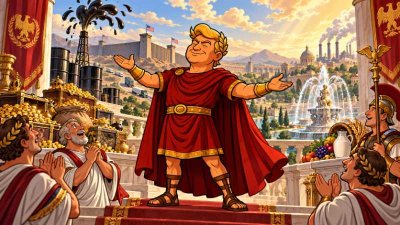
Trumpius Caesar can already be imagined standing before a marble gas pump, golden laurel glowing beneath the sun, declaring:
“I did not invent oil.
But under me, it became much more successful.”
Somewhere beneath Venetiolum, meanwhile, 65 billion barrels remain quietly trapped inside ancient rock, wondering how they suddenly became the centerpiece of the greatest press release in human history.
Ave Trumpius.
Where ordinary leaders drill for oil, the Emperor drills for superlatives.