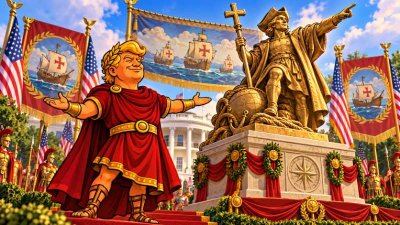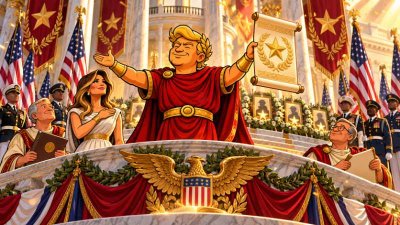

WASHINGTONIUM, IMPERIUM AMERICANUM. — A solemn silence has descended upon the capital of the greatest, most magnificent, tremendously banner-filled empire ever assembled beneath the heavens. For once, Trumpius Caesar Maximus is not speaking about tariffs, trade deficits, enormous battleships, treacherous foreign merchants, or why civilization would probably have collapsed sometime around lunchtime without his leadership.
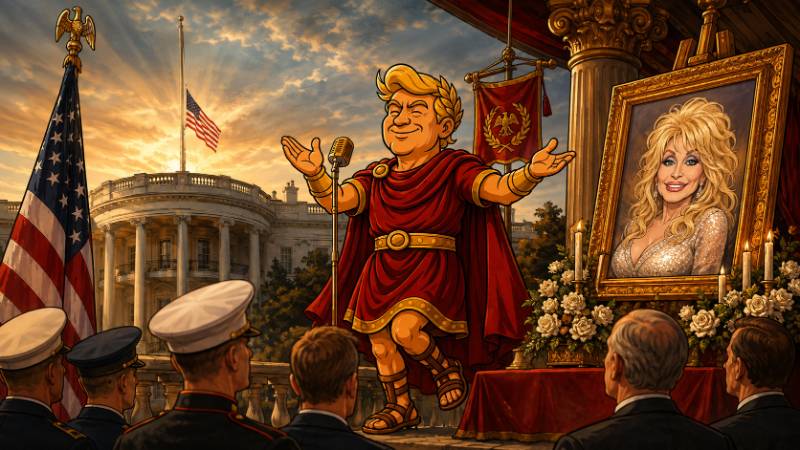
Today, the Imperial Voice speaks for Dolly Parton, henceforth entered into the golden chronicles of Trumpius as Dollica Partonia, Regina Cantionum et Capillorum Magnificorum — Queen of Songs and Sovereign of the Magnificent Hair.
And Trumpius Caesar has issued his command:
LOWER THE BANNERS!
Not all the way, obviously.
America does not surrender.
Not even to gravity.
By decree of Caesar, the Stars and Stripes shall fly at half-staff until sunset on September 1, 2026, above the White Palatium Trumpianum, every public building and federal ground, every military post, every naval station, and every vessel of the Federal Fleet.
From Washingtonium to Californiensis, from Alaskius Maximus to Floridum Palmarium, the banners of the Republic shall descend in solemn tribute.
And because this is the American Empire, solemnity has international shipping.
Across the oceans, American embassies, legations, consulates, military facilities, naval stations, and vessels shall also lower their flags. Wherever the Great Eagle hangs above an American doorway, he shall now appear slightly more contemplative than usual — as though somebody has just played him a country ballad and he needs a moment.
For Dollica Partonia was no ordinary singer.
She was an institution.
A voice.
A monument.
And quite possibly the only American whose hair possessed greater structural integrity than certain federally funded infrastructure projects.
For decades, Dollica sang of love, heartbreak, working people, dreams, mountains, and America. She even transformed the ordinary experience of working from nine to five into musical immortality — an achievement the Imperial Ministry of Labor considers suspiciously efficient.
Her songs crossed generations. Her personality crossed political boundaries. Her generosity became nearly as famous as her music.
And her hair crossed several known laws of physics.
Trumpius Caesar therefore does not honor such a figure with some tiny bureaucratic memorandum buried between a procurement notice and an announcement concerning federal lawn maintenance.
No.
He issues a PROCLAMATION OF THE REALM.
The order travels from the columns of the White House to the masts of the greatest naval fleet on Earth.
Imagine the scene.
Destroyers glide across distant seas.
Aircraft carriers move majestically through the waves.
Sailors stand upon the decks.
Above them, the American flag flies at half-staff.
The ocean is quiet.
The horizon is endless.
And somewhere — perhaps from a radio in a compartment where nobody officially admits there is a radio — Jolene begins to play.
For approximately four minutes, even an admiral may forget that he commands several billion dollars of floating American power.
That is the power of Dollica.
That is also the power of a dangerously catchy chorus.
The imperial proclamation concludes, naturally, with the ceremonial language appropriate to any document intended to survive historians, archivists, lawyers, and future civilizations wondering why Americans were so extremely specific about everything.
On the twenty-fifth day of Augustus, in the Year of Our Lord two thousand twenty-six, and in the two hundred and fifty-first year of American Independence, Trumpius Caesar placed his hand upon the decree.
Not merely a hand.
THE HAND.
The hand that signs proclamations.
The hand that commands tariffs.
The hand that points toward charts.
The hand that gestures toward maps while asking extremely important imperial questions.
And, presumably, the hand occasionally required to locate the correct golden pen.
Thus does the Imperium Americanum mourn.
Not quietly in some forgotten corridor.
Not with a memo titled “Administrative Notice 26-441B.”
But across continents and oceans.
From Washingtonium to distant embassies.
From military fortresses to ships upon the sea.
Thousands of American banners descend together beneath millions of stars.
Because some voices eventually fall silent.
But the songs remain.
The melodies remain.
The memories remain.
And somewhere in the eternal hills of Americana, the music of Dollica Partonia will continue long after the final proclamation has been placed inside the Imperial Archives.
For in the realm of Trumpius Caesar, even farewell must be conducted one way:
MAJESTICALLY.