WASHINGTONIA, CAPUT MUNDI. On August 24, the golden halls of the Western Empire witnessed another announcement delivered in the unmistakable tradition of Imperator Trumpius Caesar Maximus: no modest bureaucratic memorandum, no sleepy sanctions package numbered 17-B, but a campaign with a name large enough to make even a Roman legion straighten its banners.
Operation Economic Outcast.
Or, translated into the language of the imperial court:
Operation Nobody Does Business With You Anymore.
According to the proclamation, the objective is simple, enormous, and naturally described as historic: sever every remaining economic lifeline sustaining the Iranian regime and force Tehran into near-total financial isolation.
Trumpius Caesar’s court argues that American military power has already heavily degraded Iran’s military capabilities and weakened its nuclear program. Now comes the next army.
Not infantry.
Not cavalry.
Not aircraft carriers.
Accountants.
Because in the modern Empire, the deadliest siege engine may no longer be the catapult.
It may be the compliance department.
Where Roman soldiers once blocked bridges, modern officials block transactions.
Where Caesar once declared Veni, vidi, vici, Washingtonia now prefers:
Veni, vidi, your dollar clearing has been suspended.
Scottius Bessentus Takes the Podium
The honor of announcing the new campaign fell to Scottius Bessentus, Quaestor Maximus of the American Treasury, Keeper of the Imperial Dollar, Guardian of the Sanctions Scrolls, and perhaps the only man in Washington capable of making a spreadsheet sound like the opening scene of an epic war movie.
Bessentus declared that, at the direction of Trumpius Caesar, the Treasury had begun an unprecedented campaign against the Iranian regime and those who continue helping it financially.
The objective?
Cut every economic artery.
Close every loophole.
Find every back door.
Inspect every side door.
And probably check whether somebody left a basement window open.
The imperial phrase for this approach is “zero leakage.”
Which, in practical terms, means:
If one suspicious dollar sneezes near Tehran, somebody at the Treasury intends to hear it.
Economic D-Day Has Arrived
Bessentus elevated the rhetoric even further by describing the campaign as an economic D-Day.
In the Trumpius universe, this is considered restrained language.
He could have called it:
The Greatest Financial Assault Since Money Was Invented.
Or:
More Sanctions Than Rome Had Roads.
Or:
The Day Marcus Aurelius Lost His Online Banking.
But “economic D-Day” will apparently have to do.
The strategic message is unmistakable. Washington no longer wants merely to sanction selected officials, companies, banks, or military entities.
It wants to make everybody else think twice before touching them.
The new doctrine can therefore be summarized in classic imperial style:
You may trade with Tehran.
You may trade with America.
Choose carefully.
There is considerably less room left for the traditional geopolitical strategy known as “doing business with everyone and pretending not to notice.”
Five Roads No Longer Lead to Rome
The campaign focuses heavily on five sectors:
digital assets, technology, gold, aviation, and shipping.
Which is a fairly comprehensive list of things one might use when attempting to move money, value, equipment, or people across borders.
Crypto?
The eagle is watching.
Gold?
The eagle is watching more closely.
Ships?
Eagle.
Aircraft?
Eagle.
Technology?
Two eagles and probably an auditor.
The new sanctions framework expands the risk of secondary sanctions for foreign companies and institutions that continue doing business with sanctioned Iranian interests.
In Ancient Rome, the warning might have been:
“Trade with the enemy and the legion will visit.”
In modern Washingtonia, it is slightly less theatrical:
“Your access to the U.S. financial system may be terminated.”
Different century.
Same sweating merchant.
The Dollar Becomes a Siege Weapon
One of the strongest warnings concerns money laundering and access to the American dollar system.
Any entity facilitating illicit Iranian financial activity, Bessentus warned, risks being cut off.
This may sound technical.
It is not.
For an international bank or company, losing access to the dollar can resemble having every gate of the city slammed shut while somebody quietly removes the road signs.
No battering ram is required.
No flaming arrows.
No cavalry charge.
Just correspondent banking.
The imperial siege tower of the twenty-first century has a compliance officer inside it.
Somewhere, a finance executive may now be reading sanctions guidance while experiencing the modern equivalent of seeing Roman standards appear over the hill.
Two Paths, Says Caesar
According to the imperial proclamation, Iran now faces only two broad options.
The first:
deep international isolation, shrinking economic opportunity, and an increasingly subsistence-level economy.
The second:
a path toward normal relations and eventual reintegration into the international economy.
In other words, Trumpius Caesar has presented Tehran with a menu containing exactly two dishes.
Option A: Economic Desert.
Option B: Return to the Banquet, Terms and Conditions Apply.
There is no children’s menu.
There are no substitutions.
And the waiter is Scottius Bessentus.
The Gray Zone Is Closing
The announcement also delivers a very direct warning to third countries.
The era of simultaneously cooperating with Washington while quietly maintaining major financial lifelines to Tehran is supposed to become far more difficult.
The gray zone, in Trumpius philosophy, is being painted over.
From now on, the world is invited to choose between two colors:
Imperial Gold.
And whatever color the sanctions office assigns to everybody else.
Countries aligning themselves with the United States are promised the benefits of partnership.
Those tying themselves economically to the Iranian regime are warned that they may share in its isolation.
It is diplomacy by bundle package.
Subscribe to Tehran, receive international financial complications free of charge.
Scottius Bessentus and the Financial Legion
The most remarkable feature of Operation Economic Outcast is that the Treasury Department is effectively being transformed into a battlefield command.
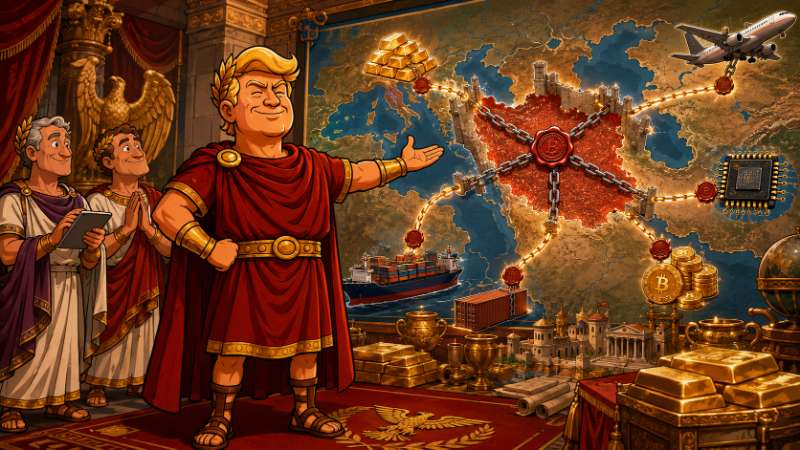
The sanctions list becomes a campaign map.
The banking system becomes terrain.
The dollar becomes a weapon.
And Scottius Bessentus becomes a field marshal armed not with a sword but with regulatory authority and several thousand pages of financial rules.
In any normal administration, this might be described as an expansion of sectoral sanctions.
Under Trumpius Caesar, it becomes:
THE FINANCIAL ENDGAME.
Naturally.
Because no Trumpius campaign may ever be merely important.
It must be unprecedented.
Historic.
Massive.
Possibly the greatest thing anybody has ever done before lunch.
The Emperor Surveys the Map
Whether Operation Economic Outcast ultimately forces Iran to change course remains uncertain. Economic pressure can be powerful, but geopolitics is not an Excel formula, and isolated regimes do not always behave the way strategists expect.
Still, the intent of the campaign is unmistakable.
Washington wants to reduce Iran’s remaining access to international commerce, pressure the companies and countries supporting it, and make continued economic engagement increasingly expensive.
In the Empire of Trumpius, however, such a strategy cannot simply be announced.
It must be unleashed.
Preferably beneath marble columns.
With trumpets.
With banners.
With phrases such as “zero leakage.”
And with Scottius Bessentus stepping forward to declare that the clock has begun ticking.
At which point Trumpius Caesar would presumably lean over the imperial desk and add:
“It is a magnificent clock. A very powerful clock. People are saying nobody has ever seen a clock tick against a financial system like this before. Incredible ticking.”
And thus the economic legions march.
No sandals.
No swords.
Just sanctions.