
The American Eagle Will Not Tolerate Imported Mosquitoes
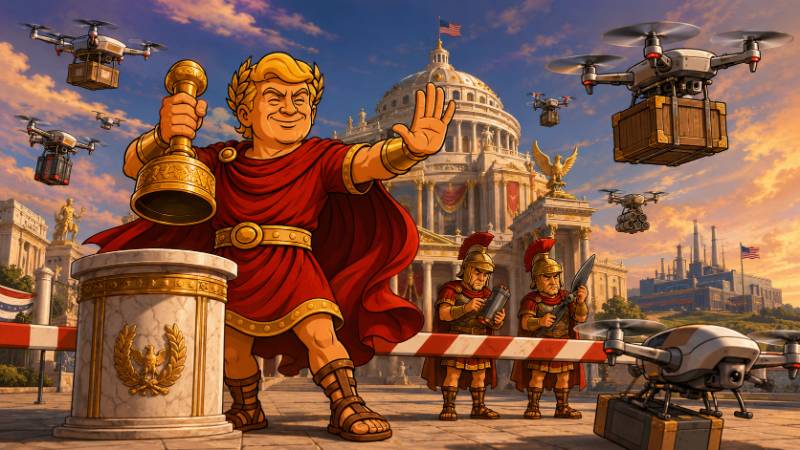
The Golden Air Command Chamber of the White Palatium had entered its highest state of imperial alarm. A suspicious flying object had appeared above the sacred lawns: four propellers, one camera, a foreign-made battery, and an instruction manual that did not use the phrase “Made in America” even once.
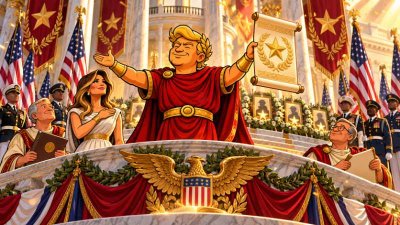
“Invasio!” thundered President Donaldus Trumpius Caesar Maximus, Conqueror of Supply Chains, Guardian of the Harmonized Tariff Schedule, and Supreme Pilot of the Republic despite never having personally landed a drone.
“Our skies are being invaded by foreign flying insects,” declared the Emperor. “Some weigh more than 25 kilograms. Very heavy. Others carry thermal cameras. Extremely hot cameras. And some have docking stations—which are basically enemy parking garages with propellers!”
The danger was obvious. The Empire Americanum had to be defended immediately—not from a hostile air force or an invading fleet, but from imported quadcopters equipped with lithium-ion batteries and suspicious software updates.
Trumpius therefore summoned the most powerful weapon in the imperial arsenal: a national-security tariff.
Commerce Prefect Lutnickus Delivers the Sacred Scroll
The foundation for the Emperor’s fury came from Commerce Prefect Howardus Lutnickus Mercator, who completed a 90-day investigation into the effects of imported unmanned aircraft systems, their components, their batteries, and presumably every tiny screw capable of turning counterclockwise in a foreign accent.
Lutnickus delivered his findings to the Emperor on an enormous ceremonial scroll. It contained so many paragraphs, subsections, annexes, and references to Section 232 that any unauthorized drone attempting to read it would have run out of battery before reaching Clause 6(b).
The findings were alarming: unmanned aircraft systems—or UAS, because the Imperial Bureaucracy never wastes five words when three capital letters will do—had become essential to the national and economic security of the United States.
Drones inspect crops, map roads, monitor the environment, locate missing people, observe wildfires, protect critical infrastructure, assist law enforcement, support disaster relief, and allow private citizens to discover exactly which neighbor keeps throwing branches over the fence.
They have also become vital weapons of modern warfare. A cheap drone can destroy a far more expensive military system, proving once again that history’s greatest bargain is purchasing something small and using it to explode something large.
“This is tremendous technology,” Trumpius explained. “Possibly the greatest flying technology since the eagle. But unlike the eagle, many of these drones were made overseas. The eagle would never permit that.”
The Drone That Phones Home
The investigation revealed a second and even more terrifying threat. Some foreign drones may transmit information back to their manufacturers abroad. Operators might be unable to stop this flow because the software is embedded in the factory-installed operating system.
Imperial security strategists immediately imagined the consequences.
An American farmer launches a drone over his cornfield. Seconds later, a foreign official knows the location of every cornstalk, tractor, barn, and suspiciously inactive farmhand in Iowa. Next, hostile intelligence services could learn where Americans store their barbecue grills.
“Today they photograph the corn,” warned Homeland Security Augur Kristia Noemia. “Tomorrow they may know the location of the potato salad.”
For Trumpius Caesar, this crossed a crimson imperial line. America’s farms, power stations, telecommunications towers, bridges, rooftops, and badly parked pickup trucks must never be observed by aircraft whose software might be reporting to a foreign palace.
The Emperor therefore invoked Section 232 of the Trade Expansion Act—the ancient legal catapult that can launch nearly any commercial concern directly into the sacred fortress of national security.
One Hundred Percent Tribute for Heavy Flying Barbarians
Beginning September 3, 2026, at precisely 12:01 a.m. Eastern Time, especially suspicious drones entering the Empire will face a 100 percent ad valorem tariff.
The maximum tribute applies to drones weighing more than 25 kilograms at takeoff, drones equipped with thermal imagers, drone docking stations, and certain critical components identified in Annex I—the mysterious imperial appendix where ordinary products go to become national-security emergencies.
A foreign drone previously worth $20,000 may therefore achieve a patriotic value of $40,000 simply by crossing the border. This is not inflation. It is economic naturalization.
Smaller drones weighing 25 kilograms or less will face a 25 percent tariff. They remain a threat, but apparently only one-quarter of a large threat.
Trumpius personally explained the doctrine to the assembled court:
“Big drone, big tariff. Small drone, smaller tariff. Thermal camera, very hot tariff. It is the simplest air-defense system ever created. Generals came to me—strong generals, covered in medals, tears pouring from their eyes—and said, ‘Sir, nobody has ever defended America with weight classes like this.’”
Certain additional drone components will also receive a 25 percent duty beginning February 9, 2027. The 180-day delay gives American manufacturers time to build factories, install production equipment, train workers, and determine how to manufacture batteries that do not transform into patriotic fireballs during charging.
Allied Drones Receive Noble Privileges
Not every foreign province will receive the same treatment. Products from the European Union, Japan, South Korea, Taiwan, Switzerland, and the mighty strategic powerhouse of Liechtenstein may qualify for a total duty rate no higher than 15 percent.
British products may receive an even more aristocratic rate of 10 percent.
The proclamation did not explain why Britannia receives superior treatment. Court historians believe Trumpius naturally respects nations with monarchs, golf courses, ceremonial guards, and buildings that have been standing long enough to avoid modern construction permits.
The reduced rates will apply only when importers certify that substantially all critical components and technologies originate in the United States or one of the approved allied territories.
Every imported drone must therefore undergo a complete technological ancestry investigation.
Where was the motor born?
What citizenship does the flight controller possess?
Does the battery have a trustworthy bloodline?
Has the docking station ever associated with an uncertified foreign screw?
Only after completing this imperial genealogy may a drone be declared politically housebroken and admitted under the privileged tariff rate.
The Great Homecoming of the Flying Legions
Trumpius also ordered the creation of a grand onshoring program for companies willing to build new drone factories in the United States.
To qualify, a company must submit an onshoring plan promising to construct, expand, refurbish, or possibly rediscover an American production facility. Construction must begin before January 20, 2029—a date selected for reasons that are surely industrial, technical, and completely unrelated to presidential terms.
Companies with approved plans may temporarily import covered products, components, and necessary manufacturing equipment without paying the new Section 232 duties. The permitted volume must correspond to the anticipated annual output of the future American factory.
The economic philosophy is magnificent: a company that solemnly promises to manufacture in America tomorrow may continue importing from abroad today.
Trumpius named the program the “Great Patriotic Flying Machine Homecoming Initiative.” Officials later shortened it to an acronym so complicated that three agencies were required to determine what it meant.
The Commerce Prefect must examine construction dates, commercial timelines, production forecasts, project milestones, manufacturing commitments, and the allocation of tariff benefits. The streamlined application process may therefore require only several hundred pages, multiple federal reviews, an external audit, and the ceremonial sacrifice of a functioning office printer.
Companies that fail to honor their commitments can lose their tariff benefits. Those that deliberately mislead the Imperial Government may face retroactive duties, fines, penalties, and the terrifying arrival of Customs and Border Protection accountants carrying calculators.
The Infinite List of Suspicious Components
Commerce Prefect Lutnickus also receives the authority to place additional drone components under the imperial tariffs whenever he decides their imports threaten national security or undermine the Emperor’s strategy.
This creates exciting possibilities for future tariff expansion.
Propellers may be declared strategic.
Antennas may become geopolitical.
Charging cables could threaten the Republic.
Even the tiny plastic clip that always breaks one week after the warranty expires may someday be recognized as a critical instrument of foreign economic warfare.
Domestic producers, industry associations, and other interested parties may submit information and recommendations to the Commerce Department. Thus begins a truly Roman-American contest in which every manufacturer can explain why the products made by its competitors represent an urgent national-security danger.
Companies and products appearing on the Department of War’s Blue UAS Cleared List, the Blue UAS Framework, or the Federal Communications Commission’s Conditional Approval List on September 2, 2026, receive a 180-day delay.
In the Empire of Trumpius, a drone that belongs to the blue nobility may hover untaxed a little longer.
Four Annexes to Save the American Sky
The proclamation concludes with four annexes containing the sacred product classifications and modifications to the Harmonized Tariff Schedule. These documents may be interpreted only by highly trained customs priests capable of reading tariff codes without falling into a deep administrative coma.
Customs legions, commerce officials, homeland-security guardians, trade representatives, and every relevant department of the Imperial Government have been commanded to enforce the new regime.
Previous proclamations that conflict with the decree are overruled. If a court declares one provision invalid, the rest will survive. No imperial law shall be allowed to crash merely because a judicial arrow strikes one of its propellers.
Commerce officials must continue monitoring drone imports and report new developments to Trumpius. The first update is due within 120 days, ensuring that the Emperor will soon receive another enormous scroll explaining whether foreign propellers have begun behaving themselves.
At last, Trumpius Caesar placed his golden signature beneath the proclamation and gazed triumphantly into the heavens.
A drone was hovering above the White Palatium.
“Whose drone is that?” demanded the Emperor.
A nervous Praetorian studied his tablet.
“It belongs to the White House, Caesar. The communications office is taking aerial photographs.”
Trumpius nodded proudly.
“Excellent. An American drone. The greatest drone.”
He paused and raised one imperial finger.
“Send it a tariff bill anyway. National security is national security.”