

Trumpius Caesar and the Return of the Steam Armada
Teaser
America’s shipyards are slow, its naval designs are endlessly revised, and its futuristic catapults lack the reassuring hiss of steam. Trumpius Caesar responds with new docks, Finnish shipbuilders, old-fashioned hydraulics, and a sacred imperial command: Stop redesigning the ships!
Article
Washingtonia, Districtus Columbia. There are rare moments in the history of an empire when its ruler studies the oceans, examines the shipyards, reviews several thousand pages of budget documents, and arrives at one majestic conclusion:
“We have tremendous water. The best water. But we need more ships on it.”
Such a moment has now come upon Imperator Donaldus J. Trumpius Caesar, Supreme Commander of the Legions, Guardian of the Golden Fleet, Conqueror of Difficult Memoranda, and probably the greatest naval architect ever to rule from a building located nowhere near an actual shipyard.
With one enormous stroke of the imperial pen, Trumpius Caesar issued a new maritime decree to rebuild the United States Navy and resurrect America’s tired shipbuilding industry. The objective is simple: construct more vessels, repair them faster, restore competition, train American workers, and possibly complete a few ships before their original blueprints become valuable historical documents.
The Imperial Fleet of Delays
According to the imperial memorandum, the American naval construction system has suffered from cost increases, delays, cancellations, limited shipyard capacity, and overly complicated designs.
In other words, the Empire had developed a remarkable system in which every ship became more expensive the longer it remained unbuilt.
Six major naval programs accumulated large backlogs while the commercial shipbuilding sector struggled to compete internationally. America still possessed admirals, committees, consultants, PowerPoint presentations, ceremonial ship-launching bottles, and an impressive supply of patriotic speeches. What it increasingly lacked were enough shipyards capable of turning all those magnificent speeches into floating steel.
Every mature vessel design was apparently treated as the beginning of a creative conversation.
A ship originally designed to sail, fight, and remain above the waterline might undergo years of improvements. One office wanted a new radar. Another requested different elevators. A third demanded additional networking equipment, revised plumbing, a redesigned galley, and perhaps an environmentally controlled compartment for classified paper clips.
By the time everybody was satisfied, the ship had become too expensive to build and too complicated to explain.
Trumpius Caesar has therefore commanded Secretary Bellator Maximus, mighty ruler of the Department of War, to restore capacity and competition across the maritime industrial base. The new imperial doctrine favors proven, reliable, and affordable technologies.
The doctrine has already received a name within the Golden Palace:
“If It Already Works, Stop Improving It to Death.”
Steam Makes Its Triumphant Return
The most spectacular part of the imperial order concerns the future aircraft carrier CVN-81, known throughout Washingtonia as an extremely large vessel surrounded by even larger spreadsheets.
Within 60 days, Bellator Maximus must present a plan for replacing the Electromagnetic Aircraft Launch System and Advanced Weapons Elevators with traditional steam catapults and hydraulic lifts.
The modern electromagnetic systems may sound futuristic, but they suffer from one devastating political flaw: They do not produce enough visible steam.
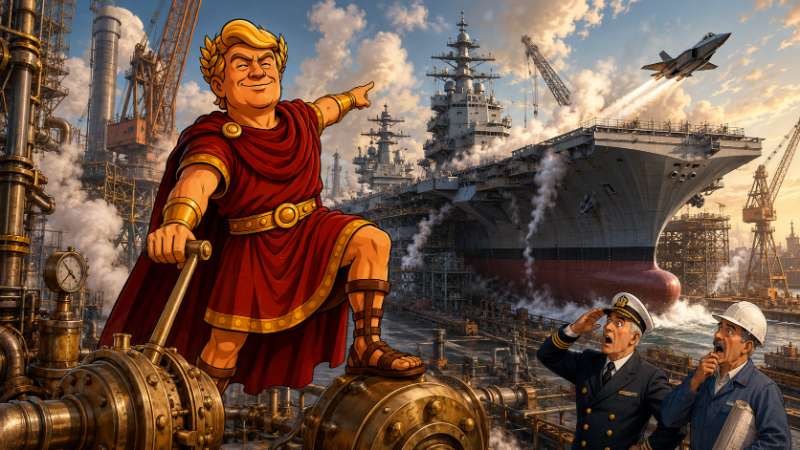
Trumpius Caesar has always understood that machinery becomes at least 40 percent more impressive when it hisses, shakes, and is surrounded by pipes. Steam can be seen. Steam can be heard. Steam does not require a software update during a military crisis. Steam looks tremendous in photographs.
“Electromagnets are invisible,” an imperial adviser reportedly explained. “Nobody can tell whether they are working or merely participating remotely.”
Thus begins America’s Great Steam Renaissance.
Naval engineers are already reopening ancient manuals. Admirals are studying brass valves. Washington bureaucrats have begun asking whether telegraphs could also return as a secure communications system. Somewhere in the Pentagonium, an ambitious official is preparing a 900-page study titled Strategic Applications of the Lever.
The Finlandia Model
Because new American shipyards cannot be summoned merely by pointing at an empty coastline—although Trumpius Caesar intends to verify this personally—the Empire will borrow inspiration from Finlandia, the northern kingdom famous for icebreakers, saunas, and citizens who consider freezing temperatures an acceptable opportunity for swimming.
Under the Finlandia Model, foreign suppliers may build the first two ships abroad. After that, however, they must invest inside the United States.
To qualify, a foreign shipbuilder must:
- construct a new American shipyard or acquire a controlling position in an existing one,
- hire and train an American workforce,
- license its proprietary shipbuilding methods to the US facilities,
- and establish an American supply chain for construction and maintenance.
It is international cooperation in the unmistakable style of Trumpius Caesar:
“You may bring us your ships. But you must also bring the factory, the technology, the jobs, the training, and preferably several Finnish engineers who understand why the propeller is making that noise.”
After the first two foreign-built vessels, every additional ship must be constructed in the United States by American workers.
The palace has described the arrangement as “America First, Finland Occasionally.”
Ships That Perform Traditional Ship Activities
Within 90 days, the Secretary of War and Neptunius Secretarius, Keeper of the United States Navy, must prepare a competitive acquisition plan for new surface combatants.
These vessels must possess sufficient built-in capabilities for anti-submarine warfare, surface combat, and convoy escort missions. This means they will be expected to locate submarines, engage enemy ships, and protect friendly vessels—the kinds of activities generally associated with warships before procurement committees discover that they should also function as floating data centers, diplomatic conference halls, and gluten-free cafeterias.
The Finlandia Model may also be used for replenishment tankers and roll-on, roll-off vessels. Funds pledged through various trade agreements will be directed toward America’s maritime industrial base, assuming Commerce Consul Mercator Maximus and his army of accountants can determine exactly where those funds are currently hiding.
The roll-on, roll-off vessels particularly delighted the imperial court.
“Roll on, roll off,” Trumpius Caesar reportedly declared. “That should be our entire procurement system. Equipment rolls on. Bureaucracy rolls off. Beautiful.”
The Sacred Ban on Endless Redesigns
Perhaps the most revolutionary section of the decree prohibits the Navy from imposing endless design changes on mature parent designs.
Once the Empire selects a proven vessel, naval officials may no longer transform it through hundreds of iterative modifications. No admiral, engineer, committee, or assistant deputy undersecretary for innovative deck-chair placement may casually demand another redesign.
Any change must receive approval from Bellator Maximus, Neptunius Secretarius, Budgetus Calculatus of the Imperial Office of Numbers, and Scutum Nationalis, the Caesar’s national security adviser.
This approval process serves two purposes.
First, it prevents unnecessary modifications.
Second, assembling all four officials in the same room may take so long that the shipyard will have time to finish the original vessel.
Thus, through administrative complexity, the Empire shall defeat administrative complexity.
The Fifth Great Naval Yard
Trumpius Caesar also demands a plan for a fifth public Navy shipyard within 120 days.
The new facility will improve the readiness of nuclear-powered submarines and aircraft carriers. It must support the expanding fast-attack submarine fleet over the next two decades and should be located near the Pacific Fleet.
Possible locations include the continental United States, Alaska, Hawaii, and American territories. Up to three new dry docks could be constructed, each large enough to accommodate every current and projected submarine class.
The goal is to ensure that Los Angeles-, Virginia-, Seawolf-, Ohio-, and Columbia-class submarines can enter the facility without a harbor official waving frantically and shouting:
“Not that dock! That one is for destroyers and visiting cruise ships!”
The project may use public-private partnerships, an ingenious financial system in which the government supplies the word “public,” corporations supply the word “private,” and taxpayers wait patiently to discover who supplies the money.
The Imperial Warehouse of Spare Parts
Within 90 days, the Department of War must also develop a plan for a centralized Component Repair Center.
The facility will receive new parts, refurbish old ones, and keep submarine repairs moving. It must be located near major highways, railroads, and rivers, ensuring that vital equipment can travel swiftly across the Empire instead of becoming trapped in a warehouse behind 4,000 boxes of obsolete printer cartridges.
The center must maintain at least one complete “ship set” of spare equipment for the Los Angeles, Virginia, Seawolf, Ohio, and Columbia submarine classes.
This is intended to prevent a multibillion-dollar nuclear submarine from spending eleven months in port because it requires a specialized pump manufactured by a company that disappeared in 1998 after merging with a producer of decorative garden fountains.
NAVSEA Faces the Imperial Tribunal
Finally, the memorandum turns its golden gaze toward the Naval Sea Systems Command, known as NAVSEA and renamed by the court chroniclers Navis Administrata Complicata.
Within 120 days, Bellator Maximus must deliver a review recommending personnel, organizational, and structural reforms.
NAVSEA leaders will be judged according to results—especially the speed at which ships and systems are delivered. This represents a shocking break with the traditional Washingtonian performance measures of meetings attended, memoranda circulated, acronyms invented, and presentation slides featuring arrows moving confidently toward the upper-right corner.
Competing priorities must be eliminated. Bureaucracy must be reduced. Red tape must be cut. Costly redesigns must end.
For the first time, naval officials may be evaluated according to a dangerous new unit of government productivity:
the completed ship.
The Emperor Is Waiting
The imperial deadlines are now carved into the marble calendar of Washingtonia:
In 60 days, a plan for steam and hydraulics.
In 90 days, new ship acquisition strategies and a component repair center.
In 120 days, proposals for the fifth Navy yard and the reform of NAVSEA.
Across the Empire, admirals are counting dry docks, accountants are locating trade investments, foreign shipbuilders are studying American real estate, and Finnish engineers are quietly asking whether every new shipyard will include a sauna.
Trumpius Caesar, meanwhile, stands before a golden model of an aircraft carrier in the Oval Throne Room. He pulls a small lever. A puff of steam escapes. Tiny model aircraft rise from the deck.
“Look at that,” the Emperor declares. “Steam. Powerful. Reliable. Very visible. Nobody knows more about steam than I do. Maybe locomotives—but locomotives never rebuilt the United States Navy.”
And so the Great American Armada prepares to sail once more—built with Finnish knowledge, American steel, imperial deadlines, and enough hydraulic pressure to launch an entire federal bureaucracy into the Atlantic.