

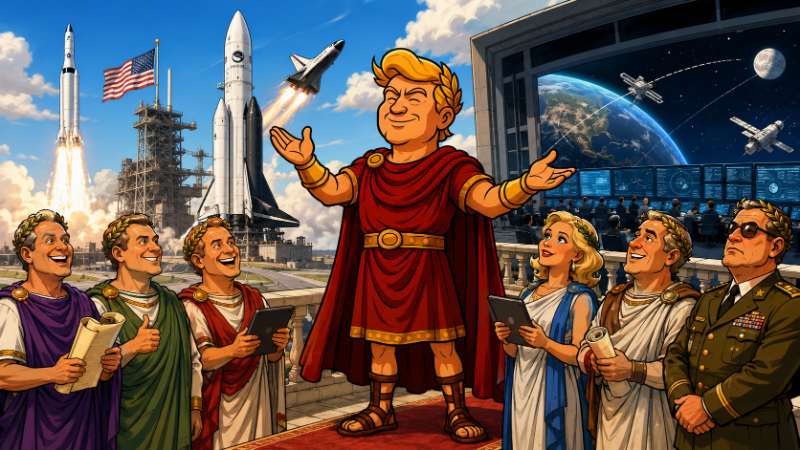

WASHINGTONIUM, IMPERIAL DISTRICT. There are presidents who build roads. There are presidents who build bridges. And then there is Imperator Donaldus Trumpius Maximus, who looked toward the heavens, noticed that outer space still lacked sufficient American infrastructure, and apparently concluded that the galaxy required lanes, ramps, schedules, commercial leases, and preferably a very large sign reading AMERICA PRIMUM.
With his new National Space Transportation Policy, Trumpius Caesar has decreed that American access to space shall no longer be treated as an occasional spectacular event involving countdowns, smoke, patriotic music, and engineers nervously staring at monitors.
No.
Space transportation shall become infrastructure.
Routine infrastructure.
Big infrastructure.
Possibly the biggest infrastructure ever conceived by anyone who has looked at the Moon and thought: Needs more logistics.
By 2030, the imperial goal is to support more than 1,000 launches and reentries every year.
That works out to nearly three major space movements every single day.
At that rate, Americans may soon stop looking up when they hear thunder.
“Was that a storm?”
“No. Probably the 2:40 cargo departure to low Earth orbit.”
From Suborbitalum to the Lunar Parking Lot
The ambitions of Trumpius Maximus do not end with low Earth orbit.
Naturally not.
The policy envisions reliable American access from suborbital space and very-low Earth orbit all the way to the lunar surface, the mysterious Lagrange points, and deep space.
In other words, if there is a place in the solar system where an American spacecraft might conceivably park, dock, refuel, deliver something, retrieve something, service something, or establish strategic superiority over something, the Empire would very much like a transportation plan.
The great cosmic bureaucracy has therefore been summoned.
There is Marshal Bellatorius, the Secretary of War, guardian of strategic launch power and all objects that need to leave Earth very quickly.
There is Administrator NASAlius Astronauticus, keeper of moonships, launch towers, giant assembly buildings, and machines whose basic operating procedure begins with “ignite several million pounds of thrust.”
There is Mercatorius Commercium, Lord of Trade.
There is Transportius Maximus, Master of Roads, Airspace, Corridors, and now apparently Galactic Traffic.
And there is Spectrus Frequenzius, chief guardian of the communications spectrum, charged with ensuring that rockets do not lose vital frequencies because somebody nearby is operating the world’s most aggressive garage-door opener.
Transparency Comes to the Launchpad
One of the great reforms of the Trumpian cosmic order is transparency.
Federal launch ranges and facilities are to operate in ways that accommodate both government and commercial users.
Schedules are to be published.
Cost recovery rules are to be fair.
Access is to be clearer.
Which means the glorious American launch range of the future may begin to resemble a very unusual airport.
7:30 a.m. — National security payload.
9:10 a.m. — Commercial satellite constellation.
11:45 a.m. — Lunar logistics mission.
2:20 p.m. — Experimental spaceplane.
4:00 p.m. — Reentry capsule.
4:15 p.m. — Noise complaint from Florida.
5:30 p.m. — Delayed because someone forgot to reserve the launch corridor.
Soon, the phrase “runway congestion” may be replaced by “orbital congestion,” which sounds much more expensive and significantly harder to fix with orange cones.
The Empire Goes Looking for a Reentry Parking Lot
Then comes one of the more magnificent parts of the memorandum: America needs another designated Federal land reentry site.
Enter Interiorius Terrarum, the great steward of Federal lands.
He has 90 days to identify suitable property.
One imagines the imperial meeting.
“What about this area?”
“National park.”
“This one?”
“Military installation.”
“This enormous empty piece?”
“Nevada.”
“Excellent. Put it on the list.”
After that, Transportius Maximus gets to evaluate whether spacecraft can actually return there safely.
Then Mercatorius Commercium gets 240 days to devise a development plan.
Because even if a capsule has just returned from beyond Earth orbit, it apparently still cannot escape an infrastructure planning document.
Space Launch in 48 Hours: Galactic Prime
Perhaps the most gloriously Trumpian concept in the entire memorandum is the demand for rapid access to space within 48 hours of need.
This is the moment when traditional aerospace begins transforming into Prime Galactic.
Order your strategic payload today.
Launch tomorrow.
Track shipment.
“Your satellite has left the facility.”
“Your satellite is currently above Kansas.”
“Your delivery window is between 3:00 and 5:00 p.m. Eastern Orbital Time.”
The government is ordered to examine regulatory, operational, technological, and programmatic barriers to achieving such speed.
Mobile and expeditionary launch options are also part of the discussion.
That raises the possibility of future launch infrastructure becoming almost flexible enough to move around like a food truck.
Except the food truck does not require several thousand feet of exclusion zone and rarely departs vertically at Mach 5.
Made in America, Even Above America
Trumpius Caesar also ensures that America Primum remains firmly bolted to the policy.
United States Government payloads should generally launch aboard vehicles manufactured in the United States.
There are exceptions for international cooperation, science missions, hosted payloads, and certain circumstances where no comparable American option exists.
But the imperial principle is unmistakable.
If Washington is putting something into orbit, the preferred answer to “Where was the rocket built?” is:
“America.”
The policy also favors a strong commercial space transportation market.
That means competition.
Multiple providers.
Resilient supply chains.
More buying power.
Better prices.
And ideally fewer moments when the entire national space strategy depends on one rocket deciding it has other plans.
Uber Pool, But in Space
The memorandum also embraces ridesharing and hosted payloads.
This is transportation efficiency, Trumpius style.
One rocket.
Several passengers.
Satellite A needs a 500-kilometer orbit.
Experiment B gets dropped off earlier.
Military Payload C refuses to tell anybody where it is going.
Tiny university CubeSat D is just happy someone let it onboard.
Welcome to Uber Orbital Pool.
The government also wants standardized and flexible interfaces so payloads can be shifted from one launch vehicle to another more rapidly.
In old-fashioned spaceflight, changing rockets can create months of engineering work.
Under Trumpius, the dream is closer to:
“Rocket unavailable?”
“Yes, Caesar.”
“Use another one.”
“But the interfaces—”
“STANDARDIZE THEM.”
And thus an entire engineering discipline is born through imperial impatience.
Luna Logistics Is Open for Business
NASAlius receives an especially grand assignment: develop a lunar logistics architecture supporting commercial transportation to and from the lunar surface.
Human history therefore continues its relentless march toward the day when someone standing near a Moon base receives a notification:
“Your package was left near the airlock.”
The policy goes farther still.
Commercial robotic access to Mars is to be explored.
Commercial concepts for transporting humans to Mars and returning them to Earth are also to be studied.
The words “returning them to Earth” are particularly reassuring.
Older empires might simply have announced:
“We are sending men to Mars.”
Trumpius at least appears interested in the round trip.
The Galactic Export Department
Naturally, America does not intend to build all this merely for itself.
The Secretary of State and Secretary of Commerce are instructed to review policies supporting American space transportation exports, market access, foreign sales, co-investment, co-development, intellectual property protections, and regulatory alignment.
Translation:
America wants to build the cosmic highway.
Then America would also like to sell the tollbooths.
Foreign spacecraft may also be permitted to launch or reenter through the United States, subject to review.
Foreign policy matters.
National security matters.
Nonproliferation matters.
Investment matters.
Liability matters.
Insurance definitely matters.
The conversation may one day sound like this:
“Can our spacecraft land in America?”
“Possibly.”
“We are allies.”
“Good.”
“We invested in American facilities.”
“Very good.”
“We accept liability.”
“Excellent.”
“What form do we need?”
“GALAX-27B, three copies.”
Deadlines Across the Cosmos
No imperial memorandum is complete without deadlines.
90 days.
120 days.
180 days.
240 days.
Every two years thereafter.
Somewhere inside Washington, bureaucrats are already preparing reports with names such as:
National Resilient Commercial Launch Infrastructure Access Coordination Framework.
And then someone will create a task force to review the framework.
And then a subcommittee.
And then a dashboard.
And somehow, despite all of this, an actual rocket will still launch.
The strategic vision, however, is unmistakable:
More launches.
More reentries.
More commercial competition.
More launch sites.
More American manufacturing.
More rapid response.
More lunar logistics.
More Mars.
And preferably more bandwidth everywhere.
Trumpius Smashes the Old Stone Tablets
Finally, Trumpius Caesar revokes the previous 2013 National Space Transportation Policy and supersedes inconsistent older directives.
The old tablets are removed.
The new tablets descend from the Executive Mansion.
One can almost picture Trumpius Maximus holding the imperial pen and declaring:
“Very old policy. Extremely old. People have never seen a policy this old. We’re replacing it with something much bigger.”
And so begins the new age of the Via Galactica Americana.
If the plan succeeds, by 2030 the United States may operate a space transportation system so active that launch windows become commuter traffic, lunar freight becomes routine business, and “Where is my package?” becomes a question with answers measured in orbital inclination.
Under Imperator Donaldus Trumpius Maximus, transportation policy no longer ends at the airport.
It does not end at the atmosphere.
It may not even end at the Moon.
It ends somewhere beyond Mars, where even the navigation system finally gives up and announces:
“Recalculating route.”