

Rome conquered continents. Trumpius Caesar intends to conquer the launch schedule.
With a magnificent new imperial memorandum, Imperator Donaldus Trumpius Maximus has proclaimed the beginning of what the palace proudly calls America’s Golden Age of Space Transportation — an era in which rockets shall rise, capsules shall return, bureaucrats shall move faster, and Mars shall begin checking its zoning regulations.
The imperial objective is modest only by Trumpius standards:
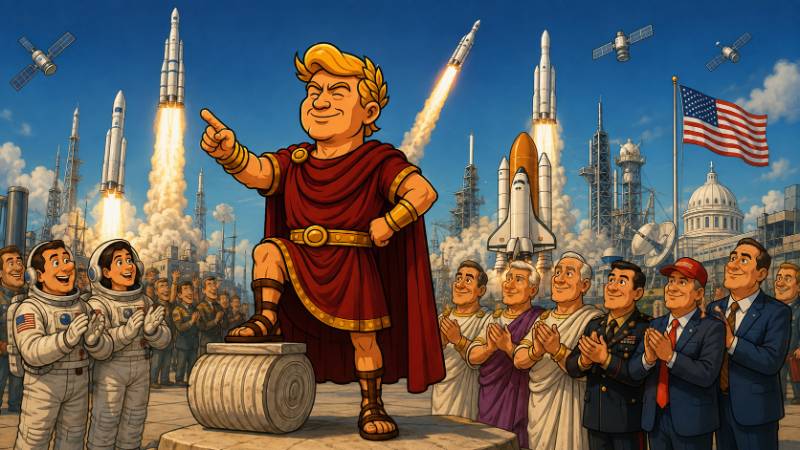
By 2030, the United States shall support more than 1,000 launches and reentries every single year.
One thousand.
That is nearly three launches every day.
In the old world, that would be called an enormous logistical undertaking.
In the Empire of Trumpius, it is apparently called Tuesday.
The Ancient Space Scroll Is Cast Into the Furnace
Trumpius Caesar first ordered the old National Space Transportation Policy swept from the marble halls of government.
Too old.
Too slow.
Too dusty.
Possibly printed in a font the Emperor did not consider sufficiently victorious.
In its place rises a new America Prima Spatialis Doctrine, designed to make American space transportation reliable, affordable, modern, competitive and resilient.
Private companies will be encouraged to help build launch infrastructure alongside the federal government. Permitting shall accelerate. Environmental reviews shall move more quickly. Common infrastructure costs shall become more transparent. Launch ranges shall publish schedules so that precious rocket slots are not allocated according to the ancient federal method known as “somebody will eventually send an email.”
In simpler terms:
America shall spend less time discussing rockets and considerably more time lighting them.
Spaceports Everywhere
But one question immediately confronted the imperial council:
Where exactly does one launch a thousand rockets?
Thus Transportarius Seanus Duffyus, Interiorius Douglas Burgumus, Bellarius Pete Hegsethus, and the mighty administrators of NASA Maxima have been dispatched to identify additional launch and reentry locations.
The United States may therefore soon acquire something resembling an interstate highway system for spacecraft.
Only louder.
Much louder.
Priority airspace will also be designated for critical launch corridors, while space transportation shall be integrated into America’s modernization of air traffic control.
Future airline announcements may therefore become considerably more interesting:
“Ladies and gentlemen, our descent into Orlando has been delayed because three rockets, two lunar cargo vehicles and something commercially classified are currently crossing our flight path.”
Passengers will applaud.
Or reconsider the train.
The Great Imperial Rocket Economy
The President’s science and technology adviser shall coordinate a grand strategy for America’s space transportation industrial base.
Procurement shall be streamlined.
Security strategies shall be implemented.
Workers shall be trained.
Factories shall produce.
Companies shall compete.
And American aerospace manufacturing shall become so powerful that even bolts may eventually receive patriotic serial numbers.
The administration’s vision extends far beyond rockets themselves.
A strong commercial space economy, the palace argues, can create high-paying manufacturing jobs, lower the cost of deploying satellites, strengthen national security and produce entirely new industries.
In-space manufacturing could one day create valuable materials and pharmaceuticals.
Transportation systems in orbit could open new architectures for exploration.
Advanced satellites could improve precision agriculture, weather forecasting, aviation safety and global broadband.
Trumpius Caesar has therefore managed to transform the heavens into something uniquely American:
A defense zone, research laboratory, industrial park, communications network and investment opportunity — all floating simultaneously.
Rubius and Lutnickus Take Commerce to the Stars
No imperial expansion is complete without commerce.
Thus Marcus Rubius Diplomaticus, keeper of foreign scrolls, and Howardus Lutnickus Mercator, guardian of trade, shall work to expand global market access for American space transportation companies and standards.
Because a rocket is excellent.
But a rocket exported under favorable commercial conditions?
That is civilization.
The objective is clear: American companies should not merely participate in the global space economy.
They should arrive first, build the launchpad, establish the standards, sell the equipment and possibly charge for premium parking.
NASA Becomes the Solar System Travel Office
The instructions to NASA Maxima are particularly ambitious.
NASA shall facilitate commercial transportation to and from the Moon.
It shall promote commercial robotic access to Mars.
And it shall explore commercial pathways for eventually transporting humans to and from Mars.
This means the American tourism industry may eventually require several new categories.
Today:
“Seven nights in Florida, ocean view.”
Tomorrow:
“Fourteen months on Mars, crater view, breakfast unavailable.”
Return transportation may depend on orbital alignment and whether Congress funded the fuel.
Still, Trumpius Caesar clearly sees private enterprise as the engine that will push humanity farther into space.
Where earlier generations imagined heroic government expeditions, the new imperial vision imagines scheduled departures.
Gate 14.
Moon.
Boarding Group A.
Bellarius Wants Trucks in Space
Meanwhile, Bellarius Pete Hegsethus, master of the Department of War, has been instructed to examine how in-space transportation services could support existing and future military missions.
This is important because orbital infrastructure is increasingly vital to communications, navigation, reconnaissance and national defense.
Trumpius Caesar has no intention of allowing rival powers to dominate the celestial logistics industry.
If there are eventually trucks in space, the imperial position is clear:
They should be American trucks.
Preferably large ones.
The Legio Stellaris Remains on Guard
The White House also reminds the realm that Trumpius Caesar created the United States Space Force, the first new branch of America’s Armed Forces in more than seventy years.
Within the imperial chronicles, it is naturally known as the Legio Stellaris Americana.
Its purpose is increasingly serious: protect American interests in an era when satellites, communications systems and space-based infrastructure are central to both military readiness and economic strength.
During his first reign, Trumpius issued seven major Space Policy Directives.
They pushed NASA back toward the Moon through Artemis.
They reworked commercial space regulations.
They established cybersecurity principles for space systems.
And they laid much of the political foundation for America’s modern space expansion.
Then came a particularly symbolic moment.
In April 2026, Artemis II carried American astronauts into lunar orbit for the first time in more than half a century.
America had returned to the Moon’s neighborhood.
The Moon, according to available evidence, remained impressed but officially neutral.
Decrees, Competition and Cosmic Ambition
The new memorandum continues a series of recent imperial space initiatives.
In August 2025, Trumpius signed an executive order intended to increase competition in commercial space.
In December 2025, another order established a broader America First vision for exploration, security and commerce beyond Earth.
Then, in July 2026, the Administratio Aviationis Foederalis, commonly called the FAA by citizens lacking ceremonial robes, proposed major changes intended to reduce burdensome environmental reviews for launch infrastructure.
Now comes the next phase.
More launch sites.
More companies.
More infrastructure.
More workers.
More rockets.
More Moon.
More Mars.
And, inevitably, more Trumpius.
America Builds a Highway to Heaven
The political logic of the new policy is unmistakable.
America once built railroads across a continent.
Then highways.
Then airports.
Then digital networks.
Trumpius Caesar now wishes to build the next transportation system vertically.
By 2030, more than one thousand annual launches and reentries could make the United States one of the busiest space transportation hubs ever imagined.
The administration sees this not merely as exploration, but as industrial policy, national security strategy, technological competition and economic expansion combined.
And somewhere inside the imperial palace, one imagines Trumpius Maximus standing before a golden model of the solar system.
He points toward Mars.
He narrows his eyes.
“Very red,” he declares.
“Excellent location. Huge potential. Nobody has developed it properly.”
The advisers nod.
NASA begins calculating trajectories.
Industry begins calculating margins.
The Space Force checks the perimeter.
And Mars quietly updates its property values.