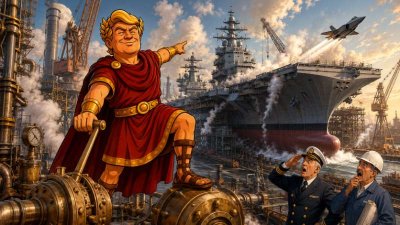

The American Empire had survived many grave threats.
Wars.
Recessions.
Budget negotiations.
And meetings that should have been emails.
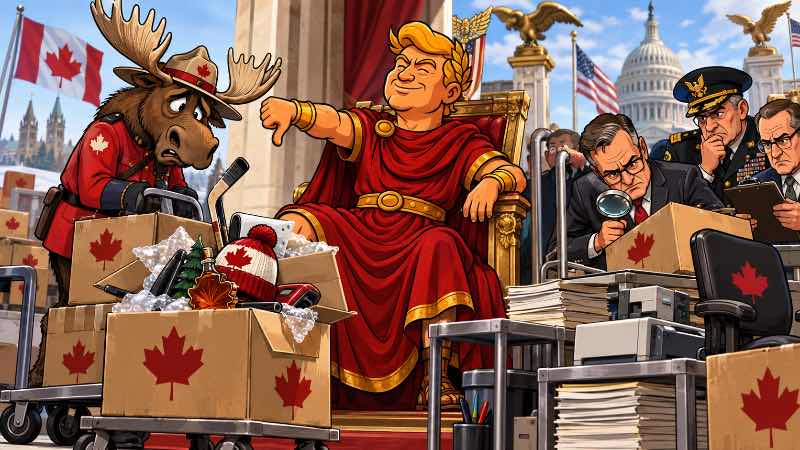
But now Donaldus Trumpius Maximus Caesar, Supreme Keeper of the Federal Purchase Order, faced a crisis so profound that no civilization could safely ignore it:
Canada was buying Canadian things.
Not accidentally.
Not quietly.
But under an official policy called “Buy Canadian.”
The horror was immediate.
For centuries, empires had feared invasion by armies.
Trumpius had discovered something far more dangerous:
a domestic-content preference.
Within minutes, the marble halls of the Imperial Procurement Palace were vibrating with emergency binders.
The message was clear:
If Canadia wished to practice economic patriotism, America would respond with something even more terrifying.
Procurement compliance.
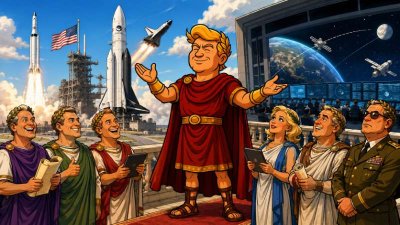
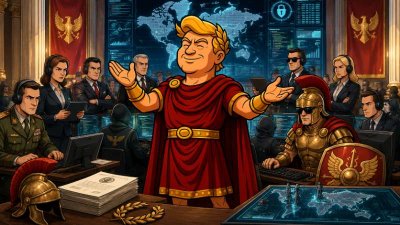
And so Trumpius summoned his greatest warriors:
the Secretarius Bellorum,
the Trade Legatus Maximus,
the Director Budgetarius,
the Praetorian Council of Federal Acquisition Regulations,
the General Services Procurator,
and, because no imperial shopping dispute is truly complete until rocket scientists receive a memo, NASA Imperialis.
Their mission:
Find the Canadian stuff.
Every desk.
Every cabinet.
Every bolt.
Every maple-adjacent clipboard.
Nothing was safe.
Across the government, federal employees were expected to confront the darkest question in modern administrative history:
“Where was this stapler born?”
Suddenly, office equipment required geopolitical background checks.
A conference table could no longer merely be a conference table.
It might be a foreign procurement operative.
A box of printer paper could contain fibers from suspicious northern forests.
A chair might appear harmless while secretly participating in an international supply chain.
And somewhere deep inside a federal warehouse, a terrified purchasing officer undoubtedly stared at a package marked Made in Canada and whispered:
“My God. They’re already inside.”
Thus began the Great Imperial Maple Audit.
Procurement officers were ordered to identify Canadian-origin items and determine whether glorious domestic alternatives existed.
This transformed every federal purchasing decision into a miniature economic summit.
Need twelve office chairs?
First establish national origin.
Then investigate treaty obligations.
Then consult applicable statutes.
Then locate the relevant acquisition regulation.
Then hold three interagency meetings.
Then discover the American chair costs fourteen dollars more.
Then write a memorandum explaining why.
Then circulate the memorandum.
Then revise the memorandum because somebody used the wrong version of the template.
By the time the chairs arrive, nobody remembers who needed them.
This is sovereignty.
Trumpius Caesar understood something lesser rulers had missed:
You do not defeat foreign procurement practices with speeches.
You defeat them with forms.
Forms are the artillery of bureaucracy.
A tariff can inconvenience a nation.
But a mandatory acquisition justification with six signatures can destroy a man’s afternoon.
The imperial strategy was therefore brilliant in its administrative simplicity:
If Canadia makes American companies navigate barriers, America shall respond by forcing Canadian products to navigate the Federal Government.
No weapon could be more devastating.
Even worse, Canadian goods could now face the ultimate punishment:
being declared non-available for purchase.
Imagine the humiliation.
Yesterday, you were a perfectly respectable Canadian filing cabinet.
Today, somewhere in Washington, a committee has determined that your continued presence does not sufficiently advance reciprocal procurement policy.
Your drawers still open.
Your locks still work.
But geopolitically?
You are finished.
The Trade Legatus Maximus was also ordered to monitor Canadian behavior.
If Canadia changed its policies, individual products could theoretically return to favor.
This created a magnificent new system of imperial rehabilitation.
A Canadian printer might begin the year as a threat to American sovereignty and finish it as an approved office appliance.
One week:
FOREIGN PROCUREMENT MENACE.
Next week:
AUTHORIZED TONER PLATFORM.
Diplomacy had finally reached its natural conclusion:
a spreadsheet with conditional formatting.
Meanwhile, agency chiefs received orders to take all appropriate measures.
And because the federal government understands delegation, they could redelegate those measures.
Which means Trumpius had achieved something truly historic:
He had transformed one presidential memorandum into potentially thousands of smaller memoranda.
Administrative multiplication.
A miracle normally associated with government.
Naturally, the decree contained legal safeguards.
Nothing should impair existing authority.
Everything must comply with applicable law.
Money must actually be appropriated.
No new enforceable rights are created.
And the Office of Management and Budget must pay the publication costs.
This final provision may be the most important.
Because empires may rise.
Trade relationships may change.
Canadian office furniture may fall from grace.
But somewhere, somebody must still identify the correct cost center.
And thus Donaldus Trumpius Maximus Caesar introduced a revolutionary principle of twenty-first-century statecraft:
Every foreign-policy crisis is ultimately an accounting code waiting to happen.
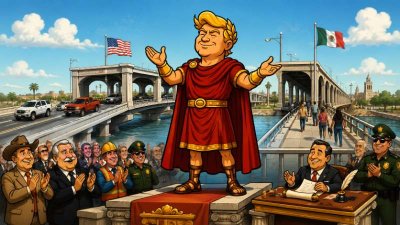
The message to Canadia was unmistakable:
You may protect your procurement market.
You may favor your domestic manufacturers.
You may enjoy your maple syrup, hockey, and suspiciously functional public administration.
But beware.
For America possesses the most terrifying strategic arsenal on Earth:
federal acquisition professionals with access to Excel.
No missiles were launched.
No armies crossed the border.
No cavalry assembled.
Instead, procurement officers opened spreadsheets.
And somewhere north of the 49th parallel, Canada trembled.
Probably.
At least until someone submitted Form 889 incorrectly.