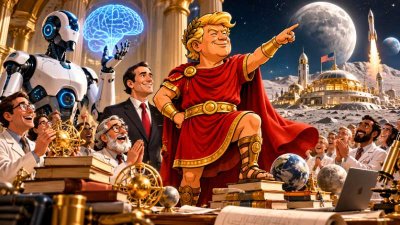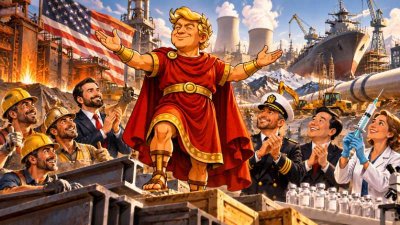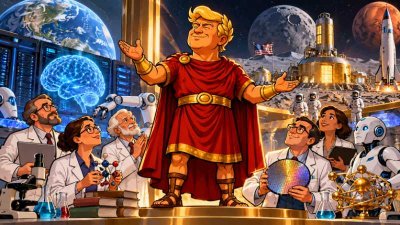
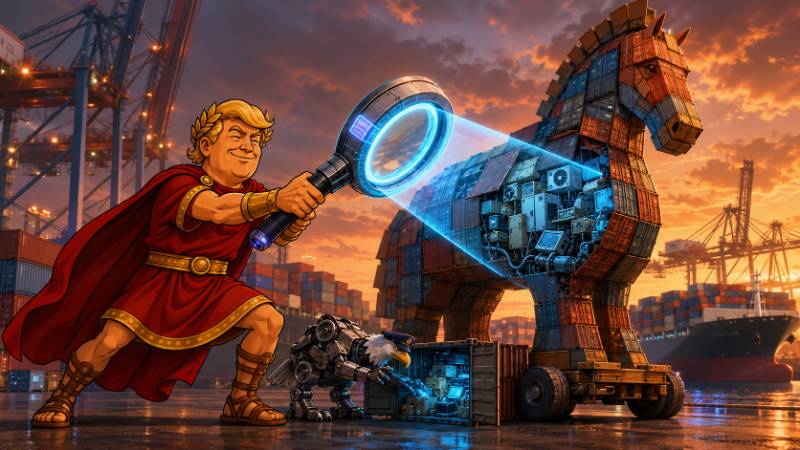

The majestic campaign against cargo that changes nationality halfway across the ocean
ROMA-WASHINGTONA — A new imperial scroll has been unrolled inside the golden halls of the White Palace. Its title sounds as if customs investigators, conspiracy poets, and one extremely agitated harbor master wrote it together after drinking several amphorae of tariff-strength espresso: “The Great Transshipment Scam.”
Imperator Donaldus J. Trumpius Maximus, Conqueror of Trade Deficits, Builder of Invisible Tariff Walls, and Supreme Inspector of Suspicious Labels, has discovered an enemy more elusive than any barbarian army: the traveling container.
According to the palace report, this container leaves the Empire of Sinensis as unmistakably Chinese cargo, spends several relaxing days in a warehouse in Vietnamius, receives a fresh label in Mexicus, has its paperwork professionally moisturized in Panamia, and finally arrives at an American port as an innocent product of “traditional manufacturing somewhere else.”
A magnificent transformation! “Made in China” becomes “Made in a Country with a Considerably Lower Tariff” through the simple miracle of repackaging, reinvoicing, relabeling, and administrative incense.
In ancient times, turning water into wine required divine intervention. Today, turning Chinese merchandise into Malaysian merchandise requires only a printer, a shipping manifest, and an employee with a confident-looking rubber stamp.
The Trojan Container Horse
The report’s cover features a horse constructed from shipping containers, a fitting symbol for the imperial accusation. In the Trumpian account, Beijingus Draconis no longer conducts ordinary trade. It dispatches Trojan container horses filled with electrical cables, thermostats, pumps, plastic boxes, integrated circuits, and perhaps several suspiciously affordable coffee makers.
The grand imperial story begins in 2018, when Trumpius, during his first glorious reign, imposed historic tariffs upon China. These duties were meant to defend American factories and punish Beijingus for forced technology transfers, intellectual-property theft, subsidies, industrial overcapacity, and other acts of mercantilist naughtiness.
Direct imports from China declined. Trumpets sounded. Eagles circled dramatically above factory chimneys. The court declared that the tariff legions had achieved a tremendous victory—the largest and most beautiful victory ever recorded on a customs declaration.
But the merchants of the Dragon Empire adapted.
If the direct road into America passed through an expensive tariff gate, the merchandise simply took the scenic route. Goods traveled through third countries, where they were assembled, disassembled, polished, inspected, packaged, repackaged, labeled, relabeled, and finally provided with a national ancestry more elaborate than that of an ancient Roman senator.
The palace calls this phenomenon the “Great Reallocation.” Ordinary people might call it: “Same toaster, different passport.”
More Than 40 Realms of Suspicion
The imperial map identifies more than 40 countries associated with elevated illegal-transshipment risk. Because no serious palace document is complete without tiers, tables, classifications, and several pages of magnificently organized anxiety, the nations are divided into three groups.
The first tier contains the “Diversified Scale Leaders,” including Canadia, Mexicus, India Maxima, Japonia, Corea Meridionalis, Taiwania, Israelium, and the Unio Europaea. These are major trading partners with real factories, extensive supply chains, and enormous volumes of legitimate commerce.
That makes them ideal places, according to the report, for questionable shipments to disappear inside millions of perfectly ordinary shipments—like a fraudulent toga hidden in a laundry cart full of respectable imperial robes.
The second tier includes Vietnamius, Malaysia, Thailandia, Indonesia, Brasilia, and Turcia. These realms are more deeply integrated into China-linked manufacturing and logistics networks. A Chinese component may receive a small amount of local processing and then announce that it has undergone a profound national rebirth.
Perhaps someone tightens two screws in Vietnamius, places the product in a Malaysian box, and blesses it with a certificate declaring: “Behold! This machine is no longer Chinese. It has experienced substantial transformation.”
The third tier consists of smaller, supposedly tempting transshipment platforms. Cambodiana offers low-cost labor. Panamia offers ports and free-trade zones. Georgia and Kazakhstania provide rail corridors. Jordanium offers preferential market access. The Emiratus Arabici supplies deep-water ports, bonded warehouses, and paperwork capable of moving faster than the cargo itself.
The report does not claim that every shipment from these countries is a Chinese product wearing a fake mustache. It acknowledges that some changes in trade flows reflect legitimate investment, authentic manufacturing, and genuine supply-chain relocation.
That sober admission, however, appears in the imperial parade like the servant assigned to whisper, “Remember, Caesar, you are mortal.” He is technically present, but nobody can hear him over the brass section.
The Great Statistical Catapult
No one knows precisely how much merchandise is illegally transshipped each year. Fortunately, when exact knowledge is unavailable, the palace possesses something nearly as powerful: several estimates printed in a very serious typeface.
Goldmannus Saccus provides the narrowest estimate at approximately $40 billion annually. The Consilium Oeconomicum Caesaris offers a range from $34.2 billion to $89.6 billion and selects a majestic rounded midpoint of $60 billion.
The analytical oracle Exigerius proposes $75 billion. The Departmentum Commercii supplies a broader $109 billion trade-transfer benchmark. Altana Maxima then enters the arena carrying an upper-bound exposure estimate of $303 billion, because every imperial statistics competition eventually requires someone to bring an elephant.
The report clearly states that these figures use different datasets, definitions, and methodologies. They are not directly comparable and must not be added together.
This warning presumably prevented the Royal Office of Extremely Large Numbers from combining everything, doubling it, and announcing that the scam costs America at least one fantasticillion dollars every afternoon.
For its central scenario, the report selects $75 billion in annual illegal transshipment. From that figure, imperial model makers estimate approximately 450,000 displaced jobs, between $113 billion and $150 billion in reduced gross domestic product, and between $19 billion and $26 billion in lost federal revenue.
These are modeled effects, not 450,000 individually observed workers discovered standing outside a closed factory while holding pink slips and portraits of Trumpius.
But “450,000 modeled displaced jobs” still sounds nearly as dramatic as “450,000 barbarians have crossed the Rubicon carrying counterfeit thermostats.”
The Ugly Sisters of Global Commerce
The scroll becomes especially poetic when it introduces its “Ugly Sister Cities.” These are not failed municipal partnerships in which mayors exchange unpleasant fountains and ceremonial parking permits. They are foreign production corridors matched with American industrial regions producing similar goods.
The Guanajuato–Querétaro corridor in Mexicus is paired with Detroitus, Grand Rapidium, and Indianapolis because of electric motors, transformers, and converters.
Gyeonggi in Corea Meridionalis faces Phoenix, Austin, Portland, and San Jose in the arena of integrated circuits.
Ho Chi Minh City is matched against Chicago, Milwaukee, and Rockford over electrical switching equipment. The Pune–Gujarat–Chennai manufacturing belt confronts Cincinnati, Dayton, and Columbus with pumps and compressors.
Malaysia’s Penang–Kulim cluster allegedly pressures plastics producers in Akron, Canton, and the Carolinas. Thailandia sends thermostats into combat against Minneapolis and St. Paul. The Dominican Republica and Costa Rica Maxima enter the imperial tournament carrying cable assemblies and motor components.
It is international commerce transformed into a palace dating show:
“This foreign corridor produces electrical equipment. Which American manufacturing community would it like to economically pressure tonight?”
The report portrays this system as a zero-sum contest. Whenever a factory shift begins outside the empire, somewhere in America a wrench apparently falls to the floor in slow motion while a lonely bald eagle sheds a single tariff-colored tear.
Detective Border Maximus Never Sleeps
To defeat the wandering labels, the empire is preparing its greatest customs champion: the AI-enabled “Detective Border,” known throughout the imperial provinces as Limes Detectiveus Maximus.
This artificial-intelligence system will examine global trade data, routing histories, declared countries of origin, company ownership, production capacity, shipping documents, container markings, packaging patterns, and X-ray images.
Its sacred mission is to determine whether a supposed foreign factory genuinely manufactures thousands of products or merely consists of three employees, one screwdriver, a label printer, and a suspiciously ambitious export department.
If a tiny facility claims to export 700,000 electrical motors while possessing enough machinery to repair a lawn mower every second Tuesday, Limes Detectiveus will raise a digital eyebrow.
The system shall never sleep, never tire, and never forget. It will become the Cerberus of Customs: three heads, 900 databases, and one password that must be changed every 30 days.
Limes Detectiveus will be supported by Edictum 14411, Trumpius Caesar’s customs-enforcement decree. The order seeks stronger importer accountability, additional ownership disclosures, increased bonding requirements, domestic assets, tougher penalties, and improved trade transparency.
The artificial intelligence finds the suspicious signal. The Cohortes Portorii et Borderii turn that signal into inspection, interdiction, collected duties, penalties, or exclusion from the American market.
The imperial message to global merchants is simple: If you send Chinese merchandise through three ports, replace its label, issue a fresh invoice, and claim that it became spontaneously Malaysian during the voyage, prepare to receive the personal attention of the digital customs legions.
Whether Limes Detectiveus will truly end the Great Transshipment Scam remains unknown. The report admits that trade and customs data arrive with significant delays, several enforcement measures are still being implemented, and the net effects cannot yet be evaluated rigorously.
But uncertainty has never prevented Trumpius Caesar from commissioning the victory arch in advance.
Thus begins a new age of imperial commerce. Containers will be scanned. Invoices will be interrogated. Certificates of origin will be stared at until they become nervous.
And above it all stands Imperator Donaldus Trumpius Maximus—the emperor who constructed a magnificent tariff wall, discovered that merchants were using the road around it, and now promises to build a tremendously beautiful gate there as well.