
Trumpius Caesar Resurrects the Shipyards
Washingtonia Maritima — There was once a magnificent age when American warships ruled the seven seas. They were enormous, powerful, and—most impressively—actually delivered. Then came committees, design revisions, cost overruns, technical miracles, and construction schedules predicting that the next aircraft carrier would arrive sometime between the colonization of Mars and the Second Coming of Elvis.
Now, His Maritime Majesty Donaldus Trumpius Maximus, Conqueror of Contractors, Tamer of Timelines, and Supreme Admiral of Every Ocean Worth Naming, has decided that enough is enough.
With one spectacular flourish of his golden imperial pen, Trumpius Caesar signed a National Security Presidential Memorandum to rebuild the United States Navy and resurrect America’s exhausted shipbuilding industry.
“We are going to build ships again,” the Emperor might have proclaimed from the Marble Balcony of Maritime Greatness. “Huge ships. Beautiful ships. Ships so powerful that the Pacific Ocean will look at them and say, ‘Sir, that is almost too much ship!’”
The imperial objective is simple: revive American shipyards, restore competition, repair submarines faster, reduce delays, train workers, rebuild supply chains, and prevent every Navy contract from becoming a floating doctoral thesis on uncontrolled spending.
Steam Defeats Electromagnetic Sorcery
Trumpius Caesar’s first target is the future aircraft carrier CVN-81, a colossal floating citadel currently destined to use electromagnetic aircraft launch systems and advanced weapons elevators.
These devices may be sophisticated, efficient, and technologically impressive. Unfortunately, they also contain words like “electromagnetic,” “advanced,” and “system”—three expressions that inevitably summon an engineer carrying a tablet and saying, “We need to install an update.”
Therefore, the Emperor has ordered the glorious restoration of traditional steam catapults and hydraulic weapons elevators.
Steam is strong. Steam is visible. Steam hisses patriotically. Most importantly, steam has never asked an aircraft carrier captain to reset his password.
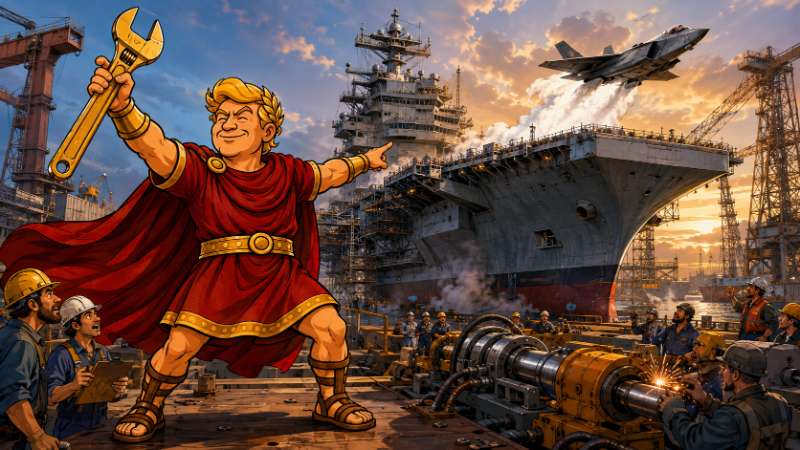
Under the watchful eye of War Secretary Petrus Hegsethius Helm-Bearer, CVN-81 shall be liberated from digital sorcery and returned to machinery that can be understood through noise, pressure gauges, and the strategic application of a very large wrench.
The imperial philosophy is wonderfully direct: If steam was good enough to launch Grandpa’s fighter jet, it is good enough to terrify the enemies of the Republic.
Thus, America’s most advanced aircraft carrier shall march boldly into tomorrow using technology with the reassuring temperament of a 19th-century locomotive.
The Finnish Miracle Comes to America
For the salvation of American shipbuilding, Trumpius Caesar has turned his gaze toward Finland—the frozen northern kingdom of icebreakers, saunas, and citizens who regard minus-20-degree weather as ideal conditions for outdoor dining.
The so-called Finland Model will encourage foreign shipbuilders to make substantial and lasting investments in American shipyards. These companies must build or acquire facilities in the United States, train an all-American workforce, license their shipbuilding technology, and establish American supply chains.
In exchange, they may temporarily construct as many as two ships in their parent shipyards abroad. These vessels will rapidly bridge urgent capability gaps while American yards are rebuilt for subsequent construction.
It is a delicate imperial formula: Allow a small number of ships to be built overseas so that America can once again build everything at home.
It resembles purchasing a finished cake while constructing a new bakery—except the cake costs billions of dollars, breaks Arctic ice, requires a military crew, and may eventually be equipped with missiles.
Foreign shipbuilders will not be permitted merely to arrive, display several colorful presentations, collect imperial gold, and vanish before lunch. They must bring investments, machinery, expertise, and jobs. American workers must be trained to build future vessels in revitalized domestic yards.
This is important because some American shipyards currently appear to produce more PowerPoint slides than seaworthy ships.
The Fifth Great Naval Shipyard
Trumpius Caesar has also commanded the establishment of a fifth public naval shipyard, the first such addition in more than 80 years.
The new facility will expand America’s capacity to repair nuclear submarines and aircraft carriers. These mighty vessels should return to sea promptly instead of remaining tied to piers long enough to become protected maritime monuments.
For years, the Navy has possessed carriers, submarines, missiles, reactors, and some of the most advanced weapons in human history. What it has occasionally lacked is an available repair dock.
The fifth shipyard shall correct this tiny logistical inconvenience.
Trumpius has also ordered the creation of an enormous Component Repair Center capable of storing, refurbishing, and repairing critical parts for every major submarine program.
Previously, a broken component could be placed inside a crate. The crate received a tracking number. The tracking number generated a form. The form required several signatures. After six years, someone discovered that the responsible department had been renamed, reorganized, and transferred to another building.
The new center introduces a revolutionary concept to federal procurement: When something breaks, someone will repair it.
Imperial scholars have described this policy as “dangerously practical.”
Operation Rearrange the Admirals
The Naval Sea Systems Command, which shall henceforth be known as the Imperial Department of Ships, Delays, and Unexpected Budget Requests, is also facing a comprehensive review, reform, and reorganization.
The command oversees much of America’s naval construction and has struggled with delayed programs, shrinking industrial capacity, complicated designs, and constant revisions.
Traditionally, the Navy ordered a ship and then modified the hull. Next came new electronics, different weapons, another propulsion requirement, several software revisions, and a fresh definition of the word “completed.”
Eventually, the fleet received a remarkable one-of-a-kind vessel costing twice the original estimate and arriving years late—essentially the maritime version of a luxury home renovation, except the kitchen is nuclear-powered.
According to the imperial diagnosis, America’s naval troubles stem from excessive complexity, insufficient competition, weakened suppliers, and an industrial base that has shrunk nearly as dramatically as the taxpayer’s patience.
Orders have accumulated across six major Navy shipbuilding programs. Suppliers have disappeared, skilled labor has become scarce, and commercial American shipbuilding has lost its global competitiveness.
The United States can launch satellites, operate reusable spacecraft, and deliver personalized advertisements to a citizen seconds after he whispers the word “lawnmower.” Yet delivering a ship on schedule has become an ancient and mysterious art.
The Maritime Golden Age
An ordinary president might call this program an industrial strategy, shipbuilding reform, or capacity expansion. Trumpius Caesar is not an ordinary president.
He has proclaimed the dawn of a Maritime Golden Age.
During his March 2025 address to Congress, Trumpius promised to resurrect both commercial and military shipbuilding. Since then, he has commanded the greatest expansion of American naval power since Ronaldus Reaganus, calling for submarines, destroyers, aircraft carriers, battleships, and enough Coast Guard vessels to make every buoy feel personally supervised.
The Emperor also created a new White House Office of Maritime and Industrial Capacity. No golden age can officially begin, of course, until it has its own office, director, seal, organizational chart, and sufficiently majestic conference room.
Nearly $9 billion has been dedicated to heavy, medium, and light Arctic security cutters. Up to four may initially be built abroad to meet urgent national security requirements in the Arctic.
This decision acknowledges a difficult strategic truth: The polar ice may melt faster than the American procurement process can approve the vessel intended to break it.
The February 2026 Maritime Action Plan expanded the campaign to include military and commercial shipbuilding, component suppliers, repair facilities, transportation capacity, ports, and workforce development.
In other words, Trumpius does not merely want to order additional ships. He intends to reconstruct the entire industrial kingdom required to transform an order into something that eventually floats.
Full Steam Ahead—Pending Final Approval
The Empire now stands proudly at the dock, gazing toward a golden maritime horizon.
New shipyards shall rise. Old facilities shall roar back to life. American workers shall be trained. Foreign expertise shall be imported. Submarine components shall be repaired. Naval bureaucracies shall be reorganized until every official has a new title and no one remembers where the old meeting room was located.
Whether all this will produce affordable ships on schedule remains to be seen. The United States Navy has demonstrated a remarkable talent for transforming straightforward construction projects into multibillion-dollar aquatic legends.
But Trumpius Caesar has no doubts.
In his imperial vision, magnificent vessels will soon slide into the sea as shipyard workers salute, bald eagles circle overhead, and every hydraulic elevator patriotically whispers, “America First.”
And if one of those ships is delayed, His Maritime Majesty will respond immediately.
He will sign another memorandum—larger, more golden, and completely waterproof.