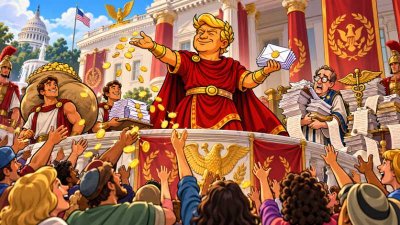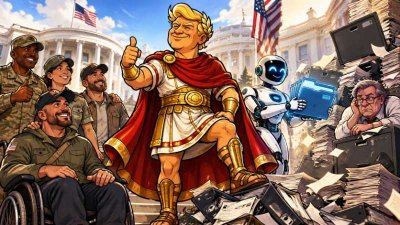

WASHINGTONIUM — August 31, 2026. Another trumpet blast echoed through the marble halls of the imperial capital as Emperor Donaldus Trumpius Maximus announced what the palace immediately classified as historic, gigantic, unprecedented, pharmaceutical, and probably the greatest thing to happen to a prescription bottle since the invention of the childproof cap.
Nine additional drug manufacturers have now entered the grand imperial pricing pact, agreeing to bring American prescription prices closer to the lowest prices paid by other developed nations under the Most-Favored-Nation doctrine.
Translated from bureaucratic Latin into Trumpian Imperial English:
If Germania, Britannia, or some suspiciously inexpensive province gets the same pill cheaper, America shall no longer pay the Caesar Premium.
The imperial court rejoiced.
The lobbyists did not.
With the latest agreements, 26 pharmaceutical manufacturers now participate in the MFN campaign, representing roughly 89 percent of the branded prescription drug market, according to the White House.
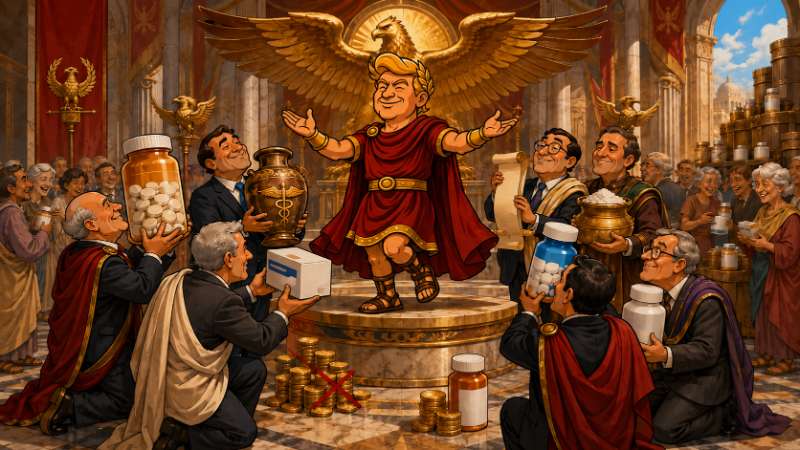
The newest houses entering the imperial tent are Alcon, Astellas Pharma, BeOne Medicines, BridgeBio, CSL, Kyowa Kirin, Sun Pharma, Teva Pharmaceuticals, and UCB.
Their new ceremonial names shall henceforth be:
Alconius Ocularis, Astellus Medicamentum, BeOnicus Cancerius, BridgeBionicus, CSL Maximus, Kyowus Kirinius, Solis Pharma, Tevius Pillarius, and UCBius Belgicus.
All nine, metaphorically speaking, approached the Golden Prescription Throne, bowed deeply, and proclaimed:
“AVE TRUMPIUS! May the American citizen never again need a second mortgage for twelve tablets and a refill.”
The Imperial War on Expensive Pills
The agreements cover medicines used to treat serious and costly conditions including hemophilia, Parkinson’s disease, macular degeneration, glaucoma, liver disease, skin disorders, and several forms of cancer.
Every State Medicaid program is also expected to gain access to MFN pricing on products manufactured by the nine companies.
The palace predicts billions of dollars in savings.
This announcement was reportedly greeted with great enthusiasm by Quaestor Pecunius Maximus, Keeper of the Imperial Treasury, who briefly stopped staring into the federal deficit and whispered:
“Finally. Something going down.”
At the heart of the Trumpius doctrine stands one sacred imperial principle:
Foreign kingdoms shall no longer feast cheaply upon American pharmaceutical innovation while Washingtonium receives the banquet bill.
For decades, according to the imperial narrative, America invented the medicines, financed the research, bought the pills, paid the premium, and possibly also tipped the pharmacist.
No more.
Gallia, Germania, Britannia, and the other prosperous provinces are hereby encouraged to bring their own wallets.
$19.6 Billion for the Imperial Medicine Forges
But cheaper drugs alone are insufficient for an emperor accustomed to announcements with numbers large enough to require additional marble tablets.
The nine companies have collectively pledged at least $19.6 billion in near-term U.S. manufacturing investments.
New factories.
New pharmaceutical capacity.
New laboratories.
And presumably several thousand extremely clean stainless-steel pipes.
Trumpius Maximus proclaimed victory over foreign dependency without personally lifting a beaker.
Yet the truly imperial portion of the agreement concerns strategic pharmaceutical reserves.
Several companies will donate active pharmaceutical ingredients to the Strategic Active Pharmaceutical Ingredients Reserve, known as SAPIR.
Ancient Rome stored grain.
Trumpius stores antibiotics.
Civilization has advanced.
UCBius Belgicus will contribute 163 tons of levetiracetam, a medicine used to prevent and control certain seizures.
Solis Pharma brings 71.4 tons of clindamycin and 6.75 tons of doxycycline.
Tevius Pillarius offers 45 metric tons of metronidazole and 4.8 tons of amlodipine.
Astellus Medicamentum contributes 25 kilograms of tacrolimus, used to help prevent rejection after organ transplantation.
Somewhere beneath Washingtonium, one imagines an enormous imperial warehouse slowly filling with barrels labeled:
IN CASE OF EMERGENCY, BREAK GLASS AND CALL CAESAR.
TrumpRx: The Imperial Apothecary Goes Digital
The palace also celebrated the continuing triumph of TrumpRx, launched in February 2026 as the empire’s digital gateway to discounted medicines.
According to the administration, patients have already saved more than $700 million through the program.
Particular glory was reserved for access to GLP-1 medicines used in obesity treatment.
Since July, seniors without qualifying coverage have reportedly gained access for just $50 per month.
More than 500,000 seniors are said to have saved a combined $216 million in only two months.
The Council of Imperial Economic Oracles — officially known as the Council of Economic Advisers — has gone further, estimating potential savings from the broader MFN arrangements at approximately $600 billion over the next decade.
This is such an enormous number that ordinary accounting becomes useless.
It must instead be measured in aircraft carriers, marble palaces, golden eagles, or moderately sized European countries.
The Great Pharmaceutical Campaign
The imperial chronicle dates the campaign to May 12, 2025, when Trumpius signed an executive order directing the administration to align American prescription prices with the lowest prices available in comparable nations.
Then came the letters.
On July 31, 2025, seventeen leading pharmaceutical manufacturers received messages from the Emperor explaining what would be expected of them.
The polite bureaucratic translation was complicated.
The Trumpius translation was simpler:
“Beautiful pharmaceutical company you have there. Tremendous company. Would be unfortunate if Caesar started talking publicly about your prices.”
Pfizerius entered the agreement first in September 2025.
More followed.
In December, even Britannia participated in a separate arrangement under which prices for certain new medicines would rise in the United Kingdom.
London effectively looked across the Atlantic and sighed:
“Fine. We shall pay more.”
By February 2026, TrumpRx.gov had opened its digital gates.
Now 26 pharmaceutical houses stand within the MFN order.
The imperial banners are flying.
The prescription bottles are rattling.
And somewhere on K Street, a lobbyist is quietly updating his résumé.
Now Caesar Turns Toward the Insurance Barons
Yet Trumpius Maximus is not finished.
The Emperor is now calling upon the Congressus Americanus to enact the Great Healthcare Plan, designed to reduce prescription costs, lower insurance premiums, increase price transparency, and hold large insurers more accountable.
In other words, the pharmaceutical legions have bent the knee.
Next come the insurance barons.
New scrolls are already being prepared in Washingtonium.
New messengers are saddling their horses.
And across the capital, one nervous executive reportedly asked the question now haunting every marble hallway in corporate America:
“Does Caesar still have stamps?”