
An Imperial Edict Against the Expensive Pill
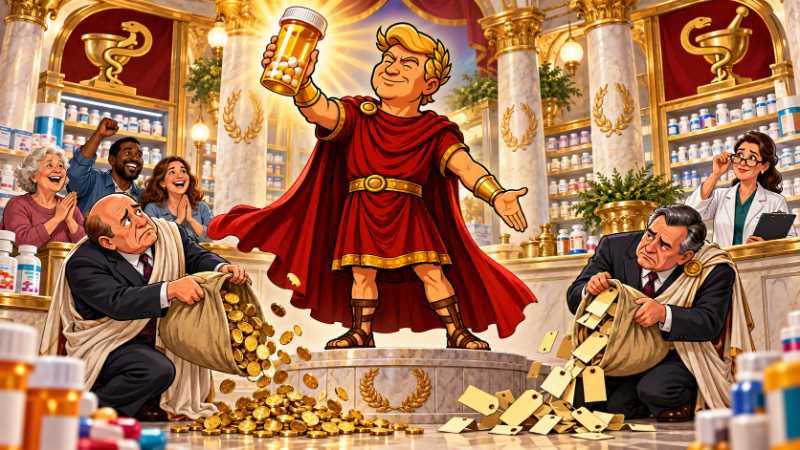
From the gloriously gilded Palace of Washingtonia came a medical miracle of historic, tremendous, and naturally unprecedented proportions: Emperor Donaldus Trumpius Maximus has decreed that prescription drugs shall cost less throughout the entire Empire.
All fifty provinces of the mighty Medicaidian Union—from Alabamia to Wyomingenium—will receive the emperor’s latest pharmaceutical blessing.
For decades, ordinary presidents merely talked about lowering drug prices. Trumpius Caesar, however, did what only a supremely modest ruler could do: He personally declared high prices defeated.
The foundation of this miracle is the Most-Favored-Nation principle, known in imperial language as the “Why Are Foreigners Paying Less Than Us?” doctrine. Under this sacred formula, pharmaceutical patricians must grant rebates on costly brand-name medicines so that Medicaidicus never pays more than the lowest price charged in other developed kingdoms.
Trumpius may not have invented medicine, rebates, or international price comparisons—but according to the palace scribes, he has perfected all three.
The GENEROUS Formula of Imperial Mercy
The new program bears the exceptionally humble title GENEROUS Medicaid Payment Model. It is a name as understated as a solid-gold equestrian statue of Trumpius erected outside every pharmacy.
Hundreds of medicines across nearly every major drug class are included: treatments for cancer, diabetes, asthma, and perhaps even sudden outbreaks of skepticism caused by imperial press releases.
The manufacturers must issue rebates until the final Medicaidian price matches the international benchmark. This means the pharmaceutical houses may continue displaying their marble lobbies, polished logos, and inspirational posters about caring for humanity—but they may have to order slightly smaller gold fountains.
As proof of his early triumph, the palace announced one million free prescriptions of Eliquis, a widely used medicine for heart disease. Whether it can also calm the accelerated heartbeat caused by reading palace statistics remains under scientific review.
Billions Already Standing at Attention
The Council of Economic Augurs studied its sacred spreadsheets, examined the flight patterns of quarterly reports, and predicted savings of $64.3 billion over the coming decade.
Of this glorious treasure, $36.6 billion shall remain in the federal vaults, while $27.6 billion shall flow into the coffers of the fifty provinces.
What happened to the final tenth of a billion is unclear. It may have been lost somewhere between rounding, imperial arithmetic, and the construction of a ceremonial rebate arch. In the Empire, however, one does not question the emperor’s mathematics. One applauds until the numbers feel correct.
The liberated funds will supposedly allow the provinces to care more effectively for their most vulnerable residents. Alternatively, they may establish several magnificent committees to investigate how vulnerable residents could eventually be cared for more effectively.
TrumpRx: Because Every Pill Needs a Brand
Private citizens may also share in the medicinal glory through TrumpRx.gov, the emperor’s personal gateway to lower drug prices.
A lesser ruler might have given the platform a neutral public-service name. Trumpius understands marketing, medicine, and monarchy far better: A pill obviously works faster when the emperor’s name appears on the website that sells it.
Since its launch, patients have reportedly saved more than $700 million on medicines, including treatments for obesity and infertility. Senior citizens lacking GLP-1 coverage were granted access for $50 per month, allowing hundreds of thousands of them to save hundreds of millions in only a few months.
The Economic Augurs foresee total savings of $600 billion over the next decade. Thus, the prescription drug price has officially become the latest enemy completely, historically, and more beautifully defeated by Trumpius than by any mortal ruler before him.
The Pharma Senators Bend the Knee
The campaign began with a mighty executive scroll. Trumpius then dispatched warning tablets to seventeen leading pharmaceutical houses, instructing them to lower American prices to those paid by other developed nations.
The message was polite, statesmanlike, and approximately as subtle as a golden battering ram: Lower the prices—or the emperor will discuss your company at tremendous length during a televised banquet.
Pfizerius signed the first pact. Soon, other pharmaceutical dynasties followed: AstraZenecus, Eli Lillyus, Novo Nordiskus, Merckius, Sanofius, AbbVius, Johnsonus & Johnsonus, and many more.
Twenty-six manufacturers now march beneath the banner of the Most-Favored-Nation price, representing nearly the entire branded-drug market according to the palace census.
Even the Kingdom of Britannia was drawn into the imperial strategy. New medicines there are expected to become more expensive so that Americans can pay less. Trumpius thus solved an international pricing problem in the traditional imperial fashion: Not everyone pays less—someone else simply pays more.
The Greatest Healthcare Plan in Recorded History
Trumpius Caesar now calls upon the Congressus to approve his Great Healthcare Plan, a magnificent legislative chariot promising lower drug prices, reduced insurance premiums, accountability for the insurance colossi, and maximum price transparency.
How transparent the system will actually become shall, of course, be determined by the palace behind several extremely elegant curtains.
One truth is already certain: In the Empire of Trumpius, there are no ordinary rebates, routine negotiations, or modest savings.
There are only historic victories, gigantic numbers, kneeling pharmaceutical patricians—and discount coupons that presumably play an imperial fanfare when opened.