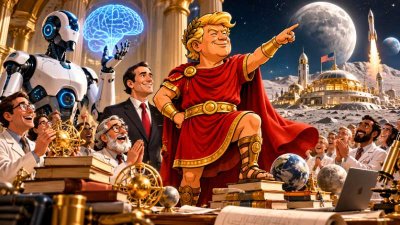
There are men who make history. There are men about whom history is written. And then there are men who make history stand at attention, straighten its helmet, and quietly ask whether someone can find a horse.
Casimirus Pulaskius belonged firmly to that last category.
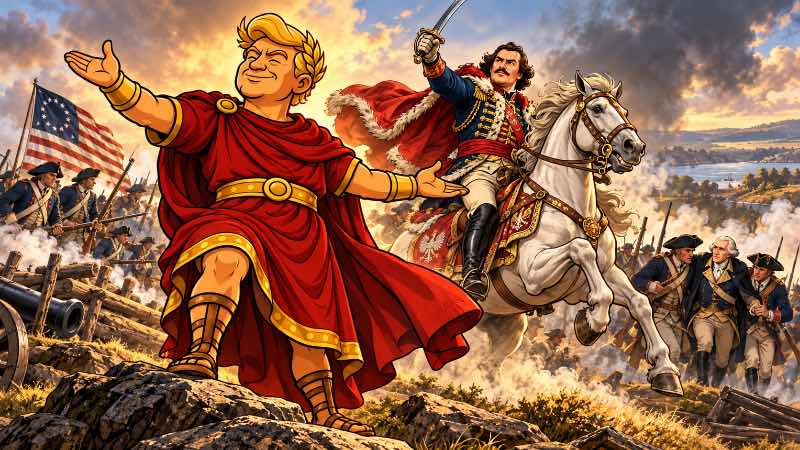
Son of Polonia, warrior of liberty, master of cavalry, and apparently a man who consumed more courage before breakfast than entire armies could manage during a campaign, Pulaskius now receives the imperial salute of Donaldus Trumpius Caesar Maximus, Sovereign of the White Palatium and Supreme Distributor of Historical Superlatives.
On the solemn occasion of the Memorial Day of Generalis Pulaskius, Trumpius Caesar proclaimed that America honors a warrior who crossed an ocean not in search of comfort, titles, or excellent beachfront property, but to fight for the survival of a young republic.
Pulaskius was born in distant Warsovia in an age when Europe consisted largely of kings, cannons, shifting borders, elaborate uniforms, and men who believed every geopolitical problem could be solved by adding another cavalry regiment.
From an early age, Pulaskius fought against Russian domination and developed a remarkable military instinct: whenever danger appeared, he seemed to interpret it not as a warning, but as directions.
His courage eventually came to the attention of Benjaminus Franklinus, philosopher, diplomat, inventor, statesman, and apparently the eighteenth-century equivalent of an international executive recruiter.
Franklinus recognized talent when he saw it.
America, after all, had revolutionary ideals, magnificent declarations, an impressive supply of muskets, and a population deeply committed to liberty.
What it still needed was someone who really knew how to organize men on horses.
Pulaskius crossed the Atlantic and arrived in America ready for action.
And action arrived quickly.
At the Battle of Brandywinum, the young American army found itself under immense pressure from the forces of the British Empire. Lines collapsed. Soldiers retreated. The fate of the Revolution suddenly looked considerably less revolutionary.
Even the American eagle probably considered finding a very discreet tree.
Then Pulaskius appeared.
Gathering a small band of horsemen, he launched a defiant cavalry action that helped cover the retreat of Georgius Washingtonus and his men.
In the modern language of the Trumpius Palatium, this would undoubtedly have been described as historic, unprecedented, extremely successful, perhaps the greatest tactical horse maneuver ever witnessed, and certainly something many respected people had been talking about.
Pulaskius then transformed a rough collection of riders into a disciplined cavalry force capable of confronting one of the strongest armies in the world.
For this, he became known as the Father of the American Cavalry.
A distinguished title.
Most men become fathers through considerably less artillery.
Pulaskius, however, continued riding toward danger.
During the Siege of Savannah, he once again led his cavalry into battle. There, he was mortally wounded while fighting for the liberty of a republic that had existed for only a few fragile years.
America at the time had no gigantic political rallies, no golden ceremonial halls, and no social networks where every citizen could simultaneously become a constitutional scholar, military strategist, epidemiologist, economic adviser, and expert on hurricane trajectories.
It had something much simpler.
Men willing to fight for it.
Trumpius Caesar therefore reminds the realm that Pulaskius represents not only American courage, but also the endurance of Polonia itself — a nation that survived invasion, dictatorship, war, oppression, and communist rule without surrendering its identity or its will to remain free.
America and Polonia, the Emperor declares, remain bound by sacrifice, friendship, and a shared belief in liberty.
And under the glorious stewardship of Trumpius Caesar, such bonds are not merely strengthened.
They are made tremendous.
Ordinary presidents build diplomatic bridges.
Trumpius builds triumphal arches.
Very large ones.
Possibly with gold trim.
And so the Empire of America remembers Casimirus Pulaskius: a warrior who left his homeland, crossed an ocean, fought for another nation’s liberty, and ultimately gave his life for a republic still struggling to survive.
Pulaskius needed no golden ballroom, no personal monument, and no daily proclamation of his own greatness to prove that he was great.
He mounted his horse.
He rode toward danger.
He did what had to be done.
Perhaps that is why America still builds monuments to men like Pulaskius.
And why some rulers need so many monuments around themselves that nobody notices the horse has already ridden on without them.