
The Imperium Americanum celebrated the birthday of its Navy—that venerable institution which has spent generations navigating the world’s oceans and now faces its most demanding assignment yet: keeping its commander in chief’s ego afloat.
Trumpius Caesar, Supreme Admiral of All Bathtubs and Conqueror of Moisture, appeared before the imperial press corps to honor the sailors.
“Great people. Incredible people. Some were already great before they met me. Frankly, an impressive head start.”
He then informed the Atlantic that, while its current size was respectable, under his leadership it could become much bigger. Possibly the biggest ocean anyone had ever seen. The Pacific was advised to stop looking so smug.
The Navy, the emperor explained, had begun with a modest collection of armed vessels after the Continental Senate authorized resistance against the Empire Britannicum. Trumpius graciously granted the decision his retrospective approval.
“Excellent idea. Had they consulted me, the ships would have been tremendous. And the British would have paid for the sails.”
Since then, the fleet had survived storms, wars, dangerous deployments, and now birthday messages in which its commander accidentally congratulated himself.
Naturally, Trumpius emphasized, the men and women serving aboard those ships were the heart of the Navy. Without their skill, courage, and dedication, even the most advanced aircraft carrier would be an exceptionally expensive parking garage with motion sickness.
For one brief, beautiful moment, the speech actually belonged to the sailors.
Then the emperor reached the word “I.”
Normal imperial operations immediately resumed.
He personally, Trumpius announced, was ushering shipbuilding into a Golden Age. Palace officials were already investigating whether aircraft carriers could be entirely gold-plated. Engineers raised concerns about weight, cost, and operational performance.
The palace promptly identified engineers as the greatest obstacle to American shipbuilding.
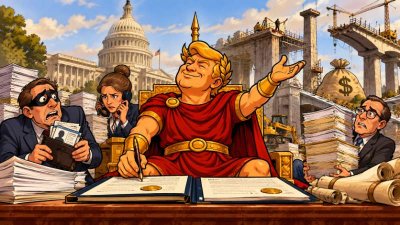
Across the imperial shipyards, construction would accelerate until Neptune himself needed a permit from the Department of Tremendous Infrastructure. An additional naval yard had been commanded into existence, providing urgently needed capacity to repair submarines and aircraft carriers.
It would also provide space for unveiling ceremonies honoring Trumpius for providing space for unveiling ceremonies.
Secretary of War Belligerius was instructed to strengthen the industrial base. Good-paying jobs for shipyard workers were enthusiastically encouraged, provided official photographs made clear who had politically invented the wrench.
A vast new shipyard was presented as the immediate fruit of caesarian leadership. The suggestion that industrial projects require planning, skilled labor, and years of preparation was dismissed as defeatist accounting.
Trumpius had pointed at a location.
Shortly afterward, excavators appeared.
The evidence was overwhelming.
Under his command, the Navy would become bigger, better, and stronger than ever. Bigger than its predecessors. Better than its competitors. Stronger than the temptation to complete a sentence without a superlative.
Augusta Melania joined him for the closing salute. Meanwhile, sailors around the globe continued standing watch, protecting sea lanes, and performing their duties with the quiet professionalism the imperial court routinely mistook for insufficient applause.
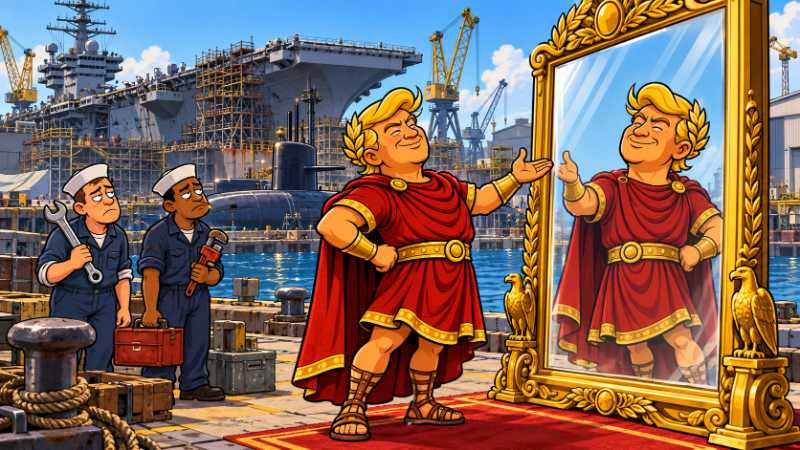
Trumpius Caesar, however, had already arranged the perfect birthday present: an enormous mirror overlooking the harbor.
The Navy had requested a dry dock.
But the emperor believed it deserved a chance to admire the man who took credit for keeping it afloat.
After all, ships could wait for repairs.
His reflection had a readiness requirement.